Top 25 API Testing Interview Questions and Answers (Beginner to Advanced Guide)
In this post we are covering Advanced API Testing Interview Questions and Answers
Introduction:
In this section, we will explore advanced API testing interview questions that focus on real-world scenarios, security, automation, and modern API architectures. Mastering advanced API testing is essential for QA engineers working with microservices and scalable systems.
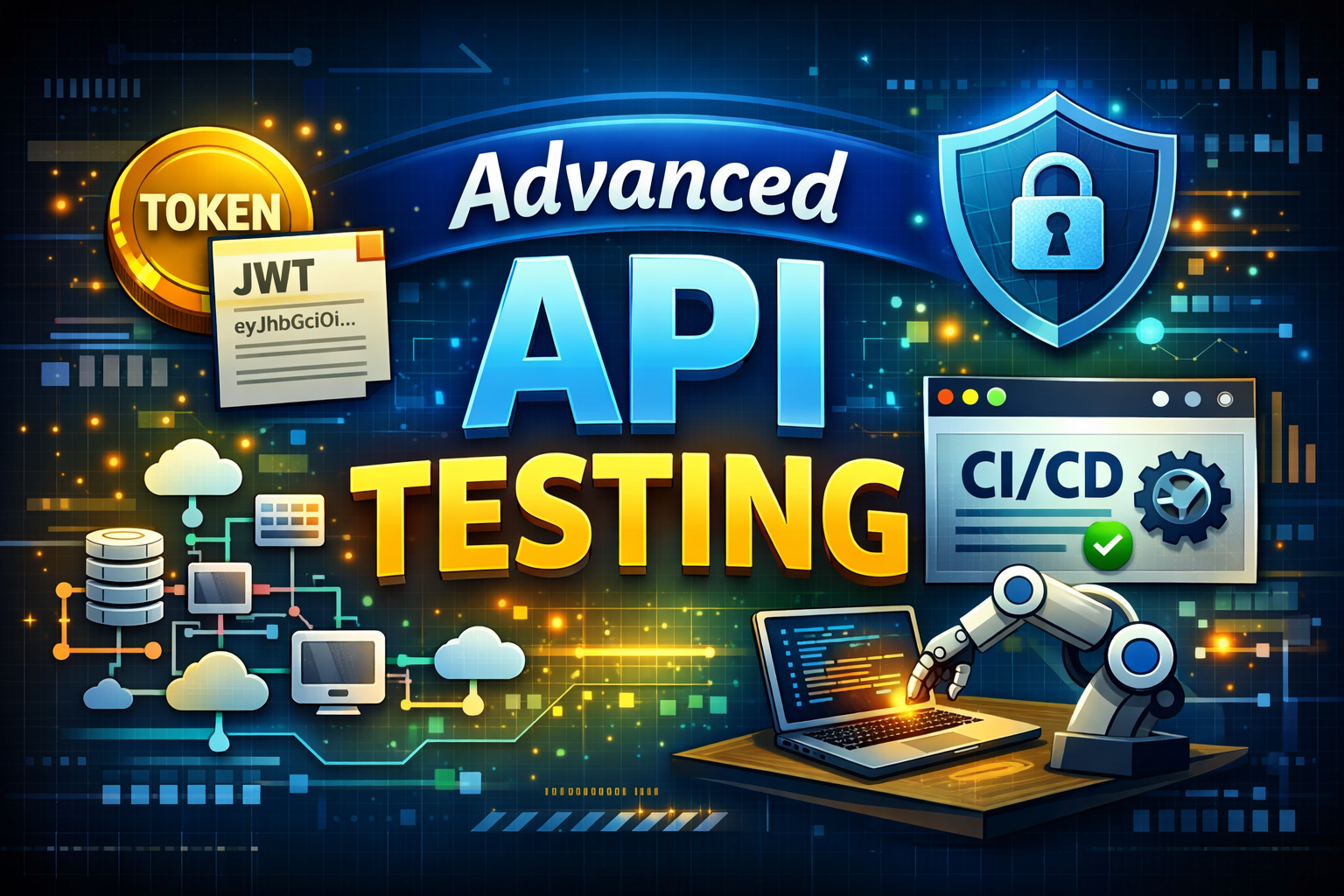
However, modern applications rely heavily on distributed architectures, microservices, security protocols, and automated pipelines. Because of this, testers are now expected to understand advanced API testing topics such as OAuth authentication, JWT tokens, API gateways, contract testing, monitoring, and CI/CD integration. Advanced API testing includes security validation to ensure APIs are protected.
In this section, we will explore advanced API testing interview questions that are commonly asked for automation testers, QA engineers, SDETs, and test architects. These questions focus on real-world API testing practices including security validation, performance testing, retry mechanisms, microservices communication, and automation framework design.
Understanding these advanced topics will help testers build robust API automation frameworks, improve system reliability, and confidently handle complex interview scenarios.
Let’s explore the advanced API testing interview questions and answers that every QA professional should know.
26. What is OAuth Authentication in APIs?
In this section, we will explore advanced API testing interview questions that cover real-world scenarios, security, automation, and modern API architectures. OAuth (Open Authorization) is a secure authentication protocol that allows applications to access user data without exposing the user’s credentials. Instead of sharing a username and password, OAuth uses access tokens that grant limited access to resources.
OAuth is commonly used when integrating with third-party services such as Google, Facebook, or GitHub. When a user authorizes an application, the API generates an access token which the client application uses for future requests.
OAuth improves security because tokens can expire and be revoked without affecting the user’s credentials.
Example
Authorization: Bearer access_token_123
Interview Takeaway
OAuth enables secure delegated access without sharing credentials.
27. What is JWT Token Authentication?
JWT (JSON Web Token) is a compact and secure method used to transmit information between two parties as a JSON object. It is commonly used for authentication and authorization in REST APIs.
A JWT token consists of three parts: header, payload, and signature. The payload contains user information, while the signature ensures that the token has not been tampered with.
Once a user logs in successfully, the server generates a JWT token that must be included in the Authorization header for future requests.
Example
Authorization: Bearer eyJhbGciOiJIUzI1NiIsInR5cCI6IkpXVCJ9
Interview Takeaway
JWT provides stateless and secure authentication for APIs.
28. What is API Security Testing?
API security testing ensures that APIs are protected against vulnerabilities such as unauthorized access, data leakage, and injection attacks. Since APIs expose business logic and sensitive data, security testing is essential.
Security testing validates authentication mechanisms, encryption protocols, and access control rules. Testers also verify whether APIs properly handle invalid tokens and unauthorized requests.
Tools such as Postman, Burp Suite, and OWASP ZAP are commonly used for API security testing.
Example
GET /users
Authorization: invalid_token
Expected response
401 Unauthorized
Interview Takeaway
Security testing protects APIs from data breaches and unauthorized access.
29. What is API Error Handling?
Error handling ensures that APIs return meaningful error messages when something goes wrong. Instead of returning generic errors, well-designed APIs provide structured error responses that help developers understand the issue.
Effective error responses include status codes, error messages, and error identifiers. This makes debugging easier for developers and testers.
Good error handling improves API usability and system reliability.
Example
{
 "error": "User not found",
 "status": 404
}
Interview Takeaway
Proper error handling improves debugging and API usability.
30. What is Test Data Management in API Testing?
Test data management involves creating and maintaining data required for API testing. APIs often require valid input data such as user IDs, authentication tokens, or transaction details.
Managing test data ensures that tests are repeatable and independent. Testers may use databases, environment variables, or data files to store test inputs.
Automated frameworks often generate dynamic test data to avoid conflicts during parallel execution.
Example
POST /users
{
 "name": "Ajit",
 "email": "ajit@test.com"
}
Interview Takeaway
Effective test data management ensures consistent and reliable API tests.
31. What is CI/CD Integration in API Testing?
Continuous Integration and Continuous Deployment (CI/CD) allow API tests to run automatically whenever code changes are pushed to the repository.
CI/CD tools such as Jenkins, GitHub Actions, and GitLab pipelines execute automated API tests to verify that new code does not break existing functionality.
Integrating API tests into CI/CD pipelines improves software quality and ensures faster feedback during development.
Example
mvn test
Interview Takeaway
CI/CD integration ensures continuous validation of APIs.
32. What is a Retry Mechanism in API Testing?
A retry mechanism automatically re-executes API requests if a temporary failure occurs. This is useful when APIs fail due to network issues, server overload, or intermittent errors.
Instead of immediately marking the test as failed, the automation framework retries the request after a short delay.
Retry logic improves the stability of automated API tests.
Example
Retry request if status != 200
maxAttempts = 3
Interview Takeaway
Retry mechanisms help handle temporary API failures.
33. What is an API Gateway?
An API Gateway acts as a central entry point for all API requests in a microservices architecture. It routes incoming requests to the appropriate service and handles tasks such as authentication, logging, and rate limiting.
Using an API Gateway simplifies client interactions because clients communicate with a single endpoint instead of multiple services.
Popular API gateway tools include AWS API Gateway and Kong.
Most companies ask advanced API testing interview questions focused on security and microservices.
Example
Client → API Gateway → Microservice
Interview Takeaway
API gateways simplify microservice communication and security.
These advanced API testing interview questions help testers understand real-world API challenges.
34. What is Microservices API Testing?
Microservices architecture divides applications into small independent services that communicate through APIs. Testing these APIs ensures that all services interact correctly.
API testing in microservices involves validating communication between services, verifying data consistency, and ensuring fault tolerance.
Automation plays a major role in microservices testing because of the large number of services involved.
Most companies ask advanced API testing interview questions focused on security and microservices.
Example
Order Service → Payment Service → Notification Service
Interview Takeaway
Microservices testing focuses on service interaction and integration.
35. What is the Circuit Breaker Pattern?
The circuit breaker pattern prevents system failures by stopping requests to a failing service. If an API service fails repeatedly, the circuit breaker temporarily blocks further requests.
This protects the system from cascading failures and improves application resilience.
Once the service recovers, the circuit breaker allows requests again.
Example
Service Down → Circuit Open → Requests Blocked
Interview Takeaway
Circuit breakers improve system stability in distributed systems.
36. What is Logging in API Testing?
Logging records API request and response information during test execution. Logs help testers identify issues, track errors, and analyze system behavior.
Automation frameworks usually log request payloads, response bodies, headers, and timestamps.
Effective logging simplifies debugging and improves test transparency.
Example
Request: GET /users/101
Response: 200 OK
Interview Takeaway
Logging helps analyze and debug API failures.
37. What is API Monitoring?
API monitoring continuously tracks API performance, uptime, and response times in production environments.
Monitoring tools detect service outages and performance degradation early, allowing teams to take corrective action quickly.
Examples include Datadog, New Relic, and Prometheus.
Interview Takeaway
Monitoring ensures API availability and performance.
38. What is Negative Testing in API Testing?
Negative testing verifies how APIs behave when invalid input or unexpected conditions occur.
Instead of sending valid data, testers intentionally provide incorrect inputs to ensure the API handles them properly.
This prevents security vulnerabilities and improves robustness.
Example
POST /users
{
 "email": "invalid"
}
Expected response
400 Bad Request
Interview Takeaway
Negative testing validates error handling and input validation.
39. What is API Load Testing?
Load testing measures how APIs perform under heavy traffic conditions. It helps determine whether the API can handle large numbers of concurrent users.
Tools such as JMeter and Gatling simulate thousands of API requests to test system performance.
Example
1000 requests per second
Interview Takeaway
Load testing ensures API scalability.
Practicing advanced API testing interview questions improves automation and debugging skills.
40. What is API Contract Testing?
Contract testing verifies that APIs follow the agreed communication format between services.
If the API response structure changes unexpectedly, it can break client applications. Contract testing ensures compatibility between providers and consumers.
Example
Expected response schema validation
Interview Takeaway
Contract testing prevents integration failures.
41. What is API Mock Server?
A mock server simulates API behavior when the real API is unavailable. It returns predefined responses that mimic the actual API.
Mock servers are useful during development when backend services are not ready.
Example
Mock response → status 200
Interview Takeaway
Mock servers enable independent testing.
42. What is API Latency?
API latency refers to the time taken by the server to respond to a request.
High latency can negatively impact application performance, especially in real-time systems.
Example
Response Time = 250 ms
Interview Takeaway
Latency affects user experience and system performance.
43. What is API Payload Validation?
Payload validation ensures that the request body contains correct data types and required fields.
APIs should reject requests with missing or invalid parameters. These advanced API testing interview questions help testers understand real-world API challenges.
Example
{
 "name": "Ajit"
}
Missing required field:
Interview Takeaway
Payload validation ensures data integrity.
44. What is API Response Time Testing?
Response time testing verifies how quickly an API processes requests.
Fast response times are essential for performance-sensitive applications.
Example
Expected response time < 500ms
Interview Takeaway
Response time testing ensures performance efficiency.
45. What is API Dependency Testing?
Dependency testing verifies how APIs behave when dependent services fail or respond slowly.
In microservices architectures, services depend on multiple APIs.
Example
User API → Payment API
Interview Takeaway
Dependency testing ensures system reliability.
46. What is API Data Validation?
Data validation checks whether API responses return correct values according to business logic.
Example
{
 "orderStatus": "Delivered"
}
Interview Takeaway
Data validation confirms business logic correctness.
47. What is API Automation Framework?
An API automation framework is a structured setup that organizes test scripts, utilities, and configuration files.
Frameworks typically include test runners, reporting tools, and reusable components.
Example tools
Rest Assured
TestNG
Jenkins
Interview Takeaway
Automation frameworks improve test maintainability and scalability.
48. What are API Test Scenarios?
API test scenarios define situations that validate API functionality.
Example
Verify user creation
Verify user deletion
Verify invalid authentication
Interview Takeaway
Test scenarios ensure complete API coverage.
49. What are API Best Practices?
API best practices improve reliability and maintainability.
Some key practices include:
- Using proper HTTP status codes
- Implementing authentication
- Validating inputs
- Implementing logging and monitoring
Interview Takeaway
Best practices ensure high-quality APIs.
50. How do you design a scalable API automation framework?
Designing a scalable API automation framework involves organizing test cases, utilities, and configurations in a modular structure.
A good framework includes reusable functions for sending requests, validating responses, and managing test data.
It should support parallel execution, reporting, and CI/CD integration.
Advanced API testing includes security validation to ensure APIs are protected
Example structure
tests
utils
config
reports
Interview Takeaway
A scalable framework enables efficient and maintainable API automation.
Conclusion:
API testing has become one of the most essential skills for modern software testers. As applications move towards microservices architecture and cloud-based systems, APIs act as the primary communication layer between services.
In this comprehensive guide, we covered 50 important API testing interview questions, starting from fundamental concepts like REST APIs, HTTP methods, and request validation to advanced topics such as OAuth authentication, JWT tokens, contract testing, CI/CD integration, and scalable automation frameworks.
For QA engineers and automation testers, mastering API testing provides several advantages. It allows faster defect detection, improves backend validation, and enables automation teams to create reliable and scalable test frameworks.
Preparing these API testing interview questions and answers will not only help you succeed in interviews but will also strengthen your practical understanding of API validation, security testing, performance testing, and automation strategies used in real-world projects.
As organizations continue to adopt API-driven architectures, the demand for testers who understand advanced API testing techniques will continue to grow. Building strong expertise in API testing will significantly enhance your career opportunities in automation testing and quality engineering.
Preparing these advanced API testing interview questions will help QA engineers succeed in automation and SDET interviews.
When explaining OAuth authentication, you can refer to the official OAuth documentation. Mastering advanced API testing helps QA engineers build scalable automation frameworks and ensures reliable API validation in modern applications.
1️⃣ OAuth Authentication Reference
2️⃣ JWT Token Documentation
3️⃣ API Security Best Practices
4️⃣ OpenAPI / Swagger Specification
5️⃣ REST Assured Documentation
For Junit documentation you can refer JUnit 4 Documentation
For Cucumber documentation you can refer
Cucumber Official Documentation
Junit
Maven repository
Have a look on Testng related Blog TestNG Automation Framework – Complete Architect Guide for Enterprise CI/CD & Parallel Execution
Have a look on API Authentication related Blog , read our The Ultimate API Authentication guide