Cucumber Automation Framework For Beginners To Crack Interviews
Introduction: Why Cucumber Automation Framework Matters
The Cucumber Automation Framework is the foundation of BDD automation in Java. Teams using the Cucumber Automation Framework benefit from readable feature files, reusable step definitions, and easy CI/CD integration.”
Behavior Driven Development (BDD) has become the gold standard for enterprise automation projects, and Cucumber is the most popular tool for implementing BDD in Java-based frameworks.
The Cucumber Automation Framework allows teams to write automation tests in a business-readable language (Gherkin), which helps bridge the gap between developers, testers, and stakeholders.
In this guide, we’ll cover:
- What is Cucumber and why it matters
- Cucumber architecture and execution flow
- Cucumber with JUnit and TestNG
- Feature files and Step Definitions
- Maven integration and CI/CD pipelines
- Tags, Hooks, and reporting
- Best practices for building a scalable automation framework
This pillar page also links to detailed cluster posts for deep-dive topics such as Cucumber with JUnit, Cucumber Maven Integration, and Cucumber Tags & Hooks.
By the end of this guide, you’ll have a complete understanding of how to design, implement, and maintain a professional Cucumber automation framework.
1. What is Cucumber?
Cucumber is a BDD tool that allows writing tests in a human-readable format using Gherkin syntax. Gherkin ensures that anyone, from a QA tester to a product manager, can understand what the test is doing.
Key Features of Cucumber
- Readable syntax: Tests are written in plain English using
Given-When-Thenformat. - Bridges communication: Developers and non-technical stakeholders can read and understand tests.
- Supports multiple languages: Cucumber supports Java, JavaScript, Ruby, and more.
- Integrates with automation frameworks: Works seamlessly with Selenium, Appium, and API testing frameworks.
Gherkin Example
Feature: Login Feature@smoke
Scenario: Valid login
  Given user is on login page
  When user enters valid credentials
  Then user should be logged in
💡 Pro Tip: Use business-readable language, avoid technical details, and keep scenarios small and reusable.
2. Why Use Cucumber in Enterprise Projects?
Cucumber is not just another testing tool; it’s the backbone of modern BDD frameworks. Enterprises choose it because:
- Improves collaboration: Test cases are readable by all stakeholders.
- Encourages reusable code: Step definitions can be reused across scenarios.
- CI/CD ready: Integrates easily with Maven, Jenkins, GitHub Actions, and GitLab pipelines.
- Supports multiple frameworks: Can run with JUnit, TestNG, or even Cucumber JVM for microservices.
- Large ecosystem: Plugins for reporting, parallel execution, and hooks are available.
🔗 For a detailed example of how Cucumber integrates with JUnit, read our full guide on Cucumber with JUnit Execution.
3. Cucumber Architecture
Understanding the Cucumber architecture is critical for building scalable frameworks.
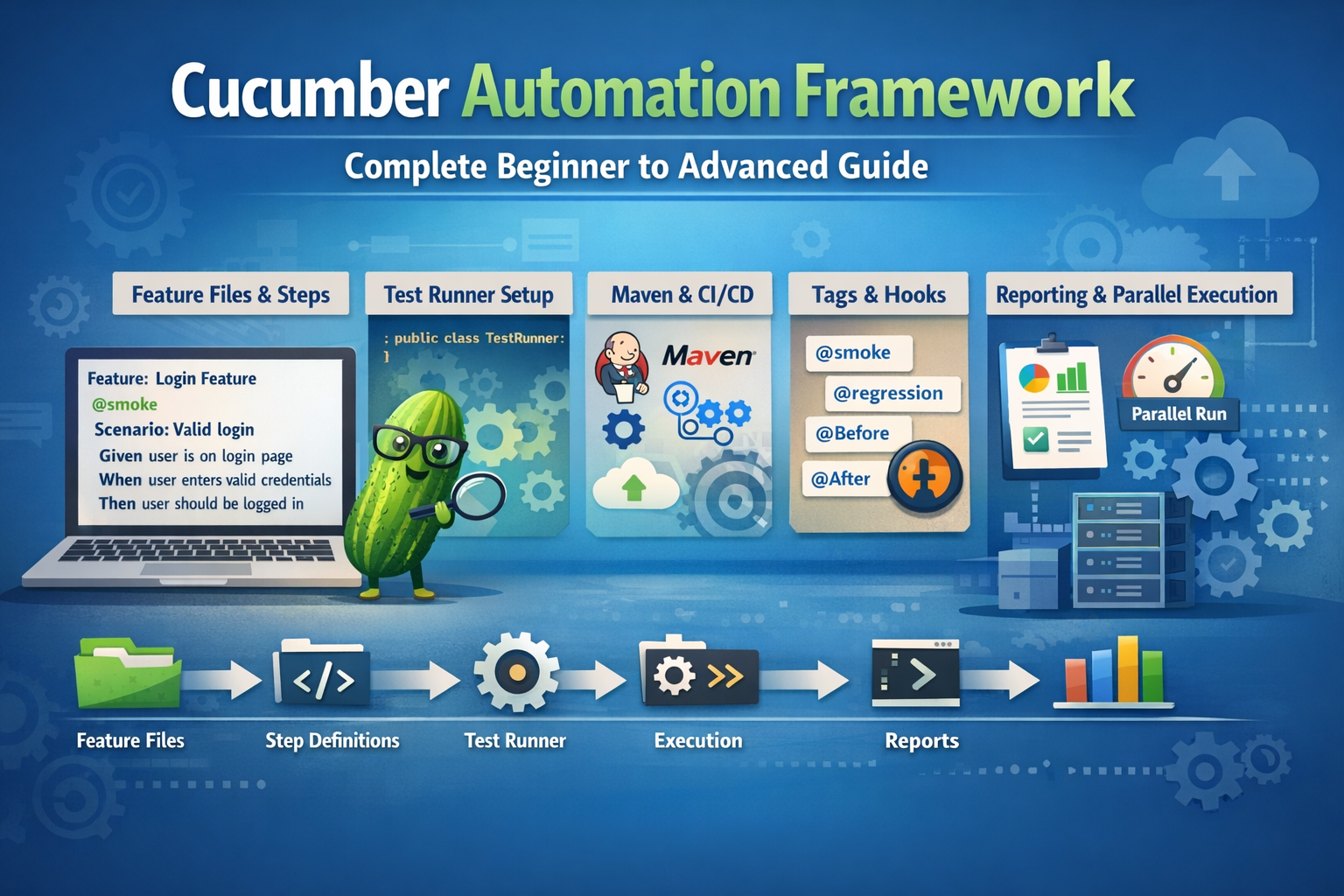
Cucumber Execution Flow
- Feature Files: Written in Gherkin, contain business-readable scenarios.
- Step Definitions: Java (or other language) methods annotated with
@Given,@When,@Then. - Test Runner: JUnit or TestNG class that connects Cucumber engine to the test framework.
- Execution Engine: Reads feature files, maps steps to step definitions, and executes code.
- Reports: HTML, JSON, or custom reporting plugins show test results.
Diagram of Flow
Feature Files → Step Definitions → Test Runner → Execution → Reports
💡 Pro Tip: Understanding this flow is often asked in automation interviews.
4. Project Structure for Cucumber Framework
A clean and maintainable Cucumber framework separates features, steps, and runner classes.
src
 └── test
     ├── java
     │   ├── runner
     │   │   └── TestRunner.java
     │   └── stepdefinitions
     │       └── LoginSteps.java
     └── resources
         └── features
             └── login.feature
Best Practices
- Keep feature files inside
src/test/resources - Keep step definitions in
src/test/java - Keep runner classes in a separate package
- Maintain modularity for scalability
🔗 For an example of Cucumber with JUnit, see our detailed guide here.
5. Setting Up Cucumber Dependencies
For a Java-based framework using Maven, include:
<dependencies>
    <dependency>
        <groupId>io.cucumber</groupId>
        <artifactId>cucumber-java</artifactId>
        <version>7.14.0</version>
    </dependency>
    <dependency>
        <groupId>io.cucumber</groupId>
        <artifactId>cucumber-junit</artifactId>
        <version>7.14.0</version>
        <scope>test</scope>
    </dependency>
    <dependency>
        <groupId>junit</groupId>
        <artifactId>junit</artifactId>
        <version>4.13.2</version>
        <scope>test</scope>
    </dependency>
</dependencies>
💡 Use JUnit 4 for stability and CI compatibility.
6. Feature Files and Step Definitions
Feature Files
- Describe scenarios in business language
- Use tags like
@smoke,@regression,@wipfor execution control - Keep scenarios small and readable
Step Definitions Example
package stepdefinitions;import io.cucumber.java.en.*;public class LoginSteps {
    @Given("user is on login page")
    public void user_is_on_login_page() {
        System.out.println("User is on login page");
    }    @When("user enters valid credentials")
    public void user_enters_valid_credentials() {
        System.out.println("User enters credentials");
    }    @Then("user should be logged in")
    public void user_should_be_logged_in() {
        System.out.println("User logged in successfully");
    }
}
🔗 For advanced step definition patterns and parameterization, see our Cucumber Step Definitions Deep Dive.
7. Test Runner (Heart of Execution)
The TestRunner connects Cucumber with the testing framework.
package runner;import org.junit.runner.RunWith;
import io.cucumber.junit.Cucumber;
import io.cucumber.junit.CucumberOptions;@RunWith(Cucumber.class)
@CucumberOptions(
    features = "src/test/resources/features",
    glue = "stepdefinitions",
    tags = "@smoke",
    plugin = {"pretty", "html:target/cucumber-report.html"},
    monochrome = true
)
public class TestRunner {}
Key Notes
features→ Path to feature filesglue→ Step definition packagetags→ Allows selective executionplugin→ Generates reportsmonochrome→ Improves console readability
🔗 For a full Cucumber with JUnit TestRunner tutorial, click here.
8. Tags and Hooks in Cucumber
Tags
Tags control which scenarios to execute:
mvn test -Dcucumber.filter.tags="@smoke and not @wip"
- Run specific tests locally
- Run different suites in CI pipelines
- Avoid hardcoding feature paths
Hooks
Hooks execute code before or after scenarios:
@Before
public void setUp() {
    System.out.println("Browser launched");
}@After
public void tearDown() {
    System.out.println("Browser closed");
}
🔗 Learn more about Cucumber Hooks & Advanced Tags in our dedicated article.
9. Maven Execution for Enterprise
Real projects never run tests directly from IDE. Maven is the standard.
- Run all tests:
mvn test - Clean and run:
mvn clean test - Run by tag:
mvn test -Dcucumber.filter.tags="@smoke"
Execution Flow
Maven → Surefire Plugin → JUnit Runner → Cucumber Engine → Feature Files → Step Definitions → Reports
Understanding this is often asked in interviews.
10. CI/CD Integration
Cucumber frameworks integrate seamlessly with CI/CD tools:
- Jenkins
- GitHub Actions
- GitLab
Pipeline Example
- Pull code from repository
- Execute
mvn clean test - Generate reports
- Publish results
🔗 Full Cucumber CI/CD integration guide available here.
11. Reporting in Cucumber
Enterprise projects require readable reports:
- HTML reports: Cucumber built-in
- JSON reports: For Allure or Jenkins integration
- Extent Reports: Detailed visual reports for stakeholders
Best practice: Always generate HTML + JSON reports for CI pipelines.
12. Parallel Execution
For large regression suites, run tests in parallel:
- Use Maven Surefire or Failsafe plugin
- Combine with TestNG or JUnit
- Use Cucumber-JVM parallel plugin
🔗 Detailed guide on Parallel Execution in Cucumber is available here.
13. Common Mistakes to Avoid
- Mixing TestNG and JUnit dependencies
- Using JUnit 5 without proper setup
- Hardcoding feature paths
- Version mismatch between dependencies
- Poor project structure
Avoid these to maintain a scalable and stable framework.
14. Best Practices for a Cucumber Automation Framework
- Maintain clean project structure
- Use tags instead of hardcoding features
- Reuse step definitions across features
- Centralize configuration files
- Integrate with CI/CD pipelines
- Generate detailed reports
- Plan for parallel execution
- Use hooks for setup/cleanup
15. FAQ[Frequently Asked Questions]
Q1: What is Cucumber Automation Framework?
A BDD framework allowing tests in business-readable language using Gherkin.
Q2: How do I integrate Cucumber with JUnit?
Use the @RunWith(Cucumber.class) annotation in a TestRunner class and add cucumber-junit dependency in Maven.
Q3: Can Cucumber run with Maven in CI/CD?
Yes. Use Maven commands like mvn test in Jenkins, GitHub Actions, or GitLab pipelines.
Q4: What are Cucumber Hooks?
Code that runs before or after scenarios, useful for setup/cleanup.
Q5: How do I run tests using tags?
Use @tags in feature files and Maven commands like mvn test -Dcucumber.filter.tags="@smoke".
16. Conclusion
The Cucumber Automation Framework is the backbone of scalable BDD automation in enterprise projects.
Mastering this framework involves understanding:
- Feature files and Gherkin
- Step Definitions
- TestRunner and execution flow
- Maven execution and CI/CD integration
- Tags, Hooks, Reporting, and Parallel Execution
By following this guide and exploring linked cluster posts, you can build a professional, interview-ready, and enterprise-grade automation framework.
For Junit documentation you can refer JUnit 4 Documentation
For Cucumber documentation you can refer
Cucumber Official Documentation
Junit
Maven repository
Have a look on Testng related Blog TestNG Automation Framework – Complete Architect Guide for Enterprise CI/CD & Parallel Execution
Have a look on API Authentication related Blog , read our The Ultimate API Authentication guide