Top 10 TestNG Automation Framework Concepts (2026) – Complete Guide with Real Examples
Powerful TestNG Automation Framework Mastery: Real-World Examples, Parallel Execution & CI/CD
Introduction to TestNG Automation Framework
If you’re working in Java automation and not using TestNG properly, you’re basically driving a Ferrari in first gear.
The TestNG Automation Framework is one of the most powerful and flexible testing frameworks in the Java ecosystem. It is heavily used in:
- Selenium UI automation
- REST Assured API automation
- Appium mobile testing
- Enterprise CI/CD pipelines
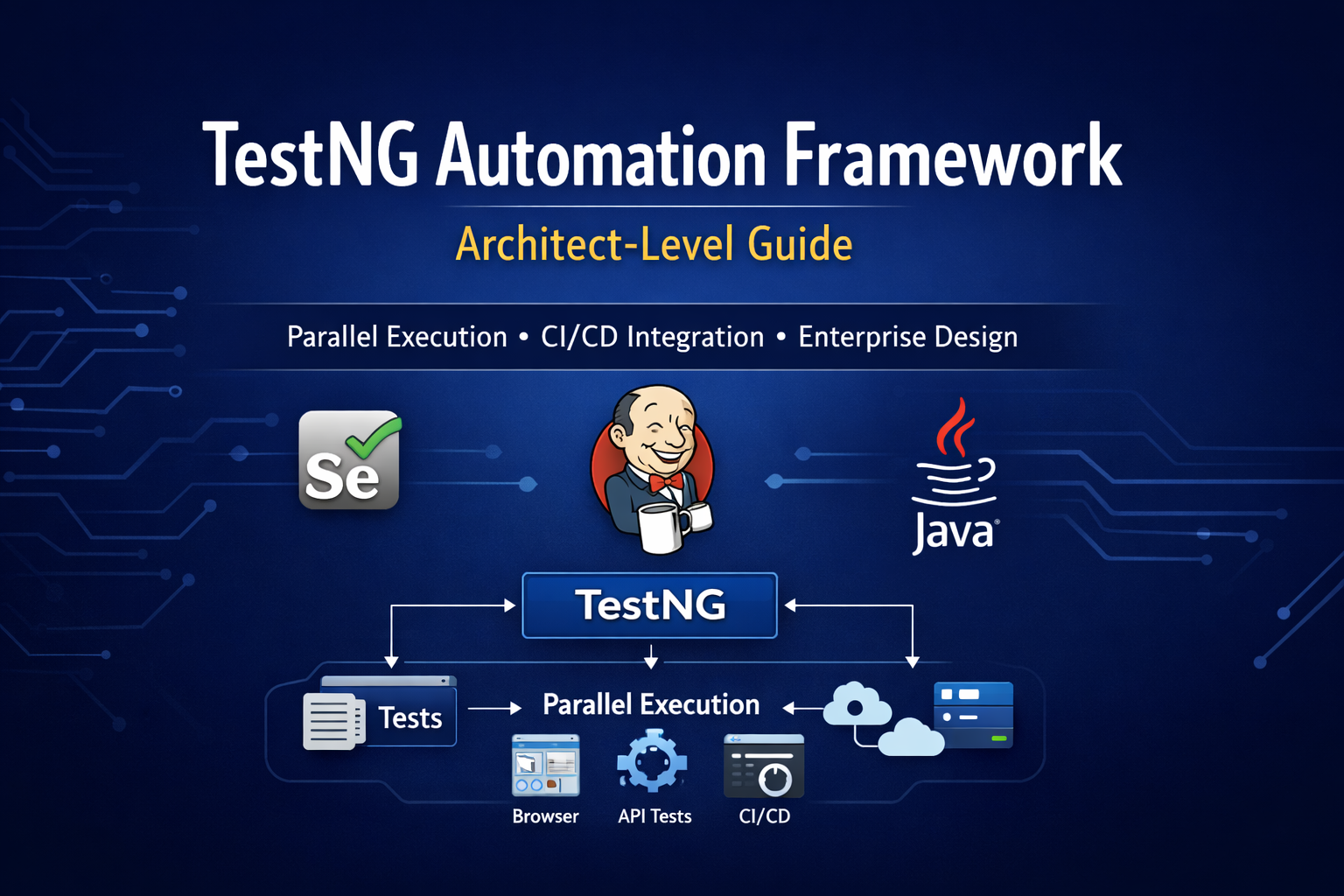
Automation testing in enterprise projects requires a robust framework to handle execution flow, parallelism, CI/CD integration, and reporting. TestNG Automation Framework provides all this and more, acting as the orchestration layer between your test logic (Selenium, Appium, Rest Assured) and CI/CD pipelines.
External Reference:
TestNG Official Documentation
Selenium
Jenkins
MVN Repository
TestNG was created to overcome the limitations of JUnit and provide advanced execution control, grouping, dependency handling, parallel execution, and reporting capabilities.
In this , TestNG Automation Framework complete guide, we’ll cover:
- Core TestNG fundamentals
- Real enterprise examples
- Framework architecture
- CI/CD integration
- Performance optimization
- 30 must-know interview questions
- SEO-optimized FAQs
Let’s build this properly.
📚 Table of Contents
- What is TestNG?
- Why Enterprises Prefer TestNG
- Setting Up TestNG with Maven
- Core Annotations Explained
- testng.xml Deep Dive
- Parallel Execution in Real Projects
- Data-Driven Testing with DataProvider
- Retry Mechanism for Flaky Tests
- TestNG Listeners (Advanced)
- TestNG with Selenium – Real Example
- Framework Design Best Practices
- CI/CD Integration with Jenkins
- Advanced Architect Concepts
- 30 TestNG Interview Questions
- FAQ Section (Schema Ready)
- Internal & External Resources
What is TestNG?
TestNG (Test Next Generation) is an open-source testing framework inspired by JUnit and NUnit but designed for advanced automation scenarios.
Unlike JUnit, TestNG provides:
- Native parallel execution
- Group-based execution
- Dependency management
- DataProvider
- Retry analyzer
- Rich reporting
GitHub Repository:
👉 https://github.com/cbeust/testng
Why Enterprises Prefer TestNG Automation Framework Based Framework
In real enterprise projects, automation suites may contain:
- 2000+ test cases
- Multiple browsers
- Parallel execution pipelines
- CI/CD integration
- Environment-based execution
TestNG handles this scale efficiently.
Here’s what makes it enterprise-ready:
✔ Flexible annotations
✔ XML-based execution control
✔ Parallel execution
✔ Thread handling
✔ Listener support
✔ Retry mechanism
✔ Integration with Selenium & REST Assured
Setting Up TestNG with Maven
Add this dependency to your pom.xml:
<dependency>
  <groupId>org.testng</groupId>
  <artifactId>testng</artifactId>
  <version>7.9.0</version>
  <scope>test</scope>
</dependency>
Then run:
mvn clean test
Official Maven Repository:
👉 https://mvnrepository.com/artifact/org.testng/testng
Core TestNG Annotations (With Real Usage)
@Test
@Test
public void loginTest() {
    System.out.println("Login executed");
}
@BeforeMethod / @AfterMethod
Used in Selenium frameworks:
@BeforeMethod
public void setup() {
    driver = new ChromeDriver();
}@AfterMethod
public void teardown() {
    driver.quit();
}
Real-world usage:
- Browser setup
- Screenshot capture
- Logging
@BeforeSuite / @AfterSuite
Used for:
- Environment initialization
- Report generation setup
- Database connection
testng.xml – Execution Control Center
Example:
<suite name="Automation Suite" parallel="methods" thread-count="3">
   <test name="Login Tests">
      <classes>
         <class name="tests.LoginTest"/>
      </classes>
   </test>
</suite>
Important attributes:
- parallel
- thread-count
- groups
- listeners
This file controls full execution strategy.
Parallel Execution in Enterprise Projects
Parallel execution types:
- methods
- classes
- tests
- instances
Example:
<suite name="Suite" parallel="classes" thread-count="2">
This reduces execution time dramatically in CI pipelines.
For Selenium Grid reference:
👉 https://www.selenium.dev/documentation/grid/
Data-Driven Testing with DataProvider
@DataProvider(name="loginData")
public Object[][] data() {
    return new Object[][] {
        {"admin","admin123"},
        {"user","password"}
    };
}@Test(dataProvider="loginData")
public void loginTest(String username, String password) {
    System.out.println(username + password);
}
Use case:
- Multiple user roles
- Multiple API payloads
- Cross environment validation
Retry Mechanism for Flaky Tests
public class Retry implements IRetryAnalyzer {
   int count = 0;
   int maxTry = 2;   public boolean retry(ITestResult result) {
      if(count < maxTry) {
         count++;
         return true;
      }
      return false;
   }
}
Attach:
@Test(retryAnalyzer = Retry.class)
Enterprise benefit:
- Stabilizes flaky UI tests
- Handles temporary network failures
TestNG Listeners (Advanced Level)
public class CustomListener implements ITestListener {   public void onTestFailure(ITestResult result) {
      System.out.println("Failed: " + result.getName());
   }
}
Attach in XML:
<listeners>
   <listener class-name="listeners.CustomListener"/>
</listeners>
Used for:
- Screenshot capture
- Custom logging
- Slack/Email notifications
TestNG with Selenium – Real Enterprise Example
public class LoginTest {   WebDriver driver;   @BeforeMethod
   public void setup() {
      driver = new ChromeDriver();
      driver.get("https://example.com");
   }   @Test
   public void login() {
      driver.findElement(By.id("username")).sendKeys("admin");
      driver.findElement(By.id("password")).sendKeys("admin123");
      driver.findElement(By.id("login")).click();
   }   @AfterMethod
   public void teardown() {
      driver.quit();
   }
}
Official Selenium Docs:
👉 https://www.selenium.dev/documentation/
Framework Structure (Recommended Architecture)
src
 ├── base
 ├── pages
 ├── tests
 ├── utilities
 ├── listeners
 └── reports
Best Practices:
- Page Object Model
- ThreadLocal WebDriver
- Centralized configuration
- Environment property files
TestNG Automation Framework is one of the most powerful approaches for building scalable automation solution
CI/CD Integration (Jenkins Example)
Jenkins Official Site:
👉 https://www.jenkins.io
Pipeline step:
stage('Run Tests') {
   sh 'mvn clean test'
}
Publish TestNG reports from:
test-output/index.html
Advanced Architect-Level Concepts
If you want to level up:
- Dynamic testng.xml generation
- Dockerized test execution
- Kubernetes-based scaling
- Selenium Grid parallel execution
- ThreadLocal driver management
- Cloud execution (BrowserStack)
This is how real enterprise frameworks scale.
🔥 Internal Learning Resource
If you want to integrate TestNG with BDD frameworks, read our detailed Cucumber guide here:
👉 https://qatribe.in/cucumber-automation-framework-guide/
That guide explains how TestNG complements Cucumber in enterprise BDD setups.
🎯 30 Must-Know TestNG Interview Questions
- What is TestNG?
- Difference between TestNG and JUnit?
- Explain testng.xml.
- What is DataProvider?
- How does parallel execution work?
- What are listeners?
- What is IRetryAnalyzer?
- Explain dependency in TestNG.
- What is group execution?
- How to skip tests?
- What is thread-count?
- Difference between @BeforeTest and @BeforeClass?
- How to generate reports?
- How to run tests from command line?
- How to execute tests in CI/CD?
- What is Page Object Model?
- How to capture screenshot on failure?
- How to manage WebDriver in parallel?
- What is priority in TestNG?
- How to parameterize tests?
- What is @Factory?
- What is invocationCount?
- How to rerun failed tests?
- What is SoftAssert?
- How to integrate with Maven?
- How to integrate with Cucumber?
- What are TestNG listeners lifecycle methods?
- What is suite execution?
- What is test-level parallelization?
- How to optimize execution time?
FAQ Section
What is TestNG used for?
TestNG is used for Java-based automation testing including UI, API, and mobile testing with advanced execution control.
Is TestNG better than JUnit?
For enterprise automation, TestNG provides more advanced features like parallel execution and dependency management.
How do I run TestNG tests in parallel?
Use parallel="methods" or parallel="classes" in testng.xml and define thread-count.
How does TestNG integrate with Selenium?
TestNG manages test execution while Selenium handles browser automation.
Conclusion
The TestNG Automation Framework is not just another testing tool.
It is the backbone of scalable Java automation projects.
If you master:
- Annotations
- DataProvider
- Parallel execution
- Retry mechanism
- Listeners
- CI/CD integration
You move from automation tester to automation engineer.
And that’s a serious upgrade.
Have a look on Cucumber related Blog For a complete BDD implementation guide, read our Cucumber Automation Framework – Complete Beginner to Advanced Guide.
Have a look on API Authentication related Blog , read our The Ultimate API Authentication guide