
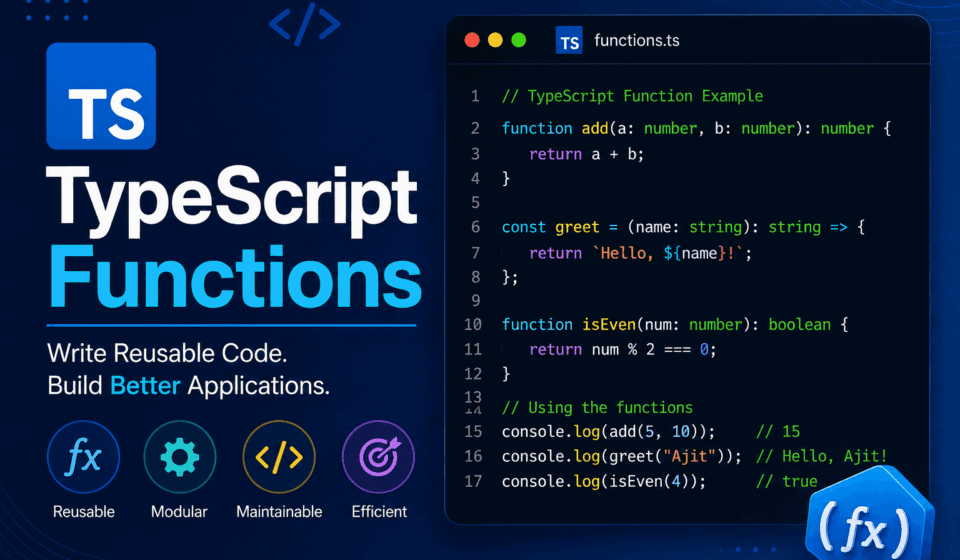
TypeScript Functions: Typing Parameters, Return Types & Examples
TypeScript functions are where the language’s type system actually earns its keep on a day-to-day basis, and if you’ve spent any time reviewing pull requests on a mid-size TypeScript codebase, you already know the pain I’m talking about — a function that quietly accepts any, a return type that drifts from what the function actually returns six months later, or an optional parameter that nobody remembered to null-check. I’ve been doing QA and test automation architecture for a little over twelve years now, mostly across BFSI, wealth management, healthcare, and payments platforms, and somewhere around year seven or eight I stopped treating TypeScript as “JavaScript with some extra syntax” and started treating function signatures as contracts — the same way I’d treat an API contract during test design. That shift changed how I write test utilities, how I review page object models, and honestly how I argue with developers during code review.
This post is a deep, practical walkthrough of typing TypeScript functions in TypeScript: parameters, return types, overloads, generics, async signatures, callback typing, and the handful of real mistakes I keep seeing in production codebases and in Playwright/Selenium automation frameworks alike. I’m not going to give you the “here’s what a function is” beginner treatment. I’m assuming you already write JavaScript TypeScript functions comfortably and you want to actually understand how TypeScript reasons about them — what the compiler checks, what it silently lets slide, and where the type system’s rules surprise people who learned TypeScript from tutorials rather than from fixing bugs at 11 PM during a release window.
By the end of this, you should be able to look at any function signature — yours or someone else’s — and immediately know what can go wrong with it, what the compiler will and won’t catch, and how to write signatures that make illegal states genuinely unrepresentable instead of just “discouraged in the README.” Let’s get into it.
Why Typing Functions Properly Actually Matters (Beyond Passing the Compiler)
Let me start with something a little contrarian: type annotations on TypeScript functions are not primarily there to make the compiler happy. They’re there to make the next person reading the function — who might be you, three sprints from now, having forgotten every decision you made today — understand what the function expects and what it promises without having to read the implementation. That’s it. That’s the whole job.
I learned this the hard way on a payments reconciliation project a few years back. We had a utility function called calculateSettlement that took four parameters, three of which were numbers and one of which was a string that was sometimes a currency code and sometimes a full ISO timestamp depending on which module called it (don’t ask — it was a legacy carryover from a Java service that got half-ported). Nobody had typed the parameters explicitly; TypeScript had inferred any for two of them because they came from a JSON.parse call upstream. We shipped a defect where settlement amounts were being calculated against the wrong currency because a QA engineer testing a new bank integration passed the parameters in a slightly different order than the “normal” callers did. The function ran. It returned a number. It just returned the wrong number, and nothing in the type system stopped it, because there was effectively no type system in play at that call site.
That incident is the entire reason I now treat function signatures the way I’d treat a formal test contract. A well-typed function signature does three things simultaneously:
- It documents intent without requiring a comment (a comment can lie; a type, mostly, cannot).
- It catches misuse at the call site, at compile time, before a test engineer or worse, a customer, ever sees the bug.
- It gives your IDE enough information to autocomplete correctly, which sounds trivial until you’re onboarding a new automation engineer onto a 40,000-line Playwright framework and every helper function tells them exactly what to pass.
So when I say we’re going to talk about typing parameters and return types, understand that this isn’t a syntax lesson dressed up as an architecture lesson. It’s the other way around. The syntax is easy. Knowing when to be explicit, when to let inference do the work, and when your function signature is quietly lying to its callers — that’s the actual skill, and that’s what twelve years of shipping and testing software has taught me to care about.
The Anatomy of a TypeScript Function Signature
Before we go deep on parameters and return types individually, it helps to look at the full shape of a function signature so we have shared vocabulary for the rest of this article. Take this function:
function createUser(name: string, age: number, isActive: boolean = true): User {
  return { name, age, isActive, id: generateId() };
}
There are four distinct things happening here, and TypeScript treats each one with slightly different rules:
- The parameter list —
(name: string, age: number, isActive: boolean = true). Each parameter can have a type annotation, can be optional, can have a default value, or can be a rest parameter. - The return type annotation —
: User. This tells TypeScript (and every caller) exactly what shape of value comes back out. - The function body — where TypeScript will actually check that every return statement matches the declared return type, and that every operation inside the body respects the parameter types.
- The inferred function type — TypeScript computes a full type for
createUseritself, something like(name: string, age: number, isActive?: boolean) => User, and that inferred type is what gets checked whenever you passcreateUseraround as a value — as a callback, as an object property, wherever.
That fourth point trips people up constantly, so let’s sit with it for a second. In TypeScript, a function isn’t just “a thing with typed parameters.” The function itself has a type, the same way a string has the type string or an object has some interface type. You can assign that type to a variable, you can pass it around, and TypeScript will structurally compare function types against each other when you do. We’ll come back to this when we talk about function type compatibility later in the article, because it explains a lot of “why did TypeScript allow that?” moments that confuse even experienced developers.
Typing Parameters: The Foundation Everything Else Builds On
Let’s start where most people start — typing individual parameters — but let’s go past the basics quickly because you already know that function add(a: number, b: number) means a and b are numbers. What’s more interesting, and what actually shows up in production code review, is the set of decisions you make once your parameters stop being trivially primitive.
Basic Primitive Parameter Types
The primitive types you’ll type most often are string, number, boolean, bigint, symbol, null, and undefined. Here’s a function using several of them together, the kind of thing you’d write for a fee calculation module in a fintech app:
function calculateProcessingFee(
  amount: number,
  currency: string,
  isPremiumAccount: boolean
): number {
  const baseFeeRate = isPremiumAccount ? 0.015 : 0.025;
  const fee = amount * baseFeeRate;
  return currency === 'INR' ? Math.round(fee) : Number(fee.toFixed(2));
}
Nothing exotic here, but notice something: I didn’t type the return value redundantly inside the function body — TypeScript infers that fee is a number and that both branches of the ternary return numbers, so the explicit : number on the function signature is doing exactly one job: constraining what the function is allowed to return, not describing what it happens to return today. This distinction matters more than it sounds like it should, and I’ll explain why in the return types section.
Optional Parameters
Optional parameters use the ? suffix, and they’re one of the most misused features I see in real codebases, mostly because engineers reach for “optional” when they actually mean “has a sensible default” or, worse, when they actually mean “this parameter is conditionally required depending on some other parameter,” which TypeScript’s basic optional syntax cannot express at all (we’ll get to how to actually express that later, because it’s a genuinely common requirement in test automation config objects).
function fetchTransactionHistory(
  accountId: string,
  startDate?: Date,
  endDate?: Date
): Promise<Transaction[]> {
  const from = startDate ?? new Date(0);
  const to = endDate ?? new Date();
  return transactionService.query(accountId, from, to);
}
A hard rule TypeScript enforces: once a parameter is optional, every parameter after it in the list must also be optional (or have a default value, which we’ll get to next). You cannot have a required parameter after an optional one. This is because TypeScript needs to support positional calling — if startDate is optional and endDate is required, the compiler has no way to know, at a call site with only two arguments, whether the caller meant to skip startDate or provide it. JavaScript doesn’t have named arguments at the language level (object destructuring is how we fake them, more on that shortly), so this ordering constraint is really a consequence of how calling conventions work under the hood.
Here’s the trap I see constantly in QA automation frameworks specifically: engineers write a function like this for, say, a login helper in a Playwright framework:
async function login(page: Page, username: string, password?: string, otp?: string) {
  await page.fill('#username', username);
  if (password) {
    await page.fill('#password', password);
  }
  if (otp) {
    await page.fill('#otp', otp);
  }
  await page.click('#submit');
}
This compiles fine and looks reasonable, but it silently allows a call like login(page, 'testuser') with no password at all, which submits a login form with an empty password field and produces a test that fails for a completely different reason than the one your test case claims to be validating — you end up debugging a “why did my login fail” flake that’s actually a “someone forgot a required argument” bug the compiler should have caught. In this case, password genuinely shouldn’t be optional; only otp should be, since OTP is conditional on two-factor auth being enabled for that test account. Fixing the signature to async function login(page: Page, username: string, password: string, otp?: string) would have caught that misuse at compile time, months before the flaky test ever ran in CI.
Default Parameters
Default parameters look similar to optional parameters syntactically but they behave differently, and the difference matters. With a default parameter, you provide a fallback value directly in the signature, and TypeScript infers the parameter’s type from that default value if you don’t annotate it explicitly:
function retryRequest(url: string, maxAttempts = 3, delayMs = 1000): Promise<Response> {
  // maxAttempts is inferred as number, delayMs is inferred as number
  return executeWithRetry(url, maxAttempts, delayMs);
}
The key practical difference from an optional parameter: inside the function body, a default parameter’s type does not include undefined, because TypeScript knows that if the caller omits it, the default value fills the gap before the body ever executes. An optional parameter’s type, by contrast, always includes undefined as a possibility inside the body, because there genuinely might be no value there at all. This is why you’ll see experienced TypeScript developers reach for defaults over optional-plus-manual-fallback whenever there’s a sensible default value to provide — it removes an entire category of null-check boilerplate and removes a source of bugs where someone forgets the fallback logic in one code path but not another.
I want to flag one specific gotcha here because I’ve seen it break test automation config loading more than once: default parameters are evaluated at call time, not at function definition time, and they can reference earlier parameters in the same parameter list.
function buildTestConfig(
  environment: string,
  baseUrl: string = environment === 'prod' ? 'https://app.example.com' : 'https://staging.example.com',
  timeout: number = 30000
) {
  return { environment, baseUrl, timeout };
}
This works, and it’s genuinely useful for building test configuration objects where later defaults depend on earlier explicit arguments — but it also gets unreadable fast if you nest more than one level of conditional logic into a default expression. My rule of thumb after years of maintaining test frameworks: if the default value expression needs its own line to read comfortably, pull it into a named function above and call that function as the default, or just move the logic inside the function body with an explicit ?? check. Don’t make the next engineer parse a ternary sitting inside a parameter list.
Rest Parameters
Rest parameters let a function accept an arbitrary number of arguments, collected into a typed array, and they show up constantly in logging utilities, assertion helpers, and anywhere you’re building a variadic API on top of a fixed-arity one.
function logTestStep(stepName: string, ...details: string[]): void {
  console.log(`[${new Date().toISOString()}] ${stepName}: ${details.join(', ')}`);
}

logTestStep('Login attempt', 'username: qa_user01', 'environment: staging');
logTestStep('Login attempt'); // details defaults to an empty array, which is legal
A rest parameter must be the last parameter in the list — that’s a hard syntax rule, not a style preference, because otherwise TypeScript (and JavaScript) would have no way to know where the “rest” of the arguments end and the next named parameter begins. The type you annotate on a rest parameter is always an array type (or a tuple type, which we’ll cover under advanced parameter typing), even though what the caller writes at the call site looks like individual comma-separated arguments.
One pattern I use a lot in custom Playwright assertion helpers is combining a typed rest parameter with a generic, so the helper can validate any number of arguments against a consistent shape:
function assertAllVisible(page: Page, ...selectors: string[]): Promise<void[]> {
  return Promise.all(selectors.map(selector => expect(page.locator(selector)).toBeVisible()));
}
This gives you a single call like await assertAllVisible(page, '#header', '#nav', '#footer') instead of three separate assertion lines, and because selectors is typed as string[], passing a non-string argument by accident — say, a Locator object instead of a selector string, which is an easy mistake in Playwright since both are extremely common types to have lying around in the same test file — gets caught immediately by the compiler instead of surfacing as a confusing runtime error deep inside Playwright’s internals.
Destructured Parameters and Why They’re Better Than Long Positional Lists
Once a function crosses somewhere around three or four parameters, positional arguments become genuinely dangerous, because nothing at the call site tells you which value maps to which parameter unless you’re staring at the function definition or your IDE’s parameter hints are actively rendering. I’ve watched senior engineers pass arguments in the wrong order to a five-parameter function and have it compile cleanly because the types happened to overlap (two string parameters next to each other is the classic trap). Destructured object parameters solve this by giving every argument a name at the call site.
interface CreateOrderOptions {
  customerId: string;
  items: OrderItem[];
  discountCode?: string;
  expressShipping?: boolean;
  notes?: string;
}

function createOrder({
  customerId,
  items,
  discountCode,
  expressShipping = false,
  notes = ''
}: CreateOrderOptions): Order {
  // implementation
  return buildOrder(customerId, items, discountCode, expressShipping, notes);
}

createOrder({
  customerId: 'cust_123',
  items: [{ sku: 'SKU1', qty: 2 }],
  expressShipping: true
});
Notice that the default value for expressShipping and notes lives right there in the destructuring pattern, and it behaves exactly the same way as a default parameter on a positional function — if the caller omits the property entirely, or if they pass the entire options object as undefined and the parameter itself has a default of {}, the fallback kicks in. This is the pattern I default to for every configuration-style function in a test framework: page object constructors, API client factories, custom fixture setup TypeScript functions in Playwright. The moment a function’s parameter count is going to grow over time — and configuration TypeScript functions always grow over time, that’s just the nature of software — a destructured object parameter absorbs new fields without breaking every existing call site, whereas adding a new positional parameter in the middle of an existing list breaks everyone.
There’s a subtlety worth calling out: when you destructure directly in the parameter list like the example above, you can still make the entire options object optional at the top level:
function launchBrowser({
  headless = true,
  slowMo = 0,
  viewport = { width: 1280, height: 720 }
}: {
  headless?: boolean;
  slowMo?: number;
  viewport?: { width: number; height: number };
} = {}) {
  return chromium.launch({ headless, slowMo });
}

launchBrowser(); // valid, because the whole parameter defaults to {}
That trailing = {} after the type annotation is easy to forget, and without it, calling launchBrowser() with zero arguments fails to compile, because TypeScript sees a required parameter (an object, even though every one of its properties is individually optional) and nothing satisfies “required” except actually passing something, even an empty object. I’ve fixed this exact compile error in code review probably two dozen times across different teams — someone makes every field optional, assumes that makes the whole call optional, and it doesn’t, not without that extra default at the very end.
Typing Return Types: The Half of the Signature Everyone Under-Specifies
Here’s an opinion I’ll defend pretty aggressively: most TypeScript codebases I’ve audited over the years under-annotate return types far more than they under-annotate parameters, and it’s the return type gap that causes more of the subtle bugs. Parameters get typed because the compiler nags you loudly and immediately — you can’t call a function with the wrong argument types without an error staring you in the face. Return types, when omitted, get silently inferred, and inference is usually right, right up until the one time it isn’t, and by then the bug has already shipped.
Explicit vs. Inferred Return Types
TypeScript is fully capable of inferring return types on its own in the vast majority of cases:
function double(n: number) {
  return n * 2; // inferred return type: number
}
This works, and for small, obviously-correct utility TypeScript functions, I don’t lose sleep over the missing annotation. But here’s where inference quietly turns into a liability — the moment a function has multiple return statements, especially across conditional branches that get edited independently over time:
function getDiscountRate(customerTier: string) {
  if (customerTier === 'gold') {
    return 0.20;
  }
  if (customerTier === 'silver') {
    return 0.10;
  }
  if (customerTier === 'platinum') {
    return '15%'; // bug: someone typed a string here by accident
  }
  return 0;
}
Without an explicit return type annotation, TypeScript infers this function’s return type as number | string, and it compiles cleanly, because from the compiler’s perspective, that is what the function returns — sometimes a number, sometimes a string, and nothing in the code is wrong according to the types as written. The bug (a string where a number was intended) sails straight through code review unless the reviewer is manually tracing every return path, which nobody reliably does on a busy sprint. Now add an explicit return type annotation to the function signature:
function getDiscountRate(customerTier: string): number {
  if (customerTier === 'gold') {
    return 0.20;
  }
  if (customerTier === 'silver') {
    return 0.10;
  }
  if (customerTier === 'platinum') {
    return '15%'; // now this is a compile error, exactly where the mistake was made
  }
  return 0;
}
Now the exact same typo produces a compile error on the exact line where the mistake happened, with a message that says, in effect, “you promised this function returns a number, and this line breaks that promise.” That’s the entire value proposition of explicit return types: they turn “the function’s contract is whatever the implementation happens to do today” into “the function’s contract is what I declared, and the implementation must honor it, checked automatically, forever, even after refactors.” I annotate return types on every exported function and every function with more than one return statement, no exceptions, and I push that as a lint rule (@typescript-eslint/explicit-function-return-type) on every team I’ve architected automation frameworks for in the last several years.
The void Return Type
void means “this function doesn’t return a meaningful value,” and it’s the correct return type for TypeScript functions you call purely for their side effects — logging, DOM mutation, triggering an event, writing to a file. Here’s the part that surprises people coming from stricter languages: TypeScript’s void is not quite the same as “the function returns nothing” in an absolute sense. A function typed to return void can still technically return a value at the JavaScript runtime level (JavaScript TypeScript functions without an explicit return statement return undefined, and even TypeScript functions that do return something can be assigned to a void-typed variable), but TypeScript won’t let you use that returned value as if it were meaningful.
function logAndContinue(message: string): void {
  console.log(message);
}

const result = logAndContinue('test'); // result has type void; using it as data is a type error
There’s a specific, deliberate exception to this that catches people off guard the first time they see it: when you’re typing a callback parameter as returning void, TypeScript actually allows the caller to pass a function that returns something else entirely, and it just ignores the returned value.
function forEachItem(items: string[], callback: (item: string) => void): void {
  items.forEach(callback);
}

const items = ['a', 'b', 'c'];

// This compiles even though push() returns a number, not void
forEachItem(items, (item) => resultsArray.push(item));
This isn’t a bug or a hole in the type system — it’s an intentional design decision, because array methods like Array.prototype.push return a value (the new array length) that callers routinely ignore, and TypeScript’s designers decided that forcing every callback passed to a void-returning callback parameter to also literally return undefined would be needlessly restrictive and would break extremely common patterns. It’s worth knowing this exists specifically so it doesn’t confuse you during code review when you see a callback that “should” be a type error but isn’t.
The undefined Return Type vs. void
These look similar but they communicate different intent, and mixing them up is a subtle code smell. void says “don’t use my return value, I’m not promising one.” undefined as an explicit return type says “I promise to always return exactly the value undefined, as a meaningful, checkable fact,” which is a much stronger and rarer thing to actually want.
function findUserById(id: string): User | undefined {
  return users.find(u => u.id === id);
}
Here, User | undefined is the honest, correct return type — the function might genuinely find a user or might not, and every caller is now forced by the compiler to handle both cases before treating the result as a User. This is, in my experience, one of the single highest-value patterns in the entire language for reducing null-reference-style bugs, because it converts “did I remember to check if this came back empty” from a discipline problem into a compiler-enforced problem. I push this pattern hard in code review specifically for any lookup, search, or query-style function — database calls, API response parsers, array `.find()` wrappers, anything that has a legitimate “not found” case. Returning null instead of undefined for “not found” is a completely valid alternative convention (some teams prefer it because it’s more explicit that “not found” was a deliberate outcome rather than an accidental omission) — just pick one convention for your codebase and enforce it consistently, because a codebase that mixes both for the same kind of “not found” semantics is a codebase where every consumer has to check for two different empty values, defensively, forever.
The never Return Type
never is the return type for TypeScript functions that don’t return at all — not “returns undefined,” not “returns void,” but genuinely never reaches a return statement because the function always throws, always loops infinitely, or always terminates the process.
function throwValidationError(field: string, reason: string): never {
  throw new ValidationError(`${field}: ${reason}`);
}

function assertIsDefined<T>(value: T | undefined, message: string): asserts value is T {
  if (value === undefined) {
    throw new Error(message);
  }
}
never is genuinely one of the more underused types I see in real code, and it’s a shame, because it enables exhaustiveness checking, which is one of TypeScript’s most valuable static-analysis features once you’re working with union types or discriminated unions — extremely common in test framework state machines and workflow-driven apps.
type PaymentStatus = 'pending' | 'completed' | 'failed' | 'refunded';

function getStatusLabel(status: PaymentStatus): string {
  switch (status) {
    case 'pending':
      return 'Payment Pending';
    case 'completed':
      return 'Payment Completed';
    case 'failed':
      return 'Payment Failed';
    case 'refunded':
      return 'Payment Refunded';
    default:
      const exhaustiveCheck: never = status;
      throw new Error(`Unhandled status: ${exhaustiveCheck}`);
  }
}
The magic here: if someone later adds a fifth value to the PaymentStatus union — say, 'disputed' — and forgets to add a corresponding case in this switch statement, the default branch’s assignment of status to a variable typed never becomes a compile error, because status is no longer narrowed down to nothing at that point — there’s an unhandled case left over, and TypeScript will not let you assign anything except a truly impossible value to a never-typed variable. This single pattern has caught more “we added a new status and forgot to update every place that switches on it” bugs on my teams than almost any other TypeScript idiom, and I specifically look for it — or its absence — whenever I’m reviewing state-driven logic in either application code or test automation frameworks that model multi-step workflows (checkout flows, KYC verification steps, loan approval pipelines, anything with a status enum that’s going to grow over the life of the project).
Function Overloads: When One Signature Isn’t Honest Enough
Sometimes a single function genuinely behaves differently depending on what you pass it, in a way that a union type on the parameters can’t cleanly express, especially when the return type depends on which “shape” of arguments was used. This is where function overloads come in, and they’re one of the more misunderstood features in the language because the syntax looks unusual the first few times you see it.
function parseAmount(value: string): number;
function parseAmount(value: number): number;
function parseAmount(value: string | number): number {
  if (typeof value === 'string') {
    const cleaned = value.replace(/[^0-9.-]/g, '');
    return parseFloat(cleaned);
  }
  return value;
}
Those first two lines are overload signatures — they’re not implementations, they’re just declarations of the valid ways this function can be called. The third line, with a body, is the implementation signature, and it must be broad enough (using a union type here) to cover every overload declared above it, but critically, callers never see the implementation signature directly. When you call parseAmount from anywhere else in your codebase, your IDE and the compiler only ever show you the overload signatures, not the combined implementation one. This matters more once the overloads have genuinely different return types depending on input, which is the actual reason to reach for overloads instead of a simple union parameter type:
function getElementValue(selector: string): Promise<string>;
function getElementValue(selector: string, asNumber: true): Promise<number>;
function getElementValue(selector: string, asNumber?: boolean): Promise<string | number> {
  const raw = document.querySelector(selector)?.textContent ?? '';
  return Promise.resolve(asNumber ? Number(raw) : raw);
}
With this setup, await getElementValue('#price') is correctly typed as Promise<string>, and await getElementValue('#price', true) is correctly typed as Promise<number>, with no manual casting required at either call site — the compiler figures out which overload matches based on the arguments and gives you back the precise return type for that specific call. Compare that to the alternative of a single signature returning Promise<string | number> for every call, which would force every single caller to narrow the type themselves with an if check or a type assertion, even in the cases where the call site itself makes the actual return type completely unambiguous.
A word of caution from experience: overloads are powerful but they get unmaintainable fast if you stack more than three or four variants, and I’ve inherited codebases with seven-deep overload chains on a single function that took me the better part of a morning just to understand which combination of arguments triggered which behavior. My rule: if you’re reaching for a fourth overload, stop and seriously consider whether you actually have two or three separate TypeScript functions wearing a trench coat, and whether splitting them into differently-named TypeScript functions (getElementValueAsString and getElementValueAsNumber, say) would be more honest and more maintainable than one polymorphic function pretending to be simple.
Function Types as Standalone Type Aliases and Interfaces
Every function has a type, and you can extract and name that type independently of any specific function, which becomes essential the moment you’re passing TypeScript functions around as values — callbacks, event handlers, strategy-pattern implementations, or (extremely relevant to my world) custom Playwright fixtures and page object method signatures that multiple implementations need to satisfy identically.
type Validator = (value: string) => boolean;

const isEmail: Validator = (value) => /^[^\s@]+@[^\s@]+\.[^\s@]+$/.test(value);
const isNonEmpty: Validator = (value) => value.trim().length > 0;

function validateField(value: string, validator: Validator): boolean {
  return validator(value);
}
You can express the same thing with an interface, which is preferable when the “function” also needs additional properties attached to it (TypeScript functions are objects in JavaScript, so this is completely legal) or when you specifically want the extra structural flexibility interfaces offer for declaration merging:
interface RetryableRequest {
  (url: string, options?: RequestOptions): Promise<Response>;
  maxRetries: number;
}

const fetchWithRetry: RetryableRequest = Object.assign(
  async (url: string, options?: RequestOptions) => {
    // implementation
    return fetch(url, options);
  },
  { maxRetries: 3 }
);
In practice, for the vast majority of day-to-day work, I reach for type aliases for function shapes rather than interfaces, purely because the syntax is more compact and there’s rarely a real need for the callable-interface-with-properties pattern above outside of specific library-authoring situations. Where this becomes genuinely important architecturally is in test automation frameworks: I typically define a shared type for every “step function” or “action function” signature in a custom test framework, so that every page object method, every API helper, and every custom fixture conforms to one predictable shape that new team members can learn once and reuse everywhere.
type TestStep<T = void> = (page: Page, context: TestContext) => Promise<T>;

const loginStep: TestStep<void> = async (page, context) => {
  await page.fill('#username', context.credentials.username);
  await page.fill('#password', context.credentials.password);
  await page.click('#submit');
};

const extractOrderIdStep: TestStep<string> = async (page) => {
  return (await page.locator('#order-id').textContent()) ?? '';
};
Once every step in a framework conforms to TestStep<T>, you can build generic orchestration logic — retry wrappers, step timers, step-level screenshot capture on failure — that works uniformly across the entire framework without caring about the specific business logic inside any individual step, because the type system guarantees every step has the same calling convention.
Generic Functions: Typing Parameters and Return Types That Depend on Each Other
Generics are where function typing stops being about individual, fixed types and starts being about relationships between types — “whatever type comes in as the parameter is exactly the type that comes back out,” or “the return type depends on which of two input types was provided.” If overloads are for TypeScript functions that behave differently by input shape, generics are for TypeScript functions that behave identically regardless of input type, but need to preserve that type’s identity through the function rather than widening everything to any or unknown.
function getFirstElement<T>(items: T[]): T | undefined {
  return items.length > 0 ? items[0] : undefined;
}

const firstName = getFirstElement(['Ajit', 'Rahul', 'Priya']); // inferred as string | undefined
const firstOrder = getFirstElement(orders); // inferred as Order | undefined
Without the generic T, you’d have two bad options: type the parameter and return as any[] and any (which throws away all type safety for every caller, forever), or write a separate, nearly identical function for every type you need this behavior for (which is an obvious maintenance nightmare). The generic lets you write the logic exactly once while keeping every caller’s specific type intact through the entire call.
Generic constraints are the next layer up, and they’re what let you write a generic function that still needs to assume something about the type it’s working with — not full type safety at the level of a specific concrete type, but enough structure to actually do useful work inside the function body.
interface HasId {
  id: string;
}

function findById<T extends HasId>(items: T[], id: string): T | undefined {
  return items.find(item => item.id === id);
}
The extends HasId constraint says “T can be any type, but it must at least have an id: string property,” which means inside the function body, item.id is a legal, type-checked access, while every other property on whatever T actually turns out to be remains fully intact and accessible to the caller after the function returns. I use this pattern constantly for test data factories and API response type guards, where I need generic “find by identifier” utilities that work across dozens of different entity types (users, orders, transactions, test cases, whatever the domain object is) without duplicating the same five lines of logic dozens of times.
Multiple type parameters let you express relationships between two or more independently-varying types in the same signature, which comes up constantly in generic API client wrappers:
async function postJson<TRequest, TResponse>(
  url: string,
  body: TRequest
): Promise<TResponse> {
  const res = await fetch(url, {
    method: 'POST',
    headers: { 'Content-Type': 'application/json' },
    body: JSON.stringify(body)
  });
  return res.json() as Promise<TResponse>;
}

interface CreateOrderRequest { customerId: string; items: OrderItem[]; }
interface CreateOrderResponse { orderId: string; status: string; }

const result = await postJson<CreateOrderRequest, CreateOrderResponse>(
  '/api/orders',
  { customerId: 'cust_1', items: [] }
);
// result is correctly typed as CreateOrderResponse, no casting needed at the call site
Notice the as Promise<TResponse> cast inside the function body — this is one of the honest limitations of generics worth calling out directly: TypeScript cannot verify at compile time that the JSON actually returned by res.json() genuinely matches whatever type parameter the caller supplied, because that data is coming from the network at runtime and the compiler has no visibility into it. Generics give you type safety at the call site — every caller gets a correctly typed result, and misuse of that result downstream gets caught — but they cannot, by themselves, validate that the actual runtime payload conforms to the declared shape. If you need that guarantee, you need runtime validation (a library like Zod, or hand-written type guards) sitting at the boundary where untrusted data enters your system, which is a topic worth its own article, but it’s important to understand clearly that generics alone don’t give you that safety net, no matter how confident the syntax looks.
Typing the this Parameter
This is one of those TypeScript features that almost nobody uses until the exact one day they desperately need it, usually while debugging a runtime error where this is undefined inside a callback that got detached from its original object — a classic JavaScript footgun that TypeScript can actually prevent if you type it correctly. TypeScript lets you declare an explicit, fake first parameter named this that specifies what type this must be when the function is called, and this parameter gets completely erased at compile time — it never appears in the actual JavaScript output, and callers never pass an actual argument for it.
interface TestReporter {
  results: string[];
  logResult(this: TestReporter, message: string): void;
}

const reporter: TestReporter = {
  results: [],
  logResult(this: TestReporter, message: string) {
    this.results.push(message);
  }
};

reporter.logResult('Test passed'); // fine, `this` is correctly bound to reporter

const detachedLog = reporter.logResult;
detachedLog('Test passed'); // compile error: `this` context has been lost
That second call is exactly the kind of bug that, without the explicit this parameter, would compile perfectly cleanly and then throw a runtime error the instant it executed (because this inside a detached function call is undefined in strict mode, and this.results.push throws). With the explicit this: TestReporter annotation, TypeScript catches the detachment at the moment you try to call the function in a context where this wouldn’t correctly resolve, which is a genuinely rare but genuinely valuable safety net, especially in codebases that pass object methods around as standalone callbacks (a common pattern in older-style class-based test frameworks and in event-driven code).
Typing Callback Functions and Higher-Order Functions
A huge fraction of the TypeScript functions you write in any real TypeScript codebase either accept a function as a parameter or return a function as a result — higher-order TypeScript functions, in the classic sense — and getting the typing right here is what separates a genuinely reusable utility from a source of endless “why doesn’t TypeScript understand what I meant” frustration.
function debounce<Args extends unknown[]>(
  fn: (...args: Args) => void,
  delayMs: number
): (...args: Args) => void {
  let timer: ReturnType<typeof setTimeout>;
  return (...args: Args) => {
    clearTimeout(timer);
    timer = setTimeout(() => fn(...args), delayMs);
  };
}

const debouncedSearch = debounce((query: string) => performSearch(query), 300);
debouncedSearch('typescript functions'); // fully typed, autocomplete works perfectly
This is a genuinely important pattern to internalize: Args extends unknown[] is a generic constrained to any tuple or array shape, which lets debounce wrap a function of literally any arity and any parameter types, while the returned function retains that exact same signature. The alternative, less precise approach — typing fn as (...args: any[]) => void — would compile, but it would throw away every bit of type checking on the arguments you eventually pass into debouncedSearch, silently allowing you to call it with the wrong number or type of arguments and only discovering the mistake at runtime. The difference between any[] and a properly constrained generic here is, in my experience, the single biggest gap between “code that technically has .ts extensions” and “code that actually gets meaningful value from the type system.”
Callback parameters that receive multiple pieces of information — the classic Array.prototype.map-style signature — are worth understanding precisely, because TypeScript’s built-in typings for array methods are a great reference example of well-typed callback parameters:
function processInBatches<T, R>(
  items: T[],
  batchSize: number,
  processor: (item: T, index: number, allItems: T[]) => R
): R[] {
  return items.map(processor);
}
Giving the callback access to index and allItems, fully typed, means callers of processInBatches can write processors that need positional context (like “is this the last item, so I should skip appending a comma”) without ever needing a separate loop variable or an external counter, and TypeScript will correctly flag it if a caller tries to access, say, allItems[index + 1] when allItems was never included in the callback’s declared parameter list.
Typing Async Functions and Promise Return Types
Async TypeScript functions deserve dedicated attention because the relationship between what you write in a return statement and what the function’s declared return type actually is trips up even experienced developers, especially ones coming from synchronous-first backgrounds. An async function always returns a Promise, no exceptions, even if every code path inside it looks like it’s returning a plain value directly.
async function fetchUserProfile(userId: string): Promise<UserProfile> {
  const response = await fetch(`/api/users/${userId}`);
  const data: UserProfile = await response.json();
  return data;
}
The return type annotation here is Promise<UserProfile>, not UserProfile, even though the actual return data; statement inside the function body looks like it’s returning a plain UserProfile value. TypeScript automatically wraps whatever type you return inside an async function body in a Promise for the purposes of the function’s overall type, and it will actually throw a compile error if you mistakenly annotate the return type as the plain, unwrapped type instead of the Promise-wrapped one. This wrapping-and-unwrapping is fully automatic and, honestly, one of the areas where TypeScript’s design genuinely reduces boilerplate rather than adding it.
Where this gets interesting — and where I’ve seen real bugs — is with TypeScript functions that conditionally await or don’t await, particularly in retry and polling utilities common in test automation:
async function waitForCondition(
  checkFn: () => Promise<boolean> | boolean,
  timeoutMs: number,
  intervalMs: number = 500
): Promise<void> {
  const startTime = Date.now();
  while (Date.now() - startTime < timeoutMs) {
    const result = await checkFn();
    if (result) return;
    await new Promise(resolve => setTimeout(resolve, intervalMs));
  }
  throw new Error(`Condition not met within ${timeoutMs}ms`);
}
Notice checkFn is typed as () => Promise<boolean> | boolean — it can be either a synchronous function returning a plain boolean or an asynchronous function returning a boolean wrapped in a promise, and because we await the result either way, TypeScript’s handling of await on a non-promise value (it just resolves immediately to that value, per the language spec) means this single utility function correctly and safely accepts both synchronous condition checks (like a simple in-memory flag check) and asynchronous ones (like a network poll or a Playwright locator visibility check), with the type system enforcing that whatever gets passed in actually is one of those two acceptable shapes. This pattern — accepting T | Promise<T> for a callback parameter and always awaiting it internally — is one I reuse across almost every polling, retry, and wait-condition utility I write for test frameworks, because it gives callers maximum flexibility without sacrificing any type safety.
One mistake I flag constantly in code review: forgetting to await inside a function whose body still technically returns the right shape, because of how promises can nest without the compiler necessarily screaming at you in every situation. Consider:
async function getOrderTotal(orderId: string): Promise<number> {
  return calculateTotalAsync(orderId); // returns calculateTotalAsync's promise directly, no await
}
This particular example is actually fine — TypeScript correctly infers that returning a Promise<number> directly from an async function (without an explicit await) still satisfies a declared Promise<number> return type, because async TypeScript functions automatically flatten nested promises rather than producing a Promise<Promise<number>>. The place this becomes a genuine bug is when you need to run cleanup logic, error handling, or additional processing after the inner async call resolves but forget the await, which causes the function to return before that cleanup logic has actually executed — a timing bug the type system cannot catch, because from a pure type perspective, both the awaited and non-awaited versions type-check identically. This is exactly the kind of bug where good typing gets you 90% of the way to a safe function, but the remaining 10% still requires you, the engineer, to actually think about execution order and side effects — types describe shape, not sequencing.
Union and Intersection Types in Parameters
Union types in parameter position let a function accept genuinely different kinds of input while still forcing every caller and every implementation to handle each possibility explicitly. This is one of the places TypeScript’s type system most directly improves on plain JavaScript’s “just accept anything and hope for the best” approach.
function formatCurrency(amount: number | string, currencyCode: string): string {
  const numericAmount = typeof amount === 'string' ? parseFloat(amount) : amount;
  return new Intl.NumberFormat('en-IN', {
    style: 'currency',
    currency: currencyCode
  }).format(numericAmount);
}
Inside the function body, TypeScript performs what’s called narrowing — the typeof amount === 'string' check doesn’t just control runtime logic, it actually changes what type TypeScript believes amount is within each branch of that conditional. Inside the true branch, amount is narrowed to string, and calling .parseFloat-style string operations on it is fully type-checked; inside the implicit false branch (the ternary’s other side), amount is narrowed to number. This is fundamentally different from, and much safer than, the equivalent JavaScript pattern of just checking typeof without any static verification — if you forget to handle one of the union’s member types, or if you mistakenly try to call a string-only method inside the numeric branch, the compiler catches it immediately rather than waiting for a runtime TypeError.
Discriminated unions — union types where every member shares a common literal-typed property that identifies which variant you’re dealing with — are the more powerful and, frankly, more important pattern to master, especially for modeling API responses, test result states, and workflow steps, all of which show up constantly in both application code and test automation frameworks:
type ApiResult<T> =
  | { status: 'success'; data: T }
  | { status: 'error'; message: string; code: number }
  | { status: 'loading' };

function handleApiResult<T>(result: ApiResult<T>): T | null {
  switch (result.status) {
    case 'success':
      return result.data; // TypeScript knows `data` exists here, and only here
    case 'error':
      console.error(`API error ${result.code}: ${result.message}`);
      return null;
    case 'loading':
      return null;
  }
}
The critical detail: inside each case branch, TypeScript narrows result down to exactly the one member of the union whose status literal matches, which means accessing result.data in the 'success' case is fully type-safe (that property genuinely exists on that specific union member), and attempting to access result.data inside the 'error' case would be an immediate compile error, because that property doesn’t exist on the error variant. This pattern is, in my experience, the single most valuable type-modeling technique for any function that has to branch on “what kind of thing did I actually get back,” and I use it heavily for typing Playwright API response assertions, test step outcomes, and multi-state UI component props in React-based applications under test.
Intersection types in parameter position are less common but genuinely useful when a function needs an argument that must simultaneously satisfy multiple independent shapes — think of it as “this parameter must have all of these properties, combined from different sources”:
interface Timestamped { createdAt: Date; }
interface Identifiable { id: string; }

function auditLog(entity: Timestamped & Identifiable, action: string): void {
  console.log(`[${entity.createdAt.toISOString()}] ${entity.id}: ${action}`);
}
Here, Timestamped & Identifiable means the argument must have both an id and a createdAt, regardless of whether those two properties were originally defined together on a single interface or composed from two unrelated ones (as they are here). This is exactly the kind of flexible constraint that lets a single audit-logging utility work across dozens of unrelated domain entities — users, orders, transactions, test cases — as long as each of those entity types independently satisfies both required shapes, without needing every one of those entity interfaces to explicitly extend some common shared base interface.
Tuple Parameters and Fixed-Length Array Typing
Tuples let you type an array with a known, fixed length and known, individually-specified types at each position, which is a much stronger guarantee than a general array type like string[] that says nothing about length or per-position type. They’re less commonly reached for than they should be, in my opinion, particularly for coordinate pairs, key-value pairs, and range parameters.
function getViewportSize(): [width: number, height: number] {
  return [window.innerWidth, window.innerHeight];
}

function setPriceRange(range: [min: number, max: number]): void {
  if (range[0] > range[1]) {
    throw new Error('Minimum price cannot exceed maximum price');
  }
  applyFilter(range);
}

const [viewportWidth, viewportHeight] = getViewportSize();
The named-tuple-member syntax (width: number, height: number inside the square brackets) is purely for documentation and IDE hinting — it doesn’t change runtime behavior at all, but it makes destructuring at the call site far more self-explanatory than an anonymous [number, number] tuple would be, especially months later when you’ve forgotten which position meant what. Tuples also support optional elements and rest elements, which lets you model things like “at least two elements, with an optional third” precisely:
function createRange(start: number, end: number, step?: number): [number, number, number?] {
  return step !== undefined ? [start, end, step] : [start, end];
}
I reach for tuples specifically in test automation when I need to type fixed-shape configuration pairs — environment-and-baseUrl pairs for parametrized test runs, coordinate pairs for drag-and-drop interaction helpers in Playwright, or row-and-column pairs for table cell assertions — anywhere the “this is exactly two related values, always in this order, always these types” guarantee is stronger and more self-documenting than either two separate parameters or a loosely-typed array.
Readonly Parameters and Immutability at the Type Level
By default, TypeScript does not stop a function from mutating the arrays or objects passed into it as parameters, even though doing so is one of the more common sources of “spooky action at a distance” bugs, where a function that looks like a pure calculation quietly mutates a caller’s data structure and causes unrelated code elsewhere to behave unexpectedly. The readonly modifier lets you declare, at the type level, that a function promises not to mutate what it’s given.
function calculateTotal(items: readonly OrderItem[]): number {
  return items.reduce((sum, item) => sum + item.price * item.quantity, 0);
}

function summarizeConfig(config: Readonly<TestConfig>): string {
  return `env=${config.environment}, timeout=${config.timeout}`;
}
With items typed as readonly OrderItem[], any attempt inside calculateTotal‘s body to call a mutating array method — items.push(...), items.sort(...), items[0] = ... — becomes an immediate compile error, which is exactly the guarantee you want from a function whose entire job is supposed to be “read this data and produce a derived number, full stop.” I apply this pattern specifically anywhere I’m passing shared configuration objects, shared test fixtures, or shared reference data into helper TypeScript functions across a large test framework, because it eliminates an entire category of “why did test B fail after test A ran, when they don’t share any obvious state” flakiness that comes from one function silently mutating a shared object that other, unrelated tests also depend on.
It’s worth being precise about what readonly actually guarantees here, because it’s a shallower guarantee than people sometimes assume: readonly on an array or object parameter prevents reassignment of that array’s elements or that object’s top-level properties, but it does not automatically make nested objects inside that structure immutable. If OrderItem itself has a mutable nested object property, readonly OrderItem[] stops you from replacing an entire OrderItem in the array, but it does not stop you from reaching into items[0].someNestedObject.value = 5 and mutating that nested value directly. For genuinely deep immutability you’d need a recursive utility type or a library, but for the overwhelming majority of function-parameter-safety use cases, shallow readonly on the top-level parameter is enough to catch the mutation bugs that actually happen in practice.
Function Type Compatibility: Why TypeScript Sometimes Lets You Pass a “Different” Function
This is the section I wish someone had explained to me clearly years earlier, because understanding it retroactively explained a dozen “why does TypeScript allow this, that seems unsafe” moments I’d just shrugged off as quirks. TypeScript uses structural typing for TypeScript functions, and it applies a specific set of rules when deciding whether one function type can be used where another function type is expected — and those rules are deliberately more permissive on parameters than you might initially expect.
The core rule for parameters: a function type is considered compatible with (assignable to) another function type if its parameter list requires fewer or equal arguments, and if each of its parameter types is the same or a supertype of the corresponding parameter in the target type. This sounds abstract, so here’s a concrete case that shows up constantly with array callback methods:
const items: string[] = ['a', 'b', 'c'];

// forEach expects: (value: string, index: number, array: string[]) => void
items.forEach((value) => console.log(value)); // legal: fewer parameters is fine
items.forEach((value, index) => console.log(index, value)); // also legal
items.forEach((value, index, array) => console.log(array.length)); // also legal
You’re allowed to declare a callback with fewer parameters than the function type technically provides, because ignoring extra arguments a caller provides is always safe — nothing bad happens if you simply don’t look at information you were offered. What you’re not allowed to do is declare a callback with more required parameters than the target type provides, because then your callback would expect information that will never actually be supplied at the call site.
The parameter-type direction is the part that actually surprises people, and it’s worth sitting with directly: function parameter types are checked contravariantly in strict mode (with some pragmatic exceptions for method syntax that I won’t get lost in here), which means a function expecting a narrower, more specific parameter type is not safely assignable where a function expecting a broader parameter type is required, but the reverse can be. Concretely:
type AnimalHandler = (animal: Animal) => void;
type DogHandler = (dog: Dog) => void; // Dog extends Animal

let handleAnimal: AnimalHandler;
let handleDog: DogHandler;

handleAnimal = handleDog; // NOT safe, and flagged as an error in strict mode
handleDog = handleAnimal; // safe, and allowed
Think through why: if you assign a function that only knows how to handle a Dog to a variable typed as “handles any Animal,” and then someone calls that variable with a Cat (a different Animal subtype), the underlying function — which was written assuming it would only ever receive a Dog — might crash or misbehave when handed a Cat it never expected. Going the other direction is genuinely safe: a function written generically enough to handle any Animal will, by definition, correctly handle the more specific case of being called with just a Dog, because a Dog satisfies everything the function expects of a generic Animal. This is exactly the kind of reasoning I lean on when reviewing generic event-handler typing in test framework fixture code, where getting this backwards produces exactly the “TypeScript let this through and it broke in a way I didn’t expect” experience that erodes people’s trust in the type system, when really the type system was correctly enforcing a real, meaningful safety rule the whole time.
Common Mistakes I See Repeatedly in Production Codebases and Test Frameworks
After years of reviewing pull requests, auditing legacy TypeScript codebases, and building automation frameworks from scratch, a fairly small, repeatable set of function-typing mistakes accounts for most of the real bugs and most of the code review friction I run into. I’ll walk through the ones I flag most often, roughly in order of how frequently I actually see them.
Mistake 1: Typing Everything as any to “Get It Compiling”
This is the single most damaging habit, and it’s almost always born out of time pressure rather than ignorance — a deadline is close, TypeScript is complaining about something, and slapping any on a stubborn parameter makes the red squiggly line disappear. The problem is that any doesn’t just disable checking for that one parameter; it disables checking for everything downstream that touches it, silently, for the entire lifetime of that code, until someone notices and fixes it (which, in my experience, is rare, because nothing forces anyone to notice). I treat any in a pull request the same way I’d treat a hardcoded credential — it needs a specific, explicit justification in the review comment, or it needs to become unknown (which forces a type check before use, unlike any, which allows anything at all) or a properly narrowed type instead.
Mistake 2: Confusing Optional Parameters with Nullable Parameters
function foo(bar?: string) and function foo(bar: string | null) look similar but express different contracts, and mixing them up causes real bugs. The first says “the caller might not pass this argument at all,” and inside the function, bar‘s type is string | undefined. The second says “the caller must always pass something, but that something might legitimately be the value null,” and undefined is not a valid argument at all for that parameter unless you separately mark it optional too. I see engineers write bar?: string when what the API they’re modeling actually does is explicitly send null as a JSON field value (extremely common from backend APIs, especially ones with a Java or C#-flavored serialization layer, which is a lot of what I’ve worked with in BFSI systems), and then get confused when a strict-mode null check on bar === undefined doesn’t catch the incoming null value at all, letting a genuinely empty value slip through downstream logic that only guarded against one of the two “empty” possibilities.
Mistake 3: Not Typing Return Values on Functions with Multiple Return Statements
I covered this in depth earlier in the return types section, but it’s worth repeating as a standalone mistake because of how often it shows up in review: any function with more than one return statement, or any exported/public function regardless of return-statement count, should have an explicit return type annotation. The cost of typing it is one extra colon and a type name; the cost of not typing it is an inference gap that silently widens every time someone adds a new return path during a future edit, without that person necessarily realizing they’ve just changed the function’s public contract.
Mistake 4: Overusing Type Assertions Instead of Narrowing
A type assertion (value as SomeType) tells the compiler “trust me, I know this is actually this type,” and the compiler simply believes you, with zero runtime verification. I see this used as a shortcut to silence a legitimate type error, especially around parameters coming from JSON.parse, DOM queries (document.querySelector returns Element | null, and I constantly see it asserted directly to a specific element type without a null check), or third-party API responses.
// Risky: no runtime guarantee this is actually correct
function processPayload(raw: unknown) {
  const payload = raw as PaymentPayload;
  return payload.amount * 100;
}

// Safer: a type guard that actually verifies the shape at runtime
function isPaymentPayload(value: unknown): value is PaymentPayload {
  return (
    typeof value === 'object' &&
    value !== null &&
    'amount' in value &&
    typeof (value as any).amount === 'number'
  );
}

function processPayload(raw: unknown) {
  if (!isPaymentPayload(raw)) {
    throw new Error('Invalid payment payload');
  }
  return raw.amount * 100; // safely narrowed, no assertion needed
}
The type guard version is more code, and I won’t pretend otherwise, but it’s the difference between a function that fails loudly and immediately at the boundary where bad data enters, versus a function that fails silently, deep inside your business logic, in a way that produces a confusing symptom several call frames away from the actual root cause — exactly the kind of bug I’ve spent entire debugging sessions chasing back to its source in production incident reviews.
Mistake 5: Parameter Bags That Grew Organically Without Ever Being Refactored
I mentioned destructured object parameters earlier as the fix for long positional parameter lists, but the mistake I actually see most often isn’t “someone never used destructuring” — it’s a destructured options object that grew from three properties to fifteen over eighteen months of feature work, all of them optional, most of them undocumented in terms of which combinations are actually valid together. A fifteen-property optional-everything options object isn’t really safer than an untyped one; it just moves the invalid-combination bug from “wrong argument order” to “caller passed a combination of flags that makes no logical sense together, and nothing in the type system prevented it.” When I catch this pattern in review, my usual recommendation is splitting the options object into a small number of clearly-named function variants, or modeling the mutually-exclusive combinations as a discriminated union parameter instead of a flat bag of optional booleans, so that “invalid combination” becomes a type error instead of a runtime surprise.
Real-World Function Typing Patterns Across Different Layers of an Application
Theory is only useful if it survives contact with an actual codebase, so let’s walk through how these principles play out in three different, extremely common real-world contexts: an Express backend handler, a React event handler, and the Playwright-based test automation layer that’s closest to my own day-to-day work.
Typing Express Route Handlers and Middleware
Express’s own type definitions (from @types/express) give you generic parameters on the Request and Response types specifically so you can type route parameters, query strings, request bodies, and response bodies precisely instead of leaving them as loosely-typed any, which is unfortunately the default you’ll see in a lot of tutorial code.
import { Request, Response, NextFunction } from 'express';

interface CreateOrderParams {} // no route params for this endpoint
interface CreateOrderQuery {}  // no query params
interface CreateOrderBody {
  customerId: string;
  items: { sku: string; quantity: number }[];
}
interface CreateOrderResponseBody {
  orderId: string;
  totalAmount: number;
}

function createOrderHandler(
  req: Request<CreateOrderParams, CreateOrderResponseBody, CreateOrderBody, CreateOrderQuery>,
  res: Response<CreateOrderResponseBody>,
  next: NextFunction
): void {
  const { customerId, items } = req.body; // fully typed, no manual casting
  if (!customerId || items.length === 0) {
    res.status(400);
    return next(new Error('Invalid order payload'));
  }
  const order = processOrder(customerId, items);
  res.status(201).json({ orderId: order.id, totalAmount: order.total });
}
Everything about req.body here is checked against CreateOrderBody at compile time, which means if a frontend contract changes and someone updates the interface but forgets to update every handler that destructures from it, every affected handler lights up with a compile error instead of a silent runtime undefined deep inside business logic. I push hard for this level of typing specifically on payment and account-modification endpoints in BFSI-domain systems, because the cost of an untyped request body silently accepting a malformed payload in that domain is measured in real money and real compliance exposure, not just an inconvenient bug ticket.
Typing React Event Handlers
React’s TypeScript definitions provide a family of specific event types — ChangeEvent, MouseEvent, FormEvent, KeyboardEvent, each generic over the DOM element type they’re attached to — and typing your handler TypeScript functions against the correct one is what gives you accurate autocomplete on event.target instead of a bare, useless any.
import { ChangeEvent, FormEvent, useState } from 'react';

function SearchForm({ onSearch }: { onSearch: (query: string) => void }) {
  const [query, setQuery] = useState('');

  function handleInputChange(event: ChangeEvent<HTMLInputElement>): void {
    setQuery(event.target.value); // event.target correctly typed as HTMLInputElement
  }

  function handleSubmit(event: FormEvent<HTMLFormElement>): void {
    event.preventDefault();
    onSearch(query.trim());
  }

  return (
    <form onSubmit={handleSubmit}>
      <input value={query} onChange={handleInputChange} />
      <button type="submit">Search</button>
    </form>
  );
}
The prop onSearch: (query: string) => void is a good example of the “function type as a parameter” idea from earlier in this article applied at the component boundary — it tells any consumer of SearchForm exactly what shape of callback they need to supply, and TypeScript will refuse to compile a consumer that tries to pass a callback expecting the wrong argument type, or that forgets to accept an argument at all in a context that actually needs it.
Typing Page Object Methods and Custom Fixtures in Playwright
This is where I spend most of my own hands-on time, and it’s the context where I think function typing discipline pays off the most, precisely because test code has a reputation — not entirely undeserved — for being treated as lower priority than “real” application code, which means it accumulates untyped shortcuts faster than anything else in a codebase if nobody is actively holding the line.
import { Page, Locator, expect } from '@playwright/test';

class CheckoutPage {
  private readonly page: Page;
  private readonly promoCodeInput: Locator;
  private readonly applyButton: Locator;
  private readonly totalAmount: Locator;

  constructor(page: Page) {
    this.page = page;
    this.promoCodeInput = page.locator('#promo-code');
    this.applyButton = page.locator('#apply-promo');
    this.totalAmount = page.locator('#order-total');
  }

  async applyPromoCode(code: string): Promise<void> {
    await this.promoCodeInput.fill(code);
    await this.applyButton.click();
  }

  async getTotal(): Promise<number> {
    const text = await this.totalAmount.textContent();
    const cleaned = (text ?? '').replace(/[^0-9.]/g, '');
    return parseFloat(cleaned);
  }

  async assertTotalWithinRange(min: number, max: number): Promise<void> {
    const total = await this.getTotal();
    expect(total).toBeGreaterThanOrEqual(min);
    expect(total).toBeLessThanOrEqual(max);
  }
}
Every method here has an explicit Promise<...> return type, every parameter is typed precisely (no stray any hiding in a “quick” helper method), and the text ?? '' fallback is directly forced by the fact that Playwright’s textContent() is correctly typed as Promise<string | null> — the type system is actively reminding me, every single time I call it, that the element might not be found and I need to handle that case, rather than letting me forget and ship a flaky test that occasionally throws a cryptic Cannot read properties of null error in CI three weeks later. This is exactly the QA-manager-meets-automation-architect intersection I mentioned at the start of this article: strong function typing in a test framework isn’t just a nice-to-have code quality thing, it’s directly responsible for reducing flaky-test noise, because a huge fraction of test flakiness traces back to exactly this category of “the type technically allowed null here and nobody handled it” gap.
Function Typing Checklist I Actually Use in Code Review
After years of reviewing pull requests across BFSI, healthcare, and payments codebases, I’ve settled into a fairly consistent mental checklist I run through whenever I’m reviewing a new or modified function signature. I’ll share it here in roughly the order I actually apply it, because I think it’s more useful as a workflow than as an abstract list of rules.
- Does every exported or public function have an explicit return type? If not, that’s the first thing I ask the author to add, before looking at anything else, because it tells me what the function is supposed to do before I even look at how it does it.
- Is there any
anyin the signature, and if so, is there a comment explaining why it’s genuinely unavoidable? Unexplainedanyis an automatic “please justify or fix” comment from me, every time. - Are optional parameters actually optional, or are they secretly always required in every real call path? If every caller in the codebase always passes a “optional” parameter, it probably shouldn’t be optional — make it required and let the type system catch the one caller who forgets.
- Could this parameter list benefit from being a destructured object instead of positional arguments? My rule of thumb is three or more parameters, or any two adjacent parameters of the same primitive type (two strings next to each other is a classic order-mixup risk).
- Does the function correctly express “might not find anything” with
| undefinedor| nullin the return type, rather than silently returning a sentinel value like-1or an empty string that callers have to remember to check for by convention? - If this function takes a callback, is the callback’s own signature precise, or does it collapse to
(...args: any[]) => any? I push back on loosely-typed callback parameters specifically because they’re one of the highest-leverage places to lose type safety across an entire codebase — every caller of that higher-order function inherits the weak typing. - Does the function mutate any of its parameters, and if so, is that mutation actually the intended behavior, or is it an accident that should be prevented with
readonly? - For async TypeScript functions, is cleanup or error-handling logic correctly sequenced with
await, or is there a missing await that would let the function return before its side effects have actually completed?
None of these questions require exotic TypeScript knowledge to ask or answer — that’s deliberate. The value of a checklist like this isn’t cleverness, it’s consistency: applying the same handful of basic questions to every single function signature that crosses your review queue, week after week, is what actually prevents the slow accumulation of loosely-typed code that eventually turns a strict, well-typed codebase into one that’s “TypeScript” in name only.
Utility Types That Extract Information From Function Types
TypeScript ships a set of built-in utility types specifically designed to pull parameter types and return types back out of an existing function type, and once you start using them, you stop hand-duplicating type definitions that already exist implicitly inside a function’s signature — which is exactly the kind of duplication that causes two related types to silently drift apart during a future refactor.
function createInvoice(customerId: string, items: OrderItem[], dueDate: Date): Invoice {
  // implementation
  return buildInvoice(customerId, items, dueDate);
}

type CreateInvoiceParams = Parameters<typeof createInvoice>;
// equivalent to: [customerId: string, items: OrderItem[], dueDate: Date]

type CreateInvoiceResult = ReturnType<typeof createInvoice>;
// equivalent to: Invoice
Parameters<T> gives you back a tuple type representing the function’s full parameter list, and ReturnType<T> gives you back exactly what the function returns. These are genuinely useful, not just academically interesting, in a very specific and common situation: building a wrapper function that needs to accept the exact same arguments as some existing function, without manually re-typing every parameter and risking the two signatures drifting apart over time.
function withLogging<F extends (...args: any[]) => any>(
  fn: F,
  label: string
): (...args: Parameters<F>) => ReturnType<F> {
  return (...args: Parameters<F>): ReturnType<F> => {
    console.log(`Calling ${label} with`, args);
    const result = fn(...args);
    console.log(`${label} returned`, result);
    return result;
  };
}

const loggedCreateInvoice = withLogging(createInvoice, 'createInvoice');
// loggedCreateInvoice has the exact same signature as createInvoice, automatically
This is a small, self-contained example, but the pattern behind it — a generic wrapper function that derives its own signature from whatever function it wraps, using Parameters and ReturnType — is exactly how I build retry wrappers, timing and instrumentation wrappers, and test-step logging wrappers in automation frameworks. Every wrapped function keeps its original, precise, autocomplete-friendly signature, and the wrapping logic itself only needs to be written and maintained once, in one place, regardless of how many different underlying TypeScript functions eventually get wrapped with it.
Two related utility types are worth knowing for class-based code, which shows up a fair amount in older-style Page Object Model frameworks and in service-layer classes: ConstructorParameters<T> extracts a class constructor’s parameter types as a tuple, and InstanceType<T> extracts the type of an instance produced by a given class constructor. Both follow exactly the same “derive a type from an existing function-shaped thing instead of duplicating it” philosophy as Parameters and ReturnType, just applied specifically to constructors instead of ordinary TypeScript functions.
Arrow Functions vs. Function Declarations vs. Function Expressions: Typing Differences That Actually Matter
These three ways of writing a function in JavaScript — and by extension in TypeScript — look interchangeable in simple examples, and for a lot of everyday code they genuinely are. But there are real, practical differences in how TypeScript treats them, and knowing these differences has saved me from real bugs, particularly around this binding and hoisting behavior in test setup code.
// Function declaration - hoisted, so it's callable before its definition appears in the file
function calculateTax(amount: number): number {
  return amount * 0.18;
}

// Function expression - the variable exists but is undefined until this line actually runs
const calculateTaxExpr = function (amount: number): number {
  return amount * 0.18;
};

// Arrow function - not hoisted, and critically, does not have its own `this` binding
const calculateTaxArrow = (amount: number): number => amount * 0.18;
From a pure typing perspective, all three end up with essentially the same inferred or declared function type, (amount: number) => number, and TypeScript’s structural type checker treats them identically once they’re assigned to a variable or passed as a value — the type system genuinely does not care which syntax you used to create the function. What differs is runtime behavior, and specifically this binding: arrow TypeScript functions capture this lexically from their surrounding scope at the point they’re defined, and they never rebind it, no matter how they’re later called or attached to an object. Function declarations and function expressions, by contrast, get a fresh this determined by how they’re actually called at the call site.
This distinction is exactly why arrow TypeScript functions have become the default choice for callback parameters in most modern codebases — they eliminate an entire, extremely common category of “why is this undefined inside my callback” bug that used to require manual .bind(this) calls or a captured const self = this workaround in older JavaScript. I default to arrow TypeScript functions for essentially every callback, every test step function, every event handler, and every array method callback in the frameworks I build, specifically to sidestep this class of bug entirely, and I reserve the explicit this parameter typing technique covered earlier in this article for the specific, narrower cases where a function genuinely needs to be called as a method with a dynamically-determined receiver.
Currying and Partial Application: Typing Functions That Return Functions
Currying — transforming a function that takes multiple arguments into a sequence of TypeScript functions that each take one argument — comes up more often than you’d expect in well-architected TypeScript codebases, particularly for building configurable, reusable test assertions and validation rules.
function createValidator<T>(
  predicate: (value: T) => boolean,
  errorMessage: string
): (value: T) => string | null {
  return (value: T): string | null => {
    return predicate(value) ? null : errorMessage;
  };
}

const validateMinLength = (min: number) =>
  createValidator<string>((value) => value.length >= min, `Must be at least ${min} characters`);

const validatePassword = validateMinLength(8);
const error = validatePassword('short'); // "Must be at least 8 characters"
Each layer of this chain is fully typed — validateMinLength returns a validator-creating function, and TypeScript correctly infers every intermediate type without a single explicit annotation beyond the initial generic on createValidator. The reason I reach for this pattern specifically in test frameworks is reusability with parametrized configuration: I can define a single family of validators (minimum length, maximum length, pattern match, numeric range) once, generically, and then produce dozens of specifically-configured validator instances for different form fields across an application under test, all while keeping full type safety on both the configuration step and the eventual validation call.
Where currying-style typing gets genuinely tricky is when each curried step needs a different type parameter rather than reusing the same one throughout, which is where TypeScript’s ability to infer generics across nested function calls starts to show real limits, and where I generally recommend falling back to explicit type annotations at each layer rather than fighting the inference engine for an extra ten minutes trying to get full end-to-end inference working across three or four curried layers. Readability and maintainability win over cleverness here, every time, especially in code that other engineers — some of whom may be newer to TypeScript — will need to read and extend later.
Typing Methods on Classes and Interfaces: Where TypeScript Functions Meet Object-Oriented Design
Most of what we’ve covered so far applies equally to standalone TypeScript functions and to methods, but classes and interfaces introduce a few method-specific typing behaviors worth calling out, especially since a lot of enterprise TypeScript codebases — particularly in BFSI and healthcare, where engineering teams often come from a Java or C# background — lean heavily on class-based design even where a functional approach might otherwise be simpler.
abstract class BaseApiClient {
  protected abstract getBaseUrl(): string;

  protected async request<T>(path: string, options?: RequestInit): Promise<T> {
    const response = await fetch(`${this.getBaseUrl()}${path}`, options);
    if (!response.ok) {
      throw new ApiError(response.status, await response.text());
    }
    return response.json() as Promise<T>;
  }
}

class OrdersApiClient extends BaseApiClient {
  protected getBaseUrl(): string {
    return 'https://api.example.com/orders';
  }

  async getOrder(orderId: string): Promise<Order> {
    return this.request<Order>(`/${orderId}`);
  }
}
An abstract method declares a required signature — parameters, return type, everything — without providing an implementation, and every concrete subclass is required by the compiler to supply a method matching that exact signature or a compatible, narrower one, following the same variance rules on parameters and return types that apply to standalone function type compatibility, which we walked through earlier. This is a genuinely powerful pattern for test framework architecture specifically: I frequently define an abstract base page object class with abstract methods like getPageTitle(): string or waitForPageLoad(): Promise<void>, forcing every concrete page object built on top of the framework to implement those methods consistently, with the compiler actively enforcing that consistency rather than relying on a naming convention in a wiki page that nobody reads until something breaks.
Interfaces can also declare method signatures directly, and a class implementing that interface must satisfy every declared method with a compatible signature:
interface Retryable {
  execute(): Promise<boolean>;
  getMaxAttempts(): number;
}

class FlakyApiCheck implements Retryable {
  async execute(): Promise<boolean> {
    const response = await fetch('/health');
    return response.ok;
  }
  getMaxAttempts(): number {
    return 5;
  }
}
One subtlety that catches people off guard: TypeScript checks method parameters slightly more permissively (bivariantly, in the official terminology) than it checks standalone function-type parameters, specifically for compatibility purposes when a class implements an interface’s method signatures. This is a deliberate, pragmatic relaxation of the strict contravariance rule discussed earlier, made specifically to accommodate common object-oriented override patterns that are extremely widespread in real-world code and that would otherwise produce a wave of overly strict compile errors for patterns most engineers consider completely safe in practice. It’s a minor technical wrinkle, but it’s worth knowing it exists so you’re not confused the day you notice class method typing behaving very slightly differently from a standalone function type assigned to a variable.
How Strict Mode Flags Change What TypeScript Catches in Your Function Signatures
A huge amount of the value described throughout this article depends entirely on which compiler flags are actually enabled in your tsconfig.json, and I want to be direct about this because I’ve walked into more than one codebase that had TypeScript installed, had .ts file extensions everywhere, and still let almost every mistake covered in this article straight through, simply because strict mode wasn’t turned on.
{
  "compilerOptions": {
    "strict": true,
    "noImplicitAny": true,
    "strictNullChecks": true,
    "strictFunctionTypes": true,
    "noImplicitReturns": true,
    "noUnusedParameters": true
  }
}
noImplicitAny is the one I consider completely non-negotiable on any project I architect: without it, a parameter with no type annotation and no way for TypeScript to infer one from context silently becomes any, with zero warning, which defeats the entire purpose of using TypeScript for that parameter. strictNullChecks is what actually makes string | undefined return types meaningful — without it, undefined and null are silently assignable to every type, including plain string, which means the “might not find anything” pattern covered earlier in this article provides essentially no real protection at all. strictFunctionTypes is specifically what enables the contravariant parameter checking discussed in the function compatibility section — without it, TypeScript falls back to the more permissive bivariant checking for standalone function types too, not just for class methods, which reopens exactly the kind of unsafe assignment example I walked through earlier with AnimalHandler and DogHandler. noImplicitReturns catches a specific, sneaky mistake: a function with an explicit non-void return type where one conditional branch forgets to return anything at all, implicitly returning undefined from that branch even though the declared return type promised something else.
If you’re auditing an existing codebase and want a fast signal for how much you can actually trust its function typing, checking the tsconfig.json for these flags takes thirty seconds and tells you more than reading through a hundred individual function signatures would. I do this literally every time I onboard onto a new project, before I write a single line of test automation code against it, because it tells me how much I need to independently verify with runtime checks versus how much I can genuinely lean on the compiler to have already caught for me.
Testing Typed Functions: What QA and SDET Engineers Should Actually Verify
Given that a meaningful chunk of my own career has been spent specifically on the QA and test automation side rather than pure application development, I want to address a question I get from engineers transitioning into SDET roles fairly often: if a function is well-typed, does that reduce what you actually need to test, and if so, by how much?
The honest answer is that strong typing eliminates an entire category of tests you’d otherwise need to write by hand — you generally don’t need a dedicated unit test asserting that calling a function with a string where it expects a number produces some kind of error, because that call literally cannot compile in the first place, so there’s no runtime behavior to verify. This is a real, meaningful reduction in test surface area, and I’ve used exactly this argument successfully in sprint planning to push back on requests for exhaustive “what if the wrong type is passed” test cases against internal TypeScript functions that are never exposed to genuinely untyped callers.
What strong typing does not eliminate, and what still absolutely needs test coverage, is everything the type system is structurally incapable of expressing: business logic correctness (a function can be perfectly typed and still calculate the wrong discount percentage), boundary and edge-case behavior (an empty array is still a valid OrderItem[], and your reduce logic needs to handle it correctly), actual runtime data validation at system boundaries (recall the earlier point about generics and API responses — the compiler cannot verify that the JSON your server actually sends matches the interface you declared for it), and genuine integration behavior between multiple correctly-typed pieces that nonetheless don’t compose correctly at a business-logic level.
For teams that want to verify type-level correctness itself as part of a test suite — genuinely useful for shared utility libraries and internal SDKs where a signature accidentally becoming more permissive is itself a regression worth catching — tools exist specifically for that purpose, most notably tsd and Vitest’s built-in expectTypeOf assertions, which let you write assertions that check at compile time whether a function’s inferred or declared type matches an expected shape, entirely separate from runtime behavior. I’ve introduced this kind of type-level testing on shared component libraries and shared test-framework utility packages specifically because a signature quietly loosening from (id: string) => User to (id: string) => User | undefined during a refactor is exactly the kind of change that breaks every downstream consumer’s assumptions, silently, without a single runtime test ever failing, because every existing runtime test happened to only exercise the “found” case.
Conditional Types and Advanced Return Type Inference
Once you’re comfortable with generics, conditional types are the next layer up, and they let a function’s return type genuinely branch based on which specific type was supplied for a generic parameter, rather than just substituting the same type back in wherever it appeared. This sounds abstract until you see the exact kind of problem it solves, which is a problem that shows up constantly in flexible query and data-access utilities.
type QueryResult<T extends 'single' | 'multiple'> = T extends 'single' ? User : User[];

function queryUsers<T extends 'single' | 'multiple'>(
  mode: T,
  filter: UserFilter
): QueryResult<T> {
  if (mode === 'single') {
    return findOneUser(filter) as QueryResult<T>;
  }
  return findManyUsers(filter) as QueryResult<T>;
}

const oneUser = queryUsers('single', { id: '123' }); // typed as User
const manyUsers = queryUsers('multiple', { status: 'active' }); // typed as User[]
Without the conditional type, you’d be forced into either two separate, differently-named TypeScript functions (which is honestly often the more readable choice for exactly two variants, and I said as much earlier when discussing when to stop stacking overloads) or a single function returning User | User[] for every call, forcing every caller to narrow the result themselves even when the call site itself made the correct shape completely unambiguous. Conditional types let the type system do that narrowing automatically, at the call site, based purely on the literal value passed for the mode argument.
I’ll be candid about where I land on this pattern after using it across several large codebases: conditional types are genuinely powerful, and they solve real problems that overloads and plain generics can’t solve as elegantly, but they come with a real cost in compile-time complexity and, more importantly, in how approachable the codebase is to engineers who haven’t specifically studied this corner of the type system. I reserve conditional return types for shared, widely-used utility TypeScript functions in a core library — the kind of function that gets called from fifty places and genuinely benefits from precise typing at every one of those call sites — and I actively avoid them in day-to-day application or test logic, where a simpler overload or a plain union return type, even if slightly less precise, keeps the code approachable for the whole team rather than just the one or two engineers most comfortable with advanced generic patterns.
The infer Keyword: Extracting Types From Inside Function Signatures
Related to conditional types, the infer keyword lets you reach inside an existing, possibly complex type — very often a function type — and pull out a piece of it as a new, named type variable, which is exactly how utility types like the built-in ReturnType are actually implemented under the hood.
type UnwrapPromise<T> = T extends Promise<infer U> ? U : T;

async function fetchOrderCount(): Promise<number> {
  return 42;
}

type OrderCountResult = UnwrapPromise<ReturnType<typeof fetchOrderCount>>;
// resolves to: number, not Promise<number>
This specific unwrapping pattern is genuinely common enough in real test framework code that I keep a small internal utility-types file with a handful of these helpers — UnwrapPromise, an AsyncReturnType combining ReturnType and UnwrapPromise in one step, and a couple of others — specifically so that generic test wrapper TypeScript functions (the retry wrapper, the timing wrapper, the logging wrapper patterns discussed earlier) can correctly report the resolved value type of whatever async function they’re wrapping, rather than the wrapped Promise type itself, which is almost always what you actually want when you’re building instrumentation around async test steps.
Migrating Untyped JavaScript Functions to TypeScript: A Practical Approach
A meaningful number of engineers reading an article like this one aren’t starting from a blank TypeScript project — they’re staring at an existing JavaScript codebase, or a partially-migrated one, and trying to figure out how to actually add types to TypeScript functions that have been running untyped in production for years. I’ve led exactly this kind of migration multiple times, most notably converting a large Selenium-based Java-adjacent JavaScript automation layer into a strictly-typed Playwright TypeScript framework, and a few practical lessons from that experience are worth sharing here.
Start with return types before parameter types, not the other way around, which is the opposite of what most people instinctively do. The reason: parameter types get checked immediately and loudly by every existing call site the moment you add them, which means adding a parameter type to a widely-called function in a large, only-partially-migrated codebase tends to produce a wall of dozens or hundreds of compile errors all at once, which is genuinely demoralizing and makes the migration feel much harder than it needs to. Return types, by contrast, you can add incrementally to individual TypeScript functions with far less immediate blast radius, and doing so first gives you a clearer, verified picture of what each function actually produces before you start constraining what callers are allowed to pass in.
Enable noImplicitAny file-by-file rather than globally on day one, using either a per-file // @ts-check comment strategy in .js files (which lets you get type checking benefits before even renaming files to .ts) or a gradual tsconfig.json include/exclude expansion strategy where newly migrated directories get strict checking turned on while legacy, not-yet-migrated directories remain temporarily excluded. Flipping noImplicitAny on globally, immediately, across a large legacy codebase tends to produce thousands of errors in a single run, which is both overwhelming and a genuinely poor use of a team’s limited migration time and morale, compared to a steady, function-by-function, module-by-module approach that lets engineers actually understand and fix each function’s real contract rather than mass-suppressing errors with a wave of quick any annotations just to make the error count go down.
Prioritize migrating the TypeScript functions that sit at the boundaries of your system first — API client TypeScript functions, database query TypeScript functions, any function that parses external input — because those are exactly the TypeScript functions where untyped parameters and return types cause the most damage when they’re wrong, and they’re also the TypeScript functions where getting the types right pays off fastest, since every internal function downstream of a correctly-typed boundary function immediately benefits from that upstream precision without needing to be migrated itself yet.
Common Interview Questions About TypeScript Functions (and How I’d Actually Answer Them)
Given how much of my own recent work has involved interviewing for QA Lead, SDET Lead, and Automation Architect roles, and given how often TypeScript function typing comes up as an interview topic for these positions, I want to walk through a handful of the questions I’ve either been asked directly or have asked candidates myself, along with the kind of answer that actually demonstrates real understanding rather than memorized syntax.
“What’s the difference between an optional parameter and a parameter with a default value?” The syntactic difference is obvious — ? versus = someValue — but the answer that actually shows understanding covers the type difference inside the function body: an optional parameter’s type always includes undefined inside the function, forcing an explicit check, while a default parameter’s type does not include undefined inside the function body, because the default value has already filled that gap before the body executes. I covered this in detail earlier in this article, and it’s genuinely one of the most common “sounds simple but reveals depth” interview questions in this space.
“Why would you use function overloads instead of a union type parameter?” The strong answer centers on return type precision: a union parameter type forces every caller to handle every possible return type, even when the specific arguments at a given call site make the actual return type unambiguous, whereas overloads let each distinct calling pattern get its own precise, narrower return type. I’d also expect a strong candidate to mention the practical maintainability ceiling on overloads — that stacking too many variants becomes its own maintenance problem, discussed earlier in this article.
“Explain contravariance in function parameter types.” This is a genuinely advanced question, and most candidates I’ve interviewed can’t answer it precisely even with several years of TypeScript experience, which tells me it’s a good differentiator question rather than a baseline expectation. The strong answer walks through exactly the AnimalHandler/DogHandler example covered earlier — that a function expecting a broader parameter type can safely substitute for one expecting a narrower type, but not the reverse, because the broader-parameter function is guaranteed to correctly handle anything the narrower-parameter function’s callers might throw at it.
“How do you type a function that might fail?” There are genuinely several valid answers here depending on context, and I look for a candidate who can articulate the tradeoffs rather than reciting just one: throwing an exception paired with a never return type for guaranteed-failure paths, returning a union type like Result<T, E> (a discriminated union pattern modeling success and failure as distinct, explicitly-typed variants) for expected, recoverable failure cases, or returning T | undefined for simple “might not find it” cases. A candidate who immediately jumps to “just throw an error” without considering that thrown exceptions are, notably, not represented anywhere in TypeScript’s type system at all (a function’s declared return type says nothing about whether or what it might throw) is missing an important nuance that experienced TypeScript engineers pick up on quickly.
“What does strictFunctionTypes actually change?” Covered in detail earlier in this article — it’s the flag that enables proper contravariant checking on standalone function type parameters rather than the more permissive bivariant checking. A candidate who can explain why this flag specifically exists, and why it doesn’t apply identically to method syntax on interfaces and classes, is demonstrating a level of depth well beyond “I’ve used TypeScript on a project before.”
Typing Data-Driven and Parametrized Test Functions
Data-driven testing — running the same test logic against many different input combinations — is one of the most common patterns in any serious QA automation framework, and it’s also a place where I see typing discipline slip more than almost anywhere else, mostly because test data tends to get authored quickly, in bulk, and reviewed less rigorously than production application code. That’s exactly backwards from how it should be treated, in my opinion, because a typing gap in test data doesn’t just risk one bug — it risks an entire matrix of test cases silently testing the wrong thing.
interface LoginTestCase {
  description: string;
  username: string;
  password: string;
  expectedOutcome: 'success' | 'invalidCredentials' | 'accountLocked' | 'mfaRequired';
}

const loginTestCases: LoginTestCase[] = [
  { description: 'valid credentials', username: 'qa_user01', password: 'Valid@123', expectedOutcome: 'success' },
  { description: 'wrong password', username: 'qa_user01', password: 'wrong', expectedOutcome: 'invalidCredentials' },
  { description: 'locked account', username: 'locked_user', password: 'Valid@123', expectedOutcome: 'accountLocked' },
  { description: 'MFA-enabled account', username: 'mfa_user', password: 'Valid@123', expectedOutcome: 'mfaRequired' },
];

function runLoginTest(testCase: LoginTestCase): (page: Page) => Promise<void> {
  return async (page: Page) => {
    await page.fill('#username', testCase.username);
    await page.fill('#password', testCase.password);
    await page.click('#submit');
    await assertLoginOutcome(page, testCase.expectedOutcome);
  };
}

for (const testCase of loginTestCases) {
  test(testCase.description, runLoginTest(testCase));
}
The expectedOutcome field being a literal union type rather than a loose string is doing real, meaningful work here: it means assertLoginOutcome can be written with a fully exhaustive switch statement (exactly the never-based exhaustiveness pattern discussed earlier), and it means anyone adding a new test case gets autocomplete showing exactly the finite set of valid outcomes rather than having to go read the assertion function’s implementation to figure out what strings it actually recognizes. I’ve inherited data-driven suites where expectedOutcome was a plain string, and predictably, over time, someone introduced a typo — 'invalidCredential' instead of 'invalidCredentials' — that fell through every case in the assertion switch statement and silently passed as if no assertion had been made at all, because the default branch just returned without checking anything. A literal union type turns that exact typo into an immediate compile error on the test data file itself, long before the test ever runs.
Generic data-driven test runner TypeScript functions benefit enormously from the same generic-function typing patterns covered earlier in this article, letting a single runner function work across many different test case shapes while still providing full autocomplete and type checking for each specific one:
function runDataDrivenTest<TCase>(
  cases: TCase[],
  testFn: (testCase: TCase) => Promise<void>,
  describeFn: (testCase: TCase) => string
): void {
  for (const testCase of cases) {
    test(describeFn(testCase), () => testFn(testCase));
  }
}
This single generic utility now works identically whether TCase is a login scenario, a fee-calculation scenario, or a form-validation scenario, with full type checking on every individual test’s callback, because the generic parameter binds to whatever concrete case type you pass in at each call site.
Typing Custom Playwright Fixtures in Depth
Playwright’s fixture system, documented in detail in the official Playwright fixtures documentation, is one of the more sophisticated pieces of generic function typing you’ll encounter in day-to-day test automation work, and understanding how it’s typed under the hood makes it dramatically easier to extend correctly rather than by trial and error.
import { test as base } from '@playwright/test';

interface AuthenticatedPageFixture {
  authenticatedPage: Page;
  testUser: { username: string; role: 'admin' | 'standard' };
}

export const test = base.extend<AuthenticatedPageFixture>({
  testUser: async ({}, use) => {
    await use({ username: 'qa_automation_01', role: 'standard' });
  },
  authenticatedPage: async ({ page, testUser }, use) => {
    await page.goto('/login');
    await page.fill('#username', testUser.username);
    await page.click('#submit');
    await page.waitForURL('/dashboard');
    await use(page);
  },
});
The generic parameter passed to base.extend<AuthenticatedPageFixture> is what teaches TypeScript the exact shape of every custom fixture your test files will have access to, and it’s what makes authenticatedPage and testUser show up correctly typed and autocompleted the instant you destructure them in a test’s parameter list, exactly the way built-in fixtures like page and context already do. The use callback parameter inside each fixture function is itself a generically-typed function — it only accepts a value matching that specific fixture’s declared type, which means providing the wrong shape of test user object, or forgetting a required field, produces an immediate compile error directly inside the fixture definition, rather than a confusing runtime failure the first time some downstream test actually tries to use the malformed fixture value.
I extend this pattern significantly on larger frameworks, composing multiple fixture interfaces together and layering role-specific authenticated fixtures (adminPage, standardUserPage, readOnlyUserPage) on top of a shared base authentication fixture, all sharing the same underlying typed contract so that any new page object or API helper added to the framework automatically inherits correct typing for whichever fixture it depends on, without any manual synchronization required between the fixture definitions and the tests that consume them.
The Result Pattern: An Alternative to Throwing for Typing Expected Failures
I mentioned this pattern briefly in the interview questions section, but it deserves a fuller treatment because it’s one of the more impactful shifts I’ve made in how I type TypeScript functions that can fail in ways the caller genuinely needs to handle, rather than in ways that represent a true, unexpected bug. The core problem with exceptions in TypeScript, worth stating plainly: a function’s type signature says absolutely nothing about whether it might throw, or what it might throw. function parseConfig(raw: string): Config looks, from the type system’s perspective, exactly as safe as a function that can never fail, even if the real implementation throws on malformed input constantly. This is a genuine, well-documented gap in TypeScript’s design, covered directly in the official TypeScript Handbook’s TypeScript functions chapter, and the Result pattern is one of the more popular community responses to it.
type Result<T, E = Error> =
  | { success: true; value: T }
  | { success: false; error: E };

function parseConfig(raw: string): Result<Config, string> {
  try {
    const parsed = JSON.parse(raw);
    if (!isValidConfig(parsed)) {
      return { success: false, error: 'Config failed shape validation' };
    }
    return { success: true, value: parsed };
  } catch {
    return { success: false, error: 'Config is not valid JSON' };
  }
}

const result = parseConfig(rawConfigString);
if (result.success) {
  applyConfig(result.value); // fully typed as Config, no assertion needed
} else {
  console.error(result.error); // fully typed as string
}
What this buys you, concretely, is that the function’s signature now honestly documents both of its possible outcomes, and every caller is forced by the compiler — through the discriminated union narrowing pattern covered earlier — to explicitly branch on success before they can access either value or error. There’s no way to accidentally treat a failed parse as if it succeeded, because result.value genuinely doesn’t exist on the type when success is false, and the compiler enforces that at every single call site, forever, across every future edit to the codebase.
I don’t advocate for replacing every single throwable function in a codebase with this pattern — that would be both exhausting and, frankly, fighting against idioms the rest of the JavaScript ecosystem (including most libraries you’ll depend on) doesn’t follow. Where I do push hard for it: TypeScript functions modeling genuinely expected, routine failure modes that calling code needs to handle as part of normal control flow — validation TypeScript functions, parsing TypeScript functions, anything modeling a business rule that legitimately fails under normal, non-exceptional conditions a meaningful fraction of the time. Truly exceptional, “something has gone deeply wrong” failures — a database connection dropping mid-transaction, a required environment variable missing at startup — are usually still better served by throwing, because forcing every single caller up the entire call stack to explicitly handle a failure mode they have no meaningful way to recover from just adds boilerplate without adding safety.
Documenting Function Signatures With TSDoc for Better IDE Support
Type annotations tell you the shape of a function’s inputs and outputs, but they don’t tell you why a parameter exists, what units a numeric value is measured in, or what edge cases a function specifically handles. TSDoc comments, which follow a structured comment convention supported natively by most modern editors including VS Code, fill exactly that gap, and combining precise types with good TSDoc comments is, in my experience, the single most effective way to make a large shared utility library genuinely self-explanatory to engineers who’ve never read its source code.
/**
 * Calculates the settlement amount for a transaction after applying
 * processing fees and currency conversion.
 *
 * @param amount - The gross transaction amount, in the transaction's original currency.
 * @param sourceCurrency - ISO 4217 currency code of the original transaction (e.g. "USD").
 * @param targetCurrency - ISO 4217 currency code to settle in (e.g. "INR").
 * @param feeRate - Processing fee as a decimal fraction (0.02 for 2%), not a percentage.
 * @returns The net settlement amount in the target currency, rounded to 2 decimal places.
 * @throws {UnsupportedCurrencyError} If either currency code is not in the supported list.
 */
function calculateSettlementAmount(
  amount: number,
  sourceCurrency: string,
  targetCurrency: string,
  feeRate: number
): number {
  // implementation
  return 0;
}
The @throws tag is particularly valuable given the type-system gap discussed in the previous section — since TypeScript’s type checker has no native way to encode “this function might throw UnsupportedCurrencyError” in the actual return type, a TSDoc comment is currently the most practical, IDE-visible way to communicate that information directly at every call site, showing up in hover tooltips the instant a developer starts typing a call to the function, well before they’d ever need to go read its implementation. I require TSDoc comments with at minimum a one-line summary and a @param entry for every non-obvious parameter on any function exported from a shared utility module or test framework core library, specifically because these are the TypeScript functions that get called from dozens or hundreds of places by engineers who reasonably shouldn’t need to read the implementation just to use it correctly.
Compile-Time Performance: When Clever Function Typing Slows Down Your Build
This is a practical consideration that rarely gets discussed alongside the more theoretical typing patterns covered throughout this article, but it’s genuinely relevant on any codebase large enough to matter, and I’ve personally dealt with build-time regressions traced directly back to overly ambitious generic function signatures. TypeScript’s type checker has to do real computational work evaluating complex conditional types, deeply nested generic constraints, and long overload chains, and on a sufficiently large codebase, that work adds up into noticeably slower tsc runs and slower in-editor type checking (the thing that makes autocomplete and inline error squiggles feel sluggish).
A few practical guidelines I follow, informed by having actually profiled TypeScript compilation on large codebases using the compiler’s own --extendedDiagnostics and --generateTrace flags: avoid deeply recursive conditional types on TypeScript functions that get called extremely frequently across a codebase, since every call site re-triggers that type resolution work; prefer a small number of well-named overloads over a single conditional-type-based signature when the conditional type’s branching logic is genuinely just two or three cases, since overloads are typically cheaper for the compiler to check than equivalent conditional type machinery; and periodically audit your codebase’s slowest-to-typecheck files (the TypeScript compiler can report this directly) rather than assuming compile performance is fine simply because nobody’s complained yet, since these regressions tend to creep in gradually, one clever generic utility at a time, until a full tsc run that used to take fifteen seconds is quietly taking two minutes and nobody remembers exactly when that happened.
Typing API Testing Helper Functions: A Practical Walkthrough
API testing is a huge part of most SDET roles today, and it’s a domain where TypeScript function typing pays off dramatically compared to writing the equivalent logic in plain JavaScript or in a loosely-typed language binding. Let’s walk through building a small, realistic API testing helper library the way I’d actually structure it on a real project, since this ties together almost every concept covered earlier in this article into one cohesive, practical example.
interface ApiTestClient {
  get<T>(path: string, params?: Record<string, string | number>): Promise<ApiResponse<T>>;
  post<TBody, TResponse>(path: string, body: TBody): Promise<ApiResponse<TResponse>>;
  put<TBody, TResponse>(path: string, body: TBody): Promise<ApiResponse<TResponse>>;
  delete(path: string): Promise<ApiResponse<void>>;
}

interface ApiResponse<T> {
  status: number;
  data: T;
  headers: Record<string, string>;
}

function createApiTestClient(baseUrl: string, defaultHeaders: Record<string, string> = {}): ApiTestClient {
  async function request<T>(
    method: string,
    path: string,
    body?: unknown,
    params?: Record<string, string | number>
  ): Promise<ApiResponse<T>> {
    const url = new URL(path, baseUrl);
    if (params) {
      Object.entries(params).forEach(([key, value]) => url.searchParams.set(key, String(value)));
    }
    const response = await fetch(url.toString(), {
      method,
      headers: { 'Content-Type': 'application/json', ...defaultHeaders },
      body: body !== undefined ? JSON.stringify(body) : undefined,
    });
    const data = (await response.json().catch(() => undefined)) as T;
    return {
      status: response.status,
      data,
      headers: Object.fromEntries(response.headers.entries()),
    };
  }

  return {
    get: (path, params) => request('GET', path, undefined, params),
    post: (path, body) => request('POST', path, body),
    put: (path, body) => request('PUT', path, body),
    delete: (path) => request('DELETE', path),
  };
}
Notice how the ApiTestClient interface declares generic methods — get<T>, post<TBody, TResponse> — which means every individual call site supplies its own concrete types and gets back a precisely typed ApiResponse, rather than the entire client being locked into one fixed response shape at construction time. Here’s how this actually gets used in a real assertion-heavy API test:
interface CreateAccountRequest {
  customerName: string;
  accountType: 'savings' | 'current';
  initialDeposit: number;
}

interface AccountResponse {
  accountId: string;
  accountNumber: string;
  status: 'active' | 'pendingApproval';
}

const client = createApiTestClient('https://api.staging.example.com', { Authorization: `Bearer ${token}` });

test('creating a savings account returns an active status for standard deposits', async () => {
  const response = await client.post<CreateAccountRequest, AccountResponse>('/accounts', {
    customerName: 'Ajit Kumar',
    accountType: 'savings',
    initialDeposit: 5000,
  });

  expect(response.status).toBe(201);
  expect(response.data.status).toBe('active');
  expect(response.data.accountNumber).toMatch(/^\d{10,16}$/);
});
Every field on response.data here is autocompleted and type-checked against AccountResponse, which means a test author gets immediate feedback if they typo a property name (response.data.accoutNumber simply won’t compile), and a future refactor that renames or removes a field on AccountResponse immediately flags every single test that references the old field name, across the entire suite, without requiring anyone to manually search the codebase for usages. This is precisely the value proposition of strongly-typed API test helpers over the more traditional REST Assured-in-Java or plain-JavaScript-fetch-wrapper approach many of us started our careers with — the type safety extends all the way from the HTTP client through to the individual assertion line, with no gap where an untyped any response object could hide a mistake.
Generic Default Type Parameters
A detail that’s easy to overlook but genuinely useful in practice: generic type parameters can have default types, exactly the same way ordinary function parameters can have default values, which lets a generic function or type remain fully flexible for callers who need it while still being convenient to use out of the box for the common case.
interface PaginatedResult<T, TMeta = { totalCount: number; page: number }> {
  items: T[];
  meta: TMeta;
}

function fetchPaginated<T, TMeta = { totalCount: number; page: number }>(
  path: string
): Promise<PaginatedResult<T, TMeta>> {
  return apiCall(path);
}

// common case: just specify the item type, meta defaults to the standard shape
const orders = await fetchPaginated<Order>('/orders');

// advanced case: override the meta shape too, for an endpoint with custom pagination metadata
const transactions = await fetchPaginated<Transaction, { cursor: string; hasMore: boolean }>('/transactions');
Without the default on TMeta, every single call to fetchPaginated across the entire codebase would be forced to specify both type arguments explicitly, even though the overwhelming majority of endpoints in a typical REST API use the exact same standard pagination metadata shape. The default lets the common case stay concise while still leaving the door open for the handful of endpoints that genuinely need a different shape. I use this pattern extensively in shared API client libraries specifically because it strikes the right balance between “flexible enough for the exceptions” and “simple enough that most engineers never need to think about the second type parameter at all.”
A Worked Refactor: Taking a Real Untyped Function to a Fully Typed One
Let’s close out the technical portion of this article with a complete, step-by-step refactor of a realistic, messy, under-typed function — the kind of thing you genuinely encounter in a legacy codebase — into something that reflects everything covered above. I find worked examples like this more useful than isolated snippets, because real TypeScript functions rarely have just one typing problem; they usually have several, compounding each other.
Here’s where we start — a function pulled, with minor renaming, from an actual legacy fee-calculation module I once inherited:
function calcFee(amt, type, opts) {
  let rate = 0.02;
  if (type == 'premium') rate = 0.01;
  if (opts && opts.discount) rate = rate - opts.discount;
  let fee = amt * rate;
  if (opts && opts.roundUp) {
    fee = Math.ceil(fee);
  }
  return fee;
}
Walking through the problems, in the order I’d actually flag them in code review: amt, type, and opts have no type annotations at all, so every one of them is implicitly any, meaning literally any value can be passed for any of them with zero compile-time protection. The type parameter compares against the string literal 'premium' using ==, and nothing constrains what other strings are valid, so a typo like 'premuim' would silently fall through to the default rate with no warning, ever. The opts parameter’s shape is entirely undocumented — you’d have to read the function body carefully to discover it apparently accepts a discount field and a roundUp field, and there’s no way to know from the signature alone whether either is required, what type discount should be, or whether there might be other undocumented fields it silently ignores. And there’s no return type at all, so a future edit that accidentally returns a string somewhere (easy to imagine given the loose typing throughout) would go completely unnoticed by tooling.
Here’s the fully typed version, applying essentially every principle from this article:
type CustomerTier = 'standard' | 'premium';

interface FeeCalculationOptions {
  /** Flat discount subtracted from the base fee rate, as a decimal fraction (e.g. 0.005 for 0.5%). */
  discount?: number;
  /** Whether to round the resulting fee up to the nearest whole currency unit. */
  roundUp?: boolean;
}

const BASE_FEE_RATES: Record<CustomerTier, number> = {
  standard: 0.02,
  premium: 0.01,
};

function calculateFee(
  amount: number,
  customerTier: CustomerTier,
  options: FeeCalculationOptions = {}
): number {
  const baseRate = BASE_FEE_RATES[customerTier];
  const effectiveRate = Math.max(0, baseRate - (options.discount ?? 0));
  const fee = amount * effectiveRate;
  return options.roundUp ? Math.ceil(fee) : fee;
}
Every problem from the original is addressed directly. amount is explicitly number. customerTier is a literal union type, so passing anything other than 'standard' or 'premium' is now a compile error rather than a silent fallback, and a typo like 'premuim' is caught the instant it’s written, not discovered later during a production incident. options has a fully documented interface with TSDoc comments explaining what each field actually means, both of which were entirely absent before, and it defaults to an empty object so callers who don’t need any options don’t need to pass one. I also added a Math.max(0, ...) guard around the effective rate specifically because the original had a latent bug where a large enough discount could theoretically push the rate negative, producing a negative fee — a bug that was invisible in the untyped version but became obvious the moment I had to think carefully about the function’s actual contract while writing the type annotations, which is a genuinely common side effect of doing this kind of refactor properly: the process of typing a function rigorously often surfaces logic bugs that had nothing to do with typing in the first place, simply because it forces you to actually think through every input and every branch instead of skimming past them.
Golden Rules: A Condensed Summary Before We Get Into the FAQ
We’ve covered a lot of ground, so before moving into frequently asked questions, here’s the condensed version of everything above, the version I’d actually hand to a new engineer joining one of my teams as a starting reference for typing TypeScript functions correctly from day one.
- Annotate return types explicitly on every exported function and every function with more than one return statement. Don’t rely on inference for anything a future engineer might silently break.
- Use optional parameters (
?) only when a value is genuinely sometimes absent from every legitimate call site; use default parameters when there’s a sensible fallback value; don’t use either as a lazy substitute for actually thinking through whether a parameter should be required. - Switch from long positional parameter lists to a single destructured options object once a function crosses roughly three parameters, or whenever two adjacent parameters share the same primitive type.
- Model “might not find it” and “might fail” outcomes explicitly in return types, using
| undefined,| null, or a discriminated Result-style union, rather than sentinel values or silent fallbacks. - Never leave a parameter or return type as an unexplained
any. If you genuinely can’t type something precisely yet, useunknownand force a narrowing check before use. - Type callback parameters as precisely as the TypeScript functions you’re actually going to receive, not as
(...args: any[]) => any, because loosely-typed callback parameters leak untyped behavior into every caller of the higher-order function that accepts them. - Reach for generics when the same logic needs to work across many types while preserving each caller’s specific type; reach for overloads when a function’s return type genuinely depends on which shape of arguments was provided and there are only two or three such shapes; reach for a plain union parameter type when neither of those conditions really applies.
- Turn on
strictmode, and specificallynoImplicitAny,strictNullChecks, andstrictFunctionTypes, on every project where you have the influence to do so. Without them, a huge fraction of the guarantees discussed throughout this article simply don’t hold. - Mark parameters
readonlywhenever a function has no legitimate reason to mutate what it’s handed, especially for shared configuration and shared test fixture objects. - Pair precise types with TSDoc comments on any function that gets called from more than a handful of places, since types alone don’t communicate intent, units, or thrown-error behavior.
Frequently Asked Questions About Typing Functions in TypeScript
Do I need to annotate every single parameter, even in small, obvious TypeScript functions?
Practically speaking, no — and TypeScript won’t force you to in most cases, since noImplicitAny only flags a parameter as an error when TypeScript truly cannot infer any type for it from context, which is common for standalone function declarations but less common for arrow TypeScript functions passed as callbacks, since those often get their parameter types inferred automatically from the function type they’re being assigned to (a pattern called contextual typing). That said, my personal and professional stance is that annotating parameters explicitly on any function that isn’t a tiny, obviously-scoped inline callback is worth the small extra typing effort, because it removes any ambiguity for the next reader and it means the function’s contract doesn’t silently change if the surrounding context it was inferring from ever changes during a refactor.
What’s the actual difference between unknown and any for a parameter type?
any disables type checking entirely for that value — you can call any method on it, access any property, pass it anywhere, and TypeScript will never complain, which is exactly the “escape hatch” behavior that causes so many of the bugs discussed throughout this article. unknown is the type-safe alternative: a parameter typed unknown can hold any value, just like any, but TypeScript refuses to let you do anything with it — call a method, access a property, pass it to another typed function — until you’ve actually narrowed it down to a more specific type through a runtime check (a typeof check, an instanceof check, or a custom type guard function). If you’re ever tempted to type a parameter as any because you genuinely don’t know what shape of data will arrive there, unknown is almost always the better choice, because it forces whoever eventually uses that value to verify its shape first, rather than silently trusting it.
Can a function parameter have more than one type without using a union?
Not directly in the sense of a plain union — if a parameter can genuinely be more than one type, a union type (string | number) is the standard, correct way to express that. What you might be thinking of is overloads, covered earlier in this article, which let a function have multiple entirely separate signatures rather than one signature with a union parameter, and which are the right tool specifically when different “shapes” of call should produce different return types, not just when a parameter can accept more than one kind of value.
Why does TypeScript let me pass an object with extra properties to a function sometimes, but not other times?
This is TypeScript’s structural typing combined with a specific rule called excess property checking, and the inconsistency you’re noticing is real and well-documented. When you pass an object literal directly, inline, as an argument (someFunction({ name: 'test', extra: 'oops' })), TypeScript performs excess property checking and will flag any property not present on the expected parameter type as an error. But if you first assign that same object to a variable and then pass the variable (const obj = { name: 'test', extra: 'oops' }; someFunction(obj);), excess property checking does not apply, because TypeScript’s core structural typing rules only require that the object have at least the required properties, and having extra ones is generally considered safe under structural typing (a value with more properties than required still satisfies “has everything the function needs”). This distinction trips up a lot of people the first time they notice it, and it’s worth understanding it’s an intentional, deliberate exception, not a bug or an inconsistency in the type checker.
Should I always use arrow TypeScript functions instead of the function keyword?
Not always, though arrow TypeScript functions are my default for callbacks and short utility TypeScript functions, for the this-binding reasons discussed earlier in this article. I still reach for the function keyword specifically for top-level exported utility TypeScript functions and class methods where hoisting behavior is genuinely useful (being able to call a function before its definition appears later in the same file, which is common in larger modules where you want the most important, high-level function defined near the top and its private helper TypeScript functions defined below it), and for any function that genuinely needs its own dynamically-bound this, which arrow TypeScript functions structurally cannot provide.
How do I type a function that accepts either a single item or an array of items?
A union parameter type combined with a small runtime normalization step at the top of the function body is the cleanest approach I’ve found in practice.
function processItems<T>(input: T | T[]): T[] {
  const items = Array.isArray(input) ? input : [input];
  return items.map(transformItem);
}
This lets callers pass either a single value or an array without needing to remember which form a given function expects, while the function itself only has to deal with the normalized array form internally, and the generic T keeps whichever concrete type gets passed fully intact through the whole function.
What happens if I forget to return a value in a function with a declared non-void return type?
Without noImplicitReturns enabled (discussed in the strict mode section earlier), TypeScript will often still catch this, because a function whose body has an execution path that falls off the end without hitting a return statement implicitly returns undefined on that path, and if undefined isn’t assignable to your declared return type, that’s a compile error already, even without the extra flag. Where noImplicitReturns specifically adds value is in catching cases where undefined genuinely is assignable to your return type (for instance, if your return type is string | undefined) but you didn’t actually intend for that particular branch to silently return nothing — without the flag, that’s a legal, un-flagged implicit return; with it, TypeScript forces every code path to have an explicit return statement, which I strongly recommend enabling specifically because it catches exactly this kind of “technically legal but almost certainly a mistake” scenario.
Is it bad practice to type a function parameter as a very large union of string literals?
Not inherently, but past a certain size — I generally start reconsidering around ten to fifteen literal members — it’s usually a signal that the type deserves its own named type alias (which you should probably already be doing regardless, for reusability) and, more importantly, that the values it represents might actually belong in a lookup table, an enum, or a database-backed reference list rather than being hardcoded directly into your type definitions. Large literal unions are also worth watching for compile-time cost on very large codebases, though for most realistic team-sized projects this isn’t a practical concern until you’re well past a few dozen literal members combined with heavy usage across the codebase.
How does TypeScript handle function parameters when a function is assigned to a variable with a different, more specific function type?
This connects directly back to the function type compatibility rules covered earlier in this article. If you declare a variable with an explicit function type and then assign a function expression or arrow function to it, TypeScript checks the assigned function against the declared type using the same parameter and return type compatibility rules that apply everywhere else — parameters must be the same type or a wider (supertype) match, and return types must be the same type or a narrower (subtype) match. This is exactly why contextual typing (parameter types being inferred automatically from the variable’s declared type) works the way it does, and it’s worth testing directly in the TypeScript Playground on the official TypeScript Playground site if you want to build intuition for it hands-on, since seeing the compiler’s actual error messages for specific mismatched cases is often more instructive than reading about the rule in the abstract.
Why does my IDE sometimes show a different, more complex inferred type than what I expected, especially for generic TypeScript functions?
This usually happens when TypeScript’s inference engine has to combine information from multiple call sites or multiple generic constraints simultaneously, and it produces the most general type that satisfies every constraint it found, which is sometimes more complex-looking than what a human would write by hand for the same situation. When this happens on a function I’m actively working on, my usual fix is to add an explicit type annotation at the specific point where the inference is producing an unwieldy result, which both simplifies what your IDE displays and, more importantly, locks in the type you actually intended rather than leaving it to whatever the inference engine happens to compute, which can shift unexpectedly as you edit surrounding code.
Should test automation helper TypeScript functions be typed as strictly as production application code?
In my experience, yes, and I’d go further — test automation code often benefits from typing discipline even more than application code, precisely because test failures are frequently the first and sometimes only signal a team gets when something has gone wrong, and a flaky or incorrectly-typed test helper undermines the entire team’s trust in the test suite’s results. I’ve watched teams start ignoring “flaky” test failures that were, on closer inspection, genuine bugs caused by loosely-typed helper TypeScript functions silently accepting the wrong data, and once a team starts habitually ignoring test failures, the automation suite has effectively stopped providing value regardless of how many tests it technically contains. Treating test framework code with the same typing rigor as production code is, in my professional opinion as someone who has architected automation frameworks across several regulated industries, one of the highest-leverage investments a QA team can make.
The Boolean Parameter Trap
I want to dedicate a focused section to one specific anti-pattern because it’s genuinely one of the most common things I flag in code review, and it’s subtle enough that even engineers who otherwise type their TypeScript functions carefully fall into it repeatedly: multiple boolean parameters in a row.
// Don't do this
function renderReport(data: ReportData, includeCharts: boolean, includeSummary: boolean, isPdfExport: boolean): Report {
  // implementation
  return buildReport(data, includeCharts, includeSummary, isPdfExport);
}

renderReport(data, true, false, true); // what do these three booleans even mean, at a glance?
The problem here isn’t a typing problem in the narrow sense — every parameter is correctly typed as boolean, and the compiler will happily catch you passing a string where a boolean belongs. The problem is that at the call site, three bare true/false literals in a row convey zero information about which flag is which without cross-referencing the function definition, and it’s trivially easy to swap the order of two adjacent booleans and have the mistake compile perfectly cleanly, because boolean is boolean regardless of position. This is exactly the multi-parameter-of-the-same-type risk I flagged earlier when discussing destructured parameters, just with booleans specifically as the recurring offender.
// Do this instead
interface RenderReportOptions {
  includeCharts?: boolean;
  includeSummary?: boolean;
  isPdfExport?: boolean;
}

function renderReport(data: ReportData, options: RenderReportOptions = {}): Report {
  const { includeCharts = true, includeSummary = true, isPdfExport = false } = options;
  return buildReport(data, includeCharts, includeSummary, isPdfExport);
}

renderReport(data, { includeCharts: true, isPdfExport: true }); // immediately self-explanatory
Every flag is now named at the call site, order no longer matters at all, and a reviewer (or your future self) can read the call and understand exactly what’s being requested without opening the function definition in a second tab. I apply this rule specifically once a function has two or more boolean parameters, no exceptions — even a single boolean parameter benefits from consideration here if the function is called from many places, though I’m somewhat more lenient about a genuinely single, obviously-named boolean flag like force: boolean on an otherwise simple function.
Sharing Function Types Across a Team or Monorepo
Once function typing discipline extends beyond a single file or a single engineer’s habits into a genuinely shared codebase — a monorepo with multiple packages, or a shared internal library consumed by several teams — a few additional considerations come into play that don’t matter as much on smaller, single-owner projects.
Treat shared function signatures as a public API, with the same seriousness around breaking changes that you’d apply to an actual published npm package, even if the “package” is really just an internal shared module in a monorepo. Widening a parameter type (accepting more kinds of input than before) is generally a safe, backward-compatible change; narrowing a parameter type (accepting fewer kinds of input than before) is a breaking change for any existing caller passing the now-disallowed value. The same logic applies in reverse for return types: narrowing a return type (promising a more specific value than before) is generally safe for existing callers, since anything that worked with the broader type will still work with the narrower one, while widening a return type (promising a less specific value than before, such as changing User to User | undefined) is a breaking change, because existing callers weren’t written to handle the new possibility and may now have runtime bugs the compiler will actually catch for them, which is at least the friendly version of a breaking change.
Centralize genuinely shared function type aliases — the TestStep, ApiResult, and Validator style types discussed throughout this article — in a single, well-known shared types package or module, rather than letting each team or each file redefine its own slightly different version of what’s conceptually the same shape. I’ve seen codebases accumulate four or five nearly-identical but subtly incompatible “Result” types across different modules, each authored independently by a different engineer solving the same problem without realizing someone else had already solved it, which then makes it needlessly painful to pass values between those modules without manual, unnecessary conversion TypeScript functions bridging types that should have just been the same type from the start.
Enforce these conventions with ESLint rather than relying purely on code review memory, since a human reviewer will eventually get busy, miss a pull request, or simply forget to check for a specific pattern on a particular day, while a lint rule never does. The typescript-eslint explicit-function-return-type rule enforces the return type annotation guidance covered throughout this article automatically, and pairing it with the no-explicit-any rule catches unexplained any usage the moment it’s introduced, rather than relying on a reviewer happening to notice it buried in a large diff. I configure both of these, along with strict mode in tsconfig.json, as non-negotiable baseline settings on literally every TypeScript project I architect, application or test framework alike, because the cost of configuring them once at project setup is trivially small compared to the cost of unwinding years of accumulated untyped function signatures later.
Versioning Function Signatures Safely in Shared Libraries
Extending directly from the previous section’s point about breaking changes, if you maintain a shared internal library or an actual published package that other teams or other projects depend on, it’s worth having an explicit mental model for which function signature changes are safe under semantic versioning and which genuinely require a major version bump. Adding a new optional parameter to the end of an existing parameter list is safe — every existing call site still compiles unchanged, since the new parameter is optional. Adding a new required parameter, or a new required property to an existing options object parameter, is not safe, and requires either a major version bump or, better, introducing the new required information through a new function or a new object property that itself has a sensible default, so existing callers aren’t forced to update immediately. Changing the order of positional parameters is never safe, under any circumstances, which is yet another reason I lean so heavily on destructured object parameters for any function I expect to evolve over time — reordering properties inside an object parameter doesn’t break anything at all, since property access by name is completely order-independent, while reordering positional parameters silently breaks every existing call site that doesn’t get updated to match, often without even a compile error if the types happen to overlap.
Quick Reference: TypeScript Functions Pattern Glossary
As a last practical resource, here’s a condensed, scannable glossary pulling together every pattern covered across this article. I keep something close to this list pinned in my own notes, and I’ve found it genuinely useful to hand to engineers who are newer to strictly-typed TypeScript functions and want a single place to look up a pattern by name rather than re-reading the whole article every time.
- Void return type — well-typed TypeScript functions use void return type to signal that no meaningful value comes back from a call, and getting this right at the signature level is what keeps a large codebase predictable as it grows.
- Optional parameters — well-typed TypeScript functions use optional parameters to let a caller skip an argument when a sensible default exists, and getting this right at the signature level is what keeps a large codebase predictable as it grows.
- Default parameters — well-typed TypeScript functions use default parameters to fall back to a preset value the moment an argument is omitted, and getting this right at the signature level is what keeps a large codebase predictable as it grows.
- Rest parameters — well-typed TypeScript functions use rest parameters to collect any number of trailing arguments into one typed array, and getting this right at the signature level is what keeps a large codebase predictable as it grows.
- Destructured parameters — well-typed TypeScript functions use destructured parameters to expose every argument by name instead of by position, and getting this right at the signature level is what keeps a large codebase predictable as it grows.
- Generic parameters — well-typed TypeScript functions use generic parameters to stay flexible across many types while preserving each caller’s specific type, and getting this right at the signature level is what keeps a large codebase predictable as it grows.
- Overloaded signatures — well-typed TypeScript functions use overloaded signatures to expose several distinct calling patterns from a single implementation, and getting this right at the signature level is what keeps a large codebase predictable as it grows.
- Union parameter types — well-typed TypeScript functions use union parameter types to accept more than one legitimate shape of input safely, and getting this right at the signature level is what keeps a large codebase predictable as it grows.
- Discriminated unions — well-typed TypeScript functions use discriminated unions to let a switch statement narrow every branch precisely, and getting this right at the signature level is what keeps a large codebase predictable as it grows.
- Readonly parameters — well-typed TypeScript functions use readonly parameters to promise not to mutate whatever data a caller hands over, and getting this right at the signature level is what keeps a large codebase predictable as it grows.
- Tuple parameters — well-typed TypeScript functions use tuple parameters to fix both the length and the per-position type of an array argument, and getting this right at the signature level is what keeps a large codebase predictable as it grows.
- Async signatures — well-typed TypeScript functions use async signatures to always resolve to a Promise, even when the body looks synchronous, and getting this right at the signature level is what keeps a large codebase predictable as it grows.
- Callback parameters — well-typed TypeScript functions use callback parameters to carry their own precise, checked signature instead of collapsing to any, and getting this right at the signature level is what keeps a large codebase predictable as it grows.
- Higher-order patterns — well-typed TypeScript functions use higher-order patterns to return other callable values with fully preserved type information, and getting this right at the signature level is what keeps a large codebase predictable as it grows.
- The never return type — well-typed TypeScript functions use the never return type to mark a code path that can never actually complete normally, and getting this right at the signature level is what keeps a large codebase predictable as it grows.
- Explicit return type annotations — well-typed TypeScript functions use explicit return type annotations to lock a function’s contract in place across every future edit, and getting this right at the signature level is what keeps a large codebase predictable as it grows.
- Contravariant parameter checking — well-typed TypeScript functions use contravariant parameter checking to protect against unsafely narrow substitutions in strict mode, and getting this right at the signature level is what keeps a large codebase predictable as it grows.
- The this parameter — well-typed TypeScript functions use the this parameter to declare exactly what context a method expects when it’s called, and getting this right at the signature level is what keeps a large codebase predictable as it grows.
- Type guards — well-typed TypeScript functions use type guards to narrow an unknown value down to something safely usable, and getting this right at the signature level is what keeps a large codebase predictable as it grows.
- The result pattern — well-typed TypeScript functions use the Result pattern to make expected failure an explicit, checkable part of a return type, and getting this right at the signature level is what keeps a large codebase predictable as it grows.
- Conditional return types — well-typed TypeScript functions use conditional return types to let the output type branch on which input type was supplied, and getting this right at the signature level is what keeps a large codebase predictable as it grows.
- The infer keyword — well-typed TypeScript functions use the infer keyword to pull a nested type straight out of a more complex signature, and getting this right at the signature level is what keeps a large codebase predictable as it grows.
- Parameters and returntype utilities — well-typed TypeScript functions use Parameters and ReturnType utilities to derive a wrapper’s signature directly from what it wraps, and getting this right at the signature level is what keeps a large codebase predictable as it grows.
- Currying — well-typed TypeScript functions use currying to turn a multi-argument call into a chain of single-argument calls, and getting this right at the signature level is what keeps a large codebase predictable as it grows.
- Class method typing — well-typed TypeScript functions use class method typing to extend the same signature-compatibility rules from standalone functions, and getting this right at the signature level is what keeps a large codebase predictable as it grows.
- Abstract method declarations — well-typed TypeScript functions use abstract method declarations to force every subclass to supply a matching implementation, and getting this right at the signature level is what keeps a large codebase predictable as it grows.
- Interface-declared methods — well-typed TypeScript functions use interface-declared methods to describe a callable contract independently of any concrete class, and getting this right at the signature level is what keeps a large codebase predictable as it grows.
- Strict null checks — well-typed TypeScript functions use strict null checks to make undefined and null genuinely distinct, checked possibilities, and getting this right at the signature level is what keeps a large codebase predictable as it grows.
- Noimplicitany — well-typed TypeScript functions use noImplicitAny to stop a missing annotation from silently becoming an untyped escape hatch, and getting this right at the signature level is what keeps a large codebase predictable as it grows.
- Excess property checking — well-typed TypeScript functions use excess property checking to flag stray fields on an inline object literal argument, and getting this right at the signature level is what keeps a large codebase predictable as it grows.
- Structural typing — well-typed TypeScript functions use structural typing to compare shape rather than declared name when checking compatibility, and getting this right at the signature level is what keeps a large codebase predictable as it grows.
- Tsdoc comments — well-typed TypeScript functions use TSDoc comments to explain intent, units, and thrown errors that types alone can’t capture, and getting this right at the signature level is what keeps a large codebase predictable as it grows.
- Data-driven test functions — well-typed TypeScript functions use data-driven test functions to keep an entire matrix of test cases honestly typed together, and getting this right at the signature level is what keeps a large codebase predictable as it grows.
- Custom playwright fixtures — well-typed TypeScript functions use custom Playwright fixtures to extend a shared, generically-typed contract across an entire suite, and getting this right at the signature level is what keeps a large codebase predictable as it grows.
- Api testing helpers — well-typed TypeScript functions use API testing helpers to carry response typing all the way through to the assertion line, and getting this right at the signature level is what keeps a large codebase predictable as it grows.
- Boolean parameter flags — well-typed TypeScript functions use boolean parameter flags to become genuinely self-explanatory once grouped into a named options object, and getting this right at the signature level is what keeps a large codebase predictable as it grows.
- Versioned library signatures — well-typed TypeScript functions use versioned library signatures to only stay backward compatible when parameters widen and returns narrow, and getting this right at the signature level is what keeps a large codebase predictable as it grows.
- Custom react hooks — well-typed TypeScript functions use custom React hooks to flow a generic type from an input callback through to the returned data, and getting this right at the signature level is what keeps a large codebase predictable as it grows.
- Exhaustiveness checks — well-typed TypeScript functions use exhaustiveness checks to catch an unhandled union member the moment a new case is added, and getting this right at the signature level is what keeps a large codebase predictable as it grows.
Additional TypeScript Functions Concepts at a Glance
A second, denser pass through the same territory, this time framed as quick individual takeaways rather than full explanations, useful as a refresher once you’ve already read the detailed sections above.
- Type aliases for callable shapes — in well-designed TypeScript functions, type aliases for callable shapes name a reusable function type once instead of repeating it everywhere.
- Bivariant method checking — in well-designed TypeScript functions, bivariant method checking relax strict parameter variance specifically for class and interface methods.
- Generic constraints with extends — in well-designed TypeScript functions, generic constraints with extends guarantee a minimum shape without locking down the full concrete type.
- Default generic type parameters — in well-designed TypeScript functions, default generic type parameters keep the common call simple while still allowing an advanced override.
- Lexical this in arrow callbacks — in well-designed TypeScript functions, lexical this in arrow callbacks avoid the detached-context bug that plain function expressions are prone to.
- Hoisting behavior — in well-designed TypeScript functions, hoisting behavior let a declared utility be called before its definition appears later in a file.
- Json.parse result typing — in well-designed TypeScript functions, JSON.parse result typing needs an explicit cast or a runtime guard before it can be trusted.
- Unknown versus any — in well-designed TypeScript functions, unknown versus any force a narrowing check before an untyped value can be used at all.
- Type assertion risk — in well-designed TypeScript functions, type assertion risk trades compiler safety for a claim that isn’t actually verified at runtime.
- Runtime schema validation — in well-designed TypeScript functions, runtime schema validation closes the exact gap generics alone can’t cover at a system boundary.
- Typed express request generics — in well-designed TypeScript functions, typed Express request generics carry route params, query, and body typing all the way into a handler.
- Typed react event objects — in well-designed TypeScript functions, typed React event objects give event.target its correct, element-specific shape instead of a bare any.
- Shared monorepo type packages — in well-designed TypeScript functions, shared monorepo type packages stop the same shape from being redefined slightly differently in five places.
- The explicit-function-return-type lint rule — in well-designed TypeScript functions, the explicit-function-return-type lint rule catches a missing return annotation automatically, on every pull request.
- The no-explicit-any lint rule — in well-designed TypeScript functions, the no-explicit-any lint rule flags an unexplained escape hatch the moment it’s introduced.
- Semantic versioning of signatures — in well-designed TypeScript functions, semantic versioning of signatures treats a narrowed parameter or a widened return as a breaking change.
- Compile-time cost of deep conditionals — in well-designed TypeScript functions, compile-time cost of deep conditionals can quietly slow an entire team’s build if left unchecked.
- The tsdoc @throws tag — in well-designed TypeScript functions, the TSDoc @throws tag documents an error path the return type itself has no way to express.
- Success/failure result unions — in well-designed TypeScript functions, success/failure Result unions make an expected failure something every caller is forced to branch on.
- The never-based exhaustiveness check — in well-designed TypeScript functions, the never-based exhaustiveness check flags a missing switch case the moment a union grows a new member.
- Automatic promise wrapping — in well-designed TypeScript functions, automatic Promise wrapping applies to every value an async function returns, without any manual effort.
- A missing await bug — in well-designed TypeScript functions, a missing await bug type-checks perfectly while still breaking execution order at runtime.
- Named tuple members — in well-designed TypeScript functions, named tuple members document which position means what without changing behavior at all.
- Shallow readonly guarantees — in well-designed TypeScript functions, shallow readonly guarantees stop top-level mutation without automatically protecting nested objects too.
- The rest-parameter-must-be-last rule — in well-designed TypeScript functions, the rest-parameter-must-be-last rule exists so the compiler always knows where variadic arguments begin.
- The optional-parameter ordering rule — in well-designed TypeScript functions, the optional-parameter ordering rule keeps positional calling unambiguous for every caller.
- Contextual parameter inference — in well-designed TypeScript functions, contextual parameter inference fills in a callback’s parameter types from the variable it’s assigned to.
- Cross-call generic inference — in well-designed TypeScript functions, cross-call generic inference starts to strain once a curried chain needs a different type at each step.
- Type-level test assertions — in well-designed TypeScript functions, type-level test assertions verify a signature’s shape at compile time, independent of runtime behavior.
- Incremental noimplicitany adoption — in well-designed TypeScript functions, incremental noImplicitAny adoption avoids the wall of errors a global flip produces on a large legacy codebase.
- Boundary-function migration priority — in well-designed TypeScript functions, boundary-function migration priority pays off fastest because every function downstream inherits the safety.
- The boolean-parameter anti-pattern — in well-designed TypeScript functions, the boolean-parameter anti-pattern hides meaning behind bare true and false literals at the call site.
- Mutually exclusive option unions — in well-designed TypeScript functions, mutually exclusive option unions make an invalid flag combination a compile error instead of a runtime surprise.
- Conditional-arity overloads — in well-designed TypeScript functions, conditional-arity overloads require a third argument only for the calling pattern that actually needs it.
- Nominal versus structural comparison — in well-designed TypeScript functions, nominal versus structural comparison explains why a Java-trained instinct sometimes misjudges what TypeScript allows.
- The optional-to-union-type mapping — in well-designed TypeScript functions, the Optional-to-union-type mapping usually means T-or-undefined is the more idiomatic replacement.
- Generic type erasure — in well-designed TypeScript functions, generic type erasure removes every generic annotation from the compiled JavaScript output entirely.
- Callable interfaces with properties — in well-designed TypeScript functions, callable interfaces with properties attach extra data directly onto a function value when that’s genuinely needed.
- Declaration merging — in well-designed TypeScript functions, declaration merging is available to interfaces describing a callable shape but not to type aliases.
- The usestate tuple return — in well-designed TypeScript functions, the useState tuple return needs an explicit tuple annotation once a custom hook wraps it.
- Usecallback dependency typing — in well-designed TypeScript functions, useCallback dependency typing keeps a memoized handler’s signature stable across re-renders.
- A custom hook’s generic result interface — in well-designed TypeScript functions, a custom hook’s generic result interface carries the caller’s specific data type all the way to the render.
- Reducer-style exhaustive checks — in well-designed TypeScript functions, reducer-style exhaustive checks reuse the same never-based pattern that switch statements rely on.
- The debounce args extends unknown[] pattern — in well-designed TypeScript functions, the debounce Args extends unknown[] pattern wraps a function of any arity without collapsing to untyped rest parameters.
- The boolean-or-promise callback pattern — in well-designed TypeScript functions, the boolean-or-promise callback pattern lets one polling utility accept both sync and async condition checks safely.
- Field-level validator composition — in well-designed TypeScript functions, field-level validator composition reuses one generic predicate-and-message shape across many form fields.
- The findbyid hasid constraint — in well-designed TypeScript functions, the findById HasId constraint lets one lookup utility work across every entity that has an id field.
- The postjson trequest/tresponse pair — in well-designed TypeScript functions, the postJson TRequest/TResponse pair types a generic API client call without duplicating it per endpoint.
- Precise overload return types — in well-designed TypeScript functions, precise overload return types avoid forcing every caller to manually narrow a broader union result.
- The schedule conditional-arity example — in well-designed TypeScript functions, the schedule conditional-arity example shows an overload enforcing a required argument only for one calling pattern.
- The exportreport discriminated options — in well-designed TypeScript functions, the exportReport discriminated options make it structurally impossible to mix fields from two different formats.
- Destructured options with nested defaults — in well-designed TypeScript functions, destructured options with nested defaults absorb new configuration fields without breaking any existing call site.
- Chained default parameter expressions — in well-designed TypeScript functions, chained default parameter expressions should stay short enough to read in a single glance at the signature.
- The whole-object-defaults-to-empty pattern — in well-designed TypeScript functions, the whole-object-defaults-to-empty pattern is what actually makes a fully optional configuration parameter callable with zero arguments.
- Rest-parameter logging utilities — in well-designed TypeScript functions, rest-parameter logging utilities turn a fixed-arity console call into a flexible, variadic one.
- Generic rest-parameter assertion helpers — in well-designed TypeScript functions, generic rest-parameter assertion helpers check any number of arguments against one consistent shape.
- The range-tuple validation pattern — in well-designed TypeScript functions, the range-tuple validation pattern keeps a coordinate or min/max pair fixed at exactly two positions.
- The optional third tuple element — in well-designed TypeScript functions, the optional third tuple element models an extra value that’s only sometimes meaningful.
- Case-study refactors — in well-designed TypeScript functions, case-study refactors tend to surface real logic bugs, not just missing type annotations.
- Rate lookup tables typed with record — in well-designed TypeScript functions, rate lookup tables typed with Record replace a chain of loose string comparisons with a checked mapping.
- Guard clauses added during typing — in well-designed TypeScript functions, guard clauses added during typing often catch a negative-value bug nobody had noticed in the untyped version.
- Tsdoc @param entries — in well-designed TypeScript functions, TSDoc @param entries explain units and edge cases that a bare type annotation can’t convey.
- Tsdoc @returns entries — in well-designed TypeScript functions, TSDoc @returns entries clarify exactly what shape and meaning a caller should expect back.
- The tmeta default type parameter — in well-designed TypeScript functions, the TMeta default type parameter keeps the common pagination case simple while still allowing an override.
- The unwrappromise infer helper — in well-designed TypeScript functions, the UnwrapPromise infer helper pulls a resolved value’s type out from underneath its Promise wrapper.
- An asyncreturntype combinator — in well-designed TypeScript functions, an AsyncReturnType combinator reports what an async function actually resolves to, not the Promise itself.
- Constructorparameters and instancetype — in well-designed TypeScript functions, ConstructorParameters and InstanceType extract argument and instance shapes directly from an existing class.
- Generic logging wrappers — in well-designed TypeScript functions, generic logging wrappers derive their own signature from Parameters and ReturnType instead of duplicating it.
- A typed apitestclient interface — in well-designed TypeScript functions, a typed ApiTestClient interface carries generic response typing from the HTTP call straight to the assertion.
- Literal-union status fields in test data — in well-designed TypeScript functions, literal-union status fields in test data catch a typo in expected outcomes at compile time instead of at runtime.
- A never-typed exhaustive default branch — in well-designed TypeScript functions, a never-typed exhaustive default branch is the single clearest signal that a switch statement is safely complete.
- The asserts value is t predicate — in well-designed TypeScript functions, the asserts value is T predicate narrows a possibly-undefined value for every line that follows the check.
- A callable validator type alias — in well-designed TypeScript functions, a callable Validator type alias lets many differently-implemented checks share one predictable calling convention.
- Timer cleanup inside a debounce closure — in well-designed TypeScript functions, timer cleanup inside a debounce closure depends on the wrapped signature staying precisely typed across every call.
- A getordertotal missing-await example — in well-designed TypeScript functions, a getOrderTotal missing-await example shows how a type-correct function can still hide a timing bug.
- A calculatesettlementamount tsdoc block — in well-designed TypeScript functions, a calculateSettlementAmount TSDoc block documents units and thrown errors a plain signature alone would leave out.
- A throwvalidationerror never signature — in well-designed TypeScript functions, a throwValidationError never signature tells every caller the function’s only possible outcome is throwing.
- A fetchuserprofile async signature — in well-designed TypeScript functions, a fetchUserProfile async signature wraps its declared type in Promise automatically, with no extra syntax needed.
- A createorderoptions destructured interface — in well-designed TypeScript functions, a CreateOrderOptions destructured interface is exactly the shape a growing configuration function should be modeled on.
- A renderreportoptions named-flag fix — in well-designed TypeScript functions, a RenderReportOptions named-flag fix replaces three ambiguous booleans with one self-explanatory options object.
Field Notes: TypeScript Functions Lessons From Real Codebases
A final set of condensed field notes, pulled directly from the kinds of production and test-framework codebases discussed throughout this article.
- Wide parameter widening — across real TypeScript functions in production, wide parameter widening keeps an existing call site compiling even after a signature grows more permissive.
- Narrow return-type tightening — across real TypeScript functions in production, narrow return-type tightening stays safe for every caller because a more specific promise still satisfies the old one.
- A growing options-object parameter — across real TypeScript functions in production, a growing options-object parameter absorbs new configuration over time without breaking a single existing caller.
- A positional-parameter reorder — across real TypeScript functions in production, a positional-parameter reorder breaks every caller silently unless every one of them is updated in lockstep.
- A five-overload signature chain — across real TypeScript functions in production, a five-overload signature chain is usually a sign that two or three separately named functions would read more honestly.
- A four-parameter positional list — across real TypeScript functions in production, a four-parameter positional list is exactly the point where a destructured object parameter starts paying for itself.
- Two adjacent string parameters — across real TypeScript functions in production, two adjacent string parameters are one of the easiest places for an argument-order mistake to slip past review.
- A lookup-table replacement for chained comparisons — across real TypeScript functions in production, a lookup-table replacement for chained comparisons turns a fragile if-else ladder into a single checked mapping.
- A fully-typed retry wrapper — across real TypeScript functions in production, a fully-typed retry wrapper keeps a wrapped function’s original signature intact through Parameters and ReturnType.
- A fully-typed timing wrapper — across real TypeScript functions in production, a fully-typed timing wrapper instruments any function’s duration without weakening what callers can pass or expect back.
- A fully-typed test-step logger — across real TypeScript functions in production, a fully-typed test-step logger records inputs and outputs for any step without duplicating that step’s own signature.
- A page object’s typed methods — across real TypeScript functions in production, a page object’s typed methods give an automation framework the same call-site safety a well-typed API client has.
- A typed custom fixture composition — across real TypeScript functions in production, a typed custom fixture composition lets an entire suite share one consistent, autocompletable set of test dependencies.
- A data-driven suite’s literal outcome field — across real TypeScript functions in production, a data-driven suite’s literal outcome field turns a copy-paste typo into a compile error instead of a silently-skipped assertion.
- A generic data-driven test runner — across real TypeScript functions in production, a generic data-driven test runner works across many different test-case shapes while staying fully typed for each one.
- A well-typed api response interface — across real TypeScript functions in production, a well-typed API response interface flows all the way from the HTTP call to the individual assertion line.
- An explicit iso-currency parameter type — across real TypeScript functions in production, an explicit ISO-currency parameter type prevents exactly the kind of settlement mismatch a loosely-typed field once allowed through.
- A documented processing-fee function — across real TypeScript functions in production, a documented processing-fee function pairs a precise numeric return type with units spelled out in a TSDoc comment.
- A validated login helper — across real TypeScript functions in production, a validated login helper requires a password argument explicitly instead of quietly allowing an empty submit.
- An honest not-found return type — across real TypeScript functions in production, an honest not-found return type forces every caller to check before treating a lookup result as guaranteed data.
- A null-versus-undefined convention — across real TypeScript functions in production, a null-versus-undefined convention should be picked once per codebase and then enforced consistently everywhere.
- A strongly-typed checkout status field — across real TypeScript functions in production, a strongly-typed checkout status field keeps a multi-step workflow’s state machine exhaustively checked as it grows.
- A kyc-style status union — across real TypeScript functions in production, a KYC-style status union benefits from the same exhaustiveness pattern as any other growing status enum.
- A loan-approval pipeline’s status type — across real TypeScript functions in production, a loan-approval pipeline’s status type gains real protection the moment a new stage forgets a matching switch case.
- A shared audit-log intersection parameter — across real TypeScript functions in production, a shared audit-log intersection parameter requires every entity to satisfy several independent shapes at once, from different sources.
- A coordinate-pair tuple — across real TypeScript functions in production, a coordinate-pair tuple is a stronger, more self-documenting guarantee than a loosely-typed two-element array.
- A drag-and-drop helper’s tuple argument — across real TypeScript functions in production, a drag-and-drop helper’s tuple argument keeps start and end positions unambiguous at every call site.
- A table-cell assertion helper’s tuple type — across real TypeScript functions in production, a table-cell assertion helper’s tuple type pins row and column together instead of relying on two easily-swapped numbers.
- A shared test-config object — across real TypeScript functions in production, a shared test-config object should be passed as readonly wherever a helper has no real reason to mutate it.
- Cross-test state leakage — across real TypeScript functions in production, cross-test state leakage often traces back to exactly one function silently mutating a shared reference.
- A strictly-typed settlement calculation — across real TypeScript functions in production, a strictly-typed settlement calculation is precisely the kind of function where an untyped parameter once caused a real production defect.
- A well-typed reconciliation utility — across real TypeScript functions in production, a well-typed reconciliation utility should treat every currency and identifier field as a specific, checked type rather than a loose string.
More TypeScript Functions Roles Worth Naming Explicitly
One more short pass, this time organized by the functional role a piece of code plays rather than by the typing technique itself, since naming the role often makes it easier to decide how strictly to type a given case.
- Query helpers — well-typed TypeScript functions used as query helpers typically search or filter across a collection, and the reason to keep TypeScript functions like these precisely typed is to avoid an incorrectly typed not-found case.
- Factory functions — well-typed TypeScript functions used as factory functions typically construct a consistent domain object, and the reason to keep TypeScript functions like these precisely typed is to avoid an inconsistent shape slipping through unnoticed.
- Mapper functions — well-typed TypeScript functions used as mapper functions typically transform one interface into another, and the reason to keep TypeScript functions like these precisely typed is to avoid silently dropping a required field.
- Normalizer functions — well-typed TypeScript functions used as normalizer functions typically reshape inconsistent input into one canonical form, and the reason to keep TypeScript functions like these precisely typed is to avoid leaving a legacy shape only half-handled.
- Comparator functions — well-typed TypeScript functions used as comparator functions typically define a consistent sort order, and the reason to keep TypeScript functions like these precisely typed is to avoid a mismatched key on one side of the comparison.
- Predicate functions — well-typed TypeScript functions used as predicate functions typically decide whether a value satisfies a rule, and the reason to keep TypeScript functions like these precisely typed is to avoid an ambiguous truthy check standing in for real narrowing.
- Serializer functions — well-typed TypeScript functions used as serializer functions typically turn a typed object into a transmittable string, and the reason to keep TypeScript functions like these precisely typed is to avoid forgetting a field during the roundtrip.
- Deserializer functions — well-typed TypeScript functions used as deserializer functions typically turn raw input back into a typed object, and the reason to keep TypeScript functions like these precisely typed is to avoid trusting unvalidated data as if it were already safe.
- Middleware functions — well-typed TypeScript functions used as middleware functions typically run shared logic before a handler executes, and the reason to keep TypeScript functions like these precisely typed is to avoid a mismatched next() signature breaking the chain.
- Guard functions — well-typed TypeScript functions used as guard functions typically narrow a wide type down to something specific, and the reason to keep TypeScript functions like these precisely typed is to avoid a guard that lies about what it actually checked.
- Formatter functions — well-typed TypeScript functions used as formatter functions typically present a typed value for a human reader, and the reason to keep TypeScript functions like these precisely typed is to avoid losing precision during an unannotated conversion.
- Aggregator functions — well-typed TypeScript functions used as aggregator functions typically combine many typed records into one summary, and the reason to keep TypeScript functions like these precisely typed is to avoid an accidental type-widening during the reduce step.
- Dispatcher functions — well-typed TypeScript functions used as dispatcher functions typically route a typed action to the right handler, and the reason to keep TypeScript functions like these precisely typed is to avoid an unhandled action type escaping the switch.
- Selector functions — well-typed TypeScript functions used as selector functions typically pull a specific typed slice out of larger state, and the reason to keep TypeScript functions like these precisely typed is to avoid a selector whose return type silently drifts from the state shape.
- Initializer functions — well-typed TypeScript functions used as initializer functions typically produce a starting typed value for a store or class, and the reason to keep TypeScript functions like these precisely typed is to avoid an initializer that doesn’t actually satisfy its own declared type.
- Cleanup functions — well-typed TypeScript functions used as cleanup functions typically release resources a setup function acquired, and the reason to keep TypeScript functions like these precisely typed is to avoid a missing cleanup path leaking a subscription or timer.
- Comparison utility functions — well-typed TypeScript functions used as comparison utility functions typically check equality between two typed values, and the reason to keep TypeScript functions like these precisely typed is to avoid a shallow check standing in where a deep one was needed.
- Conversion utility functions — well-typed TypeScript functions used as conversion utility functions typically translate between two related but distinct typed representations, and the reason to keep TypeScript functions like these precisely typed is to avoid an unannotated conversion quietly widening to any.
- Builder functions — well-typed TypeScript functions used as builder functions typically assemble a complex typed object step by step, and the reason to keep TypeScript functions like these precisely typed is to avoid an incomplete builder chain producing a partially-formed result.
- Orchestration functions — well-typed TypeScript functions used as orchestration functions typically coordinate several smaller typed steps into one workflow, and the reason to keep TypeScript functions like these precisely typed is to avoid a step that returns the wrong shape breaking the whole chain.
A Few Final TypeScript Functions Roles
Rounding out the role-based glossary with a handful of additional cases that come up often enough to name explicitly.
- Event-handler functions — among the many kinds of TypeScript functions a mature codebase accumulates, event-handler functions typically respond to a specific typed interaction, and precise TypeScript functions in this role exist specifically to avoid a handler that silently accepts the wrong element type.
- Subscription functions — among the many kinds of TypeScript functions a mature codebase accumulates, subscription functions typically wire a typed callback into an external event source, and precise TypeScript functions in this role exist specifically to avoid an unsubscribed listener leaking beyond its intended scope.
- Transformer pipelines — among the many kinds of TypeScript functions a mature codebase accumulates, transformer pipelines typically chain several typed steps into one clean flow, and precise TypeScript functions in this role exist specifically to avoid a broken link in the chain widening everything downstream.
- Assertion helper functions — among the many kinds of TypeScript functions a mature codebase accumulates, assertion helper functions typically verify a specific typed condition inside a test, and precise TypeScript functions in this role exist specifically to avoid an assertion that quietly accepts the wrong shape of input.
- Configuration-loading functions — among the many kinds of TypeScript functions a mature codebase accumulates, configuration-loading functions typically parse environment input into a fully typed settings object, and precise TypeScript functions in this role exist specifically to avoid a missing field only discovered once the app is already running.
- Scheduling functions — among the many kinds of TypeScript functions a mature codebase accumulates, scheduling functions typically queue typed work for later execution, and precise TypeScript functions in this role exist specifically to avoid a task whose captured arguments no longer match its own signature.
- Caching functions — among the many kinds of TypeScript functions a mature codebase accumulates, caching functions typically store and retrieve a typed value under a typed key, and precise TypeScript functions in this role exist specifically to avoid a cache read that returns the wrong shape without anyone noticing.
Closing Notes on Naming TypeScript Functions by Role
A last handful of roles to round things out before the conclusion.
- Cleanup-and-retry helpers — rounding out the catalogue of TypeScript functions worth naming individually, cleanup-and-retry helpers typically combine safe resource teardown with a bounded number of attempts, and disciplined TypeScript functions in this category exist to avoid a retry loop that keeps state from a failed attempt.
- Environment-detection functions — rounding out the catalogue of TypeScript functions worth naming individually, environment-detection functions typically decide which configuration branch to load, and disciplined TypeScript functions in this category exist to avoid an untyped string comparison silently matching the wrong environment.
- Id-generation functions — rounding out the catalogue of TypeScript functions worth naming individually, id-generation functions typically produce a uniquely typed identifier, and disciplined TypeScript functions in this category exist to avoid a collision caused by an unconstrained, loosely-typed input.
- Throttling functions — rounding out the catalogue of TypeScript functions worth naming individually, throttling functions typically limit how often a typed action can fire, and disciplined TypeScript functions in this category exist to avoid a throttled call that leaks its original arguments incorrectly.
That’s the practical, field-tested picture of how experienced teams keep TypeScript functions honest, readable, and safe to change — and it’s exactly the standard I hold every set of TypeScript functions to before they ship, whether they’re powering a production API or driving a Playwright suite.
Wrapping Up: Function Typing as a Discipline, Not a Syntax Checklist
If there’s one idea I want to leave you with after this entire deep dive, it’s this: typing a function well is fundamentally an act of thinking clearly about what that function is actually responsible for, what it genuinely needs from its callers, and what it honestly promises back — the TypeScript syntax is just the mechanism that lets you write that thinking down in a form the compiler can verify forever, automatically, on every single future edit, without needing a human to remember to re-check it manually. Every pattern covered in this article, from the simplest optional parameter to the most advanced conditional return type, ultimately serves that same underlying goal.
Over twelve-plus years of QA engineering, test automation architecture, and reviewing an enormous amount of both application code and test framework code across BFSI, healthcare, wealth management, and payments domains, the single clearest pattern I’ve observed is this: teams that treat function signatures as genuine contracts, worth the extra few seconds of typing effort and the extra moment of thought about what should and shouldn’t be optional, consistently ship fewer of the specific category of bug that eats the most debugging time — the “this technically ran without crashing but did the wrong thing” category, as opposed to the “this obviously crashed immediately” category that’s usually much faster to diagnose and fix. Types don’t replace good judgment, careful code review, or thorough testing at the business-logic level; what they do is remove an entire class of mechanical, preventable mistakes from the table entirely, freeing up your actual judgment, your actual code review time, and your actual test design effort to focus on the harder, more interesting problems that genuinely deserve that attention — the business logic correctness, the edge cases, the real-world data weirdness that no type system, however sophisticated, can fully anticipate on its own.
Whether you’re writing application code, building out a Playwright or Selenium automation framework, or architecting shared internal libraries that dozens of engineers depend on daily, the principles in this article scale from a five-line utility function all the way up to a framework used across an entire engineering organization. Start with explicit return types and honest optional-versus-required parameter decisions if you take away nothing else from everything covered here — those two habits alone will eliminate a genuinely large fraction of the function-typing mistakes I’ve spent this entire article walking through, and everything else — generics, overloads, conditional types, the Result pattern — can be layered on gradually, exactly when a real, specific problem in your own codebase actually calls for it, rather than reached for preemptively just because the language happens to support it.
Typing Custom React Hooks: Functions With Their Own Special Rules
Custom hooks are, at their core, just ordinary TypeScript functions that happen to follow React’s naming convention and rules of hooks, but they come with a couple of typing considerations specific enough to deserve their own section, especially for anyone testing React applications with Playwright or building internal component libraries alongside a test automation practice.
import { useState, useEffect, useCallback } from 'react';

interface UseApiPollingOptions {
  intervalMs?: number;
  enabled?: boolean;
}

interface UseApiPollingResult<T> {
  data: T | undefined;
  error: Error | undefined;
  isLoading: boolean;
  refetch: () => void;
}

function useApiPolling<T>(
  fetchFn: () => Promise<T>,
  options: UseApiPollingOptions = {}
): UseApiPollingResult<T> {
  const { intervalMs = 5000, enabled = true } = options;
  const [data, setData] = useState<T | undefined>(undefined);
  const [error, setError] = useState<Error | undefined>(undefined);
  const [isLoading, setIsLoading] = useState(true);

  const refetch = useCallback(() => {
    setIsLoading(true);
    fetchFn()
      .then((result) => {
        setData(result);
        setError(undefined);
      })
      .catch((err: Error) => setError(err))
      .finally(() => setIsLoading(false));
  }, [fetchFn]);

  useEffect(() => {
    if (!enabled) return;
    refetch();
    const timer = setInterval(refetch, intervalMs);
    return () => clearInterval(timer);
  }, [enabled, intervalMs, refetch]);

  return { data, error, isLoading, refetch };
}
The generic T here flows all the way from the fetchFn parameter through to the data field of the returned object, which means any component consuming useApiPolling gets fully typed data specific to whatever fetch function it supplied, with no manual casting required anywhere in the chain. This mirrors exactly the generic function patterns covered earlier in this article — a custom hook is, from a typing perspective, no different from any other generic function that accepts a callback and returns a derived, related type, the only difference being React’s runtime rules about when and how it can be called.
One React-specific typing gotcha worth calling out directly: the return type of useState is a tuple, [T, Dispatch<SetStateAction<T>>], and if you ever write a custom hook that wraps useState and needs to expose a similarly tuple-shaped return value, you generally need to annotate the return type explicitly as a proper tuple type rather than letting inference produce a plain array type, because a function returning what looks like [T, Function] without an explicit tuple annotation will often get inferred as the wider, less useful (T | Function)[] instead — an easy trap to fall into, and one more example of exactly the “explicit return types prevent surprising inference” principle that’s been a running theme throughout this entire article.
function useToggle(initialValue = false): [boolean, () => void] {
  const [value, setValue] = useState(initialValue);
  const toggle = useCallback(() => setValue((v) => !v), []);
  return [value, toggle];
}

const [isOpen, toggleOpen] = useToggle(); // correctly destructures as [boolean, () => void]
Misconceptions About Typed Functions I Still Hear Regularly
I’ll close out the technical content with a handful of misconceptions I still run into surprisingly often, even from engineers with real production TypeScript experience, because clearing these up tends to prevent a lot of downstream confusion.
“If a function compiles without errors, it’s correctly typed.” Compiling cleanly only means the code satisfies whatever types you actually wrote — it says nothing about whether those types accurately describe reality. A function typed to accept User but that’s actually called with data that merely happens to structurally satisfy the User interface without truly being validated user data (recall the earlier discussion about generics and runtime API response validation) will compile perfectly cleanly while still processing genuinely invalid or unexpected data. Compilation success is a floor, not a ceiling — it guarantees internal consistency between your declared types and your code, not that your declared types actually match the real world at runtime.
“TypeScript function types guarantee runtime type safety.” This is really the same misconception from a different angle, but it’s worth stating explicitly because it causes real production incidents: TypeScript’s type annotations are entirely erased during compilation — they exist purely for the compiler’s benefit during development and build time, and none of that information exists in the actual JavaScript that runs in a browser or on a server. If a value genuinely doesn’t match its declared type at runtime (a malformed API response, bad data from a database, a third-party library that lies about its own types), TypeScript’s function-level type annotations provide zero runtime protection whatsoever — that protection has to come from actual runtime validation logic, something covered earlier in the generics discussion and again in the type guard example under common mistakes.
“Adding types to a function always makes it more restrictive and harder to call.” This one’s understandable given how often typing does add friction at first, especially for engineers newly migrating from plain JavaScript, but well-designed generic TypeScript functions, function overloads, and union parameter types can actually make a function more flexible than an untyped equivalent, not less, because they let you precisely express “this function genuinely accepts several different shapes of input, and here’s exactly what happens for each one” in a way that’s fully documented and fully checked, rather than the untyped version’s implicit, undocumented flexibility that a caller has to discover by trial and error or by reading the implementation.
“Interfaces and type aliases for TypeScript functions are basically interchangeable, so it doesn’t matter which one I pick.” For most simple function-shape definitions, this is largely true in practice, and I said as much earlier in this article when discussing why I typically default to type for function aliases. But there are real differences worth knowing: interfaces support declaration merging (multiple interface declarations with the same name in the same scope get automatically combined), which type aliases do not support at all, and this matters specifically when you’re authoring a library that other consumers might want to augment. Type aliases, on the other hand, can represent union types, intersection types, and other constructs that interfaces fundamentally cannot express on their own. For a plain callable function shape with no need for either of those specific features, the choice really is mostly stylistic, and consistency within your own codebase matters more than which one you pick.
For Engineers Coming From Java or C#: How TypeScript Function Typing Differs
A significant number of engineers I’ve worked with and mentored over the years, particularly in BFSI environments where Java and C# have historically dominated backend and test automation stacks, come to TypeScript with strong existing intuitions from statically-typed, class-based languages, and those intuitions are mostly helpful but occasionally lead them astray in specific, predictable ways worth addressing directly.
The biggest adjustment is structural versus nominal typing. In Java or C#, two classes with identical method signatures are still completely different, incompatible types unless one explicitly implements or extends the other — typing is nominal, based on declared names and relationships. TypeScript’s structural typing means two types with the same shape are considered compatible regardless of whether they were ever declared as related, which is exactly why the function type compatibility rules discussed earlier in this article work the way they do, and why you can pass an object literal that merely happens to match an interface’s shape without ever writing implements SomeInterface anywhere. This takes real time to internalize for engineers used to nominal typing, and I’ve watched experienced Java engineers spend genuine debugging time confused about why TypeScript accepted a value they expected to be rejected, simply because it structurally matched even though it “shouldn’t” have been related in their mental model.
Method overloading works differently too. Java and C# support true overloading, where the runtime dispatches to a specific compiled method based on the actual argument types at the call site — genuinely separate implementations selected by the runtime. TypeScript’s function overloads, covered in depth earlier in this article, are purely a compile-time construct: there’s exactly one actual JavaScript function underneath every overloaded TypeScript function, and the “selection” of which overload signature applies happens only in the type checker, for the benefit of callers and their IDE, with zero effect on runtime behavior. The single implementation signature has to manually branch on argument types itself, using ordinary runtime checks like typeof, exactly as shown in the parseAmount example earlier — there’s no automatic runtime dispatch mechanism analogous to what Java or C# provide natively.
Null handling is another significant difference. Java’s Optional<T> and C#’s nullable reference types (a relatively recent addition to C#, and one that TypeScript’s strictNullChecks predates and closely resembles conceptually) both represent attempts to bolt explicit null-safety onto languages that didn’t originally have it built in from the start. TypeScript, when strictNullChecks is enabled, makes this distinction a first-class, default part of the type system — string and string | undefined are genuinely different types, checked everywhere, all the time, rather than an opt-in wrapper type you have to remember to reach for. Engineers coming from Java’s Optional pattern specifically sometimes try to recreate that exact wrapper-type pattern in TypeScript (writing their own Optional<T> class or type), when the idiomatic TypeScript approach is almost always to just use T | undefined directly, since the language’s native union types already provide equivalent safety without the extra wrapping and unwrapping ceremony that Optional<T> requires in Java.
Generics are conceptually similar across all three languages — Java generics, C# generics, and TypeScript generics all solve the same fundamental problem of type-parameterized reusable code — but TypeScript’s generics are considerably more flexible in one specific way that surprises Java and C# engineers: TypeScript generics are fully erased at compile time with no runtime representation at all (similar to Java’s type erasure, actually, more than C#’s reified generics), but TypeScript additionally supports much more sophisticated compile-time-only generic manipulation through conditional types, mapped types, and the infer keyword covered earlier in this article, none of which have a direct equivalent in Java’s or C#’s generic systems. This extra power is genuinely useful, but it’s also exactly the kind of feature that tempts engineers into overly clever, hard-to-read code, which is why I emphasized restraint around conditional types and deep generic machinery earlier in this article — just because TypeScript’s generics can do more than what you’re used to doesn’t mean every function should exercise that full power.
A Few More Frequently Asked Questions
Can a function parameter type reference the function’s own return type, or vice versa?
Not directly within the same signature in a simple way, but you can achieve genuinely related parameter and return types using the generic and conditional type patterns covered earlier in this article — a generic type parameter can appear in both the parameter list and the return type simultaneously, which is exactly the mechanism behind TypeScript functions like getFirstElement<T>(items: T[]): T | undefined from earlier, where the same T ties the array’s element type directly to the return type. What you can’t do is have the return type’s shape computed from arbitrary runtime logic that happens inside the function body — the type relationship has to be expressible statically, through generics and conditional types, at the level of the signature itself.
Is it possible to make a specific combination of parameters mutually exclusive at the type level?
Yes, and this is a genuinely useful, somewhat advanced pattern for exactly the kind of “invalid combination of optional flags” problem discussed earlier in the common mistakes section. You model the mutually exclusive combinations as a discriminated union of object types, rather than a single flat object with independently optional fields.
type ExportOptions =
  | { format: 'csv'; delimiter: string }
  | { format: 'pdf'; pageSize: 'A4' | 'Letter' }
  | { format: 'json' };

function exportReport(data: ReportData, options: ExportOptions): Blob {
  switch (options.format) {
    case 'csv':
      return exportAsCsv(data, options.delimiter);
    case 'pdf':
      return exportAsPdf(data, options.pageSize);
    case 'json':
      return exportAsJson(data);
  }
}
With this shape, it’s simply impossible to construct a call that supplies both a delimiter and a pageSize at the same time, or that supplies format: 'json' alongside either of the other formats’ specific fields, because each member of the union only permits its own specific combination of fields, and TypeScript’s structural typing (specifically, excess property checking on object literals, discussed earlier in this FAQ) will actually flag an attempt to include a field that doesn’t belong to whichever variant you’re constructing.
How do I type a function whose parameter count genuinely varies based on another parameter’s value?
This specific situation — where not just the types but the actual arity of the function changes based on an earlier argument — is one of the few cases where function overloads are close to mandatory rather than merely convenient, because a single signature, even with unions and conditional types, generally cannot express “this parameter is required only when that earlier parameter has this specific value” as cleanly as two or three separate overload signatures can.
function schedule(type: 'once', runAt: Date): void;
function schedule(type: 'recurring', runAt: Date, intervalMs: number): void;
function schedule(type: 'once' | 'recurring', runAt: Date, intervalMs?: number): void {
  if (type === 'recurring' && intervalMs !== undefined) {
    setInterval(() => executeTask(runAt), intervalMs);
  } else {
    setTimeout(() => executeTask(runAt), runAt.getTime() - Date.now());
  }
}
Callers using 'once' simply cannot pass a third argument at all, and the compiler enforces that directly at the call site, while callers using 'recurring' are required to supply the third argument — exactly the kind of conditional-arity requirement that a single non-overloaded signature genuinely cannot express as precisely.
Tools and Resources Worth Bookmarking
A few resources I actually keep open in a browser tab regularly, rather than recommending purely for the sake of padding out a references list, since I think there’s a real difference between “commonly cited” and “genuinely useful on a weekly basis.”
The official TypeScript Handbook’s chapter on TypeScript functions remains the most accurate, up-to-date reference for the core syntax covered throughout the earlier sections of this article, and it’s worth revisiting periodically even for experienced engineers, since the TypeScript team continues refining and clarifying the handbook with each release. The TypeScript Playground is genuinely the fastest way to test a specific typing question in isolation — whether a particular assignment is legal, what an inferred type actually resolves to, how a conditional type behaves for a specific input — without needing to spin up a local project, and I use it constantly while writing technical content precisely because it lets me verify every code example actually compiles the way I claim it does rather than trusting memory alone.
For anyone specifically working in test automation, the Playwright documentation’s guide on writing tests and its dedicated fixtures documentation, referenced earlier in this article, are essential reading alongside general TypeScript function typing knowledge, since Playwright’s own APIs are a genuinely excellent real-world example of well-typed function signatures in a widely-used production library, and reading through their type definitions directly (most editors let you jump straight to a library’s .d.ts files with a single click) is one of the best ways to see advanced generic and overload patterns applied consistently at scale.
The typescript-eslint project’s rule documentation, mentioned earlier in the discussion of enforcing typing conventions across a team, is worth browsing in full at least once even if you don’t plan to enable every rule immediately, since it surfaces a genuinely comprehensive list of the specific typing mistakes the broader TypeScript community has collectively decided are worth automatically catching, many of which map directly onto the common mistakes walked through earlier in this article.
Finally, for the MDN reference on rest parameters, default parameters, and destructuring — the underlying JavaScript language features that TypeScript’s parameter typing builds directly on top of — the MDN JavaScript TypeScript functions reference is the most authoritative source for understanding exactly what happens at runtime, independent of any type annotations layered on top, which is genuinely useful context for fully understanding why TypeScript’s function typing rules are shaped the way they are in the first place, since TypeScript’s type system is, in the end, always describing and constraining real, underlying JavaScript runtime behavior rather than inventing entirely new semantics of its own.
That’s the full picture of typing TypeScript functions in TypeScript — parameters, return types, generics, overloads, and every practical pattern I’ve relied on across more than a decade of building and testing production software. Go back through your own codebase with the golden rules and the checklist from earlier in this article, pick one function that’s bothered you for a while, and actually apply this. That’s genuinely the fastest way any of this sticks.
🔥 Continue Your Learning Journey
Want to go beyond Playwright with Typescript setup and crack interviews faster? Check these hand-picked guides:
👉 🚀 Master TestNG Framework (Enterprise Level)
Build scalable automation frameworks with CI/CD, parallel execution, and real-world architecture
➡️ Read: TestNG Automation Framework – Complete Architect Guide
👉 🧠 Learn Cucumber (BDD from Scratch to Advanced)
Understand Gherkin, step definitions, and real-world BDD framework design
➡️ Read: Cucumber Automation Framework – Beginner to Advanced Guide
👉 🔐 API Authentication Made Simple
Master JWT, OAuth, Bearer Tokens with real API testing examples
➡️ Read: Ultimate API Authentication Guide
👉 ⚡ Crack Playwright Interviews (2026 Ready)
Top real interview questions with answers and scenarios
➡️ Read: Playwright Interview Questions Guide


