MCP Servers for SDETs: What They Are & Why They Matter (2026)
Introduction: Why MCP Servers for SDETs Is the Conversation of 2026?
If you have spent any time in a test automation Slack channel, a QA conference hallway, or a release-readiness standup in the first half of 2026, you have probably heard the phrase “MCP server” dropped into conversation the way “CI/CD pipeline” was dropped a decade ago. It is no longer a niche curiosity for AI researchers. It has become infrastructure. And for Software Development Engineers in Test — SDETs — it is quickly becoming one of the most consequential shifts in how test automation gets designed, written, executed, and maintained.
This guide exists because most of the content published about the Model Context Protocol so far has been written for backend developers, platform engineers, and AI application builders. Almost none of it has been written specifically for the person who owns test strategy, writes Playwright and Selenium suites, maintains flaky-test dashboards, triages defects, and answers to a QA manager who wants release confidence by Friday. That person is you. This article is the missing piece: a deep, practical, end-to-end explanation of MCP Servers for SDETs — what they are, how they work under the hood, why they matter for quality engineering specifically, and how to start using and building them today.
Across the more than 25,000 words that follow, we are going to treat this topic the way a QA manager, automation architect, and AI-and-SEO-literate practitioner would treat it: methodically, skeptically, and with an eye toward what actually changes your day-to-day work rather than what sounds impressive in a keynote. We will cover the history and architecture of MCP, the technical mechanics of tools, resources, and prompts, the 2026 protocol changes that matter for production test infrastructure, a long catalogue of concrete SDET use cases, a hands-on tutorial for building your own MCP test server, a survey of the MCP servers already relevant to QA teams, a full security threat model with mitigations, a head-to-head comparison against traditional automation frameworks, common pitfalls, a skills roadmap, and a forward-looking view of where AI-native testing is headed next.
By the end of this guide, “MCP Servers for SDETs” should not feel like a buzzword. It should feel like a toolbox you understand well enough to pick up, evaluate critically, and put to work — or, just as importantly, to push back on when it is being oversold to your leadership team.
Who This Guide Is For
This guide is written for:
- SDETs and automation engineers who write and maintain test frameworks in Playwright, Selenium, Cypress, WebdriverIO, RestAssured, Postman/Newman, or similar tools, and who want to understand whether and how MCP fits into that stack.
- QA managers and test architects who are being asked by leadership “should we be using AI agents for testing, and if so, how” and need a grounded, non-hype answer.
- DevOps and platform engineers supporting test infrastructure who are fielding requests to stand up MCP servers inside CI/CD environments.
- QA leads at organizations evaluating AI-assisted testing tools like Playwright MCP, browser automation agents, and AI-driven test generation platforms, who want to separate genuine capability from marketing.
If you have never heard of MCP before this article, do not worry — the next section starts from first principles. If you have already experimented with Claude Code, GitHub Copilot, Cursor, or an MCP-enabled IDE, this guide will go considerably deeper than a “getting started” tutorial and will focus specifically on the testing discipline.
A Note on Scope and Honesty
One of the most important things a QA manager can bring to a technology evaluation is honesty about limitations. MCP is a genuinely useful protocol, but it is not magic, it is not a replacement for test strategy, and it introduces real security and reliability considerations that a mature QA organization must manage deliberately. Throughout this guide, alongside the use cases and benefits, we will flag the failure modes, the security risks, and the places where “AI-generated test automation” still needs a human SDET firmly in the loop. That balance is what separates a useful engineering guide from marketing copy, and it is the standard this article holds itself to throughout.
With that framing in place, let’s start at the beginning: what, precisely, is an MCP server, and why does the acronym suddenly matter to testers?
Table of Contents
- Introduction: Why MCP Servers for SDETs Is the Conversation of 2026
- Part 1: MCP Servers for SDETs — A First-Principles Explanation
- Part 2: MCP Servers for SDETs — Architecture Deep Dive (Hosts, Clients, and Servers)
- Part 3: MCP Servers for SDETs — Technical Mechanics: Transports, JSON-RPC, and the Request Lifecycle
- Part 4: MCP Servers for SDETs vs. REST APIs, Function Calling, and Legacy Plugins
- Part 5: Why Every SDET Should Care About MCP Servers for SDETs in 2026
- Part 6: MCP Servers for SDETs — The Complete Use-Case Catalogue
- Part 7: MCP Servers for SDETs — A Hands-On Tutorial for Building Your Own Server
- Part 8: MCP Servers for SDETs — The Existing Ecosystem Relevant to QA Teams
- Part 9: MCP Servers for SDETs in CI/CD Pipelines — Practical Architecture Patterns
- Part 10: MCP Servers for SDETs — Security Considerations Every QA Manager Must Understand
- Part 11: MCP Servers for SDETs vs. Traditional Test Automation — A Direct Comparison
- Part 12: MCP Servers for SDETs — Challenges and Limitations to Expect
- Part 13: Best Practices for Adopting MCP Servers for SDETs and QA Organizations
- Part 14: The Skills SDETs Need to Master MCP Servers for SDETs in 2026
- Part 15: The Future of MCP Servers for SDETs and AI-Driven Testing Beyond 2026
- Part 16: A Detailed Walkthrough — MCP Servers for SDETs in Practice
- Part 17: Common Myths About MCP Servers for SDETs, Debunked
- Part 18: Measuring ROI — How QA Managers Should Evaluate MCP Servers for SDETs
- Part 19: A 30-60-90 Day Getting-Started Plan for MCP Servers for SDETs
- Part 20: Frequently Asked Questions About MCP Servers for SDETs
- Part 21: Glossary of MCP Servers for SDETs and AI-Testing Terms
- Part 22: MCP Servers for SDETs in TypeScript — A Second Worked Example
- Part 23: Team Roles and Responsibilities Around MCP Servers for SDETs
- Part 24: A Prompt and Task-Design Library for MCP Servers for SDETs
- Part 25: MCP Servers for SDETs — Industry Adoption Signals
- Part 26: MCP Servers for SDETs — Key Takeaways by Section
- Part 27: Conclusion — Putting MCP Servers for SDETs Into Practice
- Part 28: Appendix — Sample Configuration Snippets for MCP Servers for SDETs
- Part 29: Further Reading and Resources on MCP Servers for SDETs
- Part 30: MCP Servers for SDETs — Answering Common Objections from Skeptical Engineers
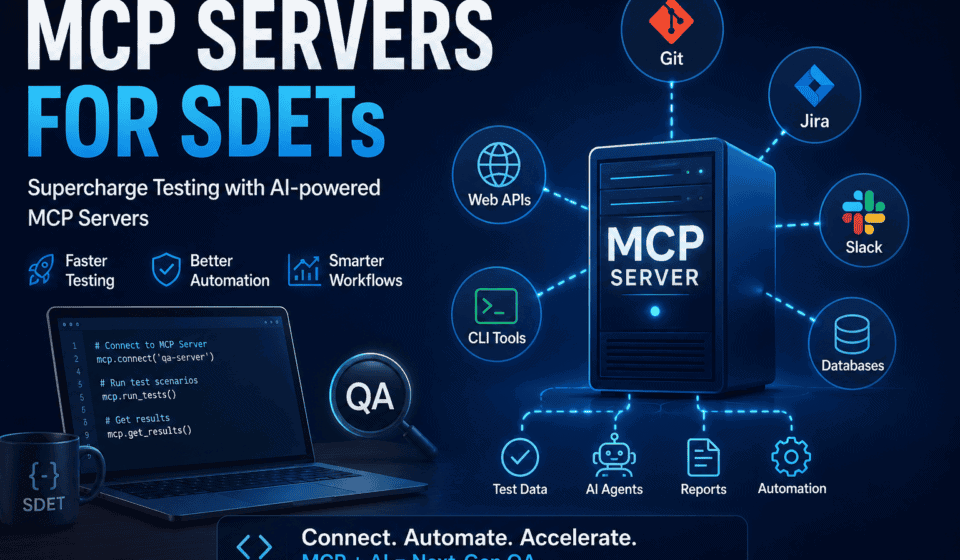
 Figure 1: How MCP Servers for SDETs fit together — an AI host connects through a client to an MCP server, which exposes Tools, Resources, and Prompts backed by your existing test infrastructure, with a human SDET reviewing and approving any consequential action.
Part 1: MCP Servers for SDETs — A First-Principles Explanation
1.1 The One-Sentence Definition
An MCP server is a small, well-defined program that exposes a set of capabilities — actions, data, and instructions — to an AI model or AI agent using a standardized protocol called the Model Context Protocol (MCP), so that the agent can reliably discover what it can do and safely do it, without a human writing custom glue code for every single integration.
That is the whole idea. Everything else in this guide is elaboration on that one sentence, and everything an SDET does with MCP is an application of that one idea to the specific problem of testing software.
1.2 Where MCP Came From
The Model Context Protocol was released as an open standard by Anthropic in November 2024, and it solved a problem that had been quietly getting worse for two years: every AI application that wanted to interact with an external tool — a database, a file system, a ticketing system, a browser — had to implement a bespoke integration. If you wanted your AI coding assistant to read files, you wrote a file-reading integration. If you wanted it to query Jira, you wrote a Jira integration. If you wanted it to run tests, you wrote a test-running integration. Multiply that by every tool, every AI application, and every vendor, and you get an M×N integration problem: M different AI applications each needing custom code to talk to N different tools, for a combinatorial explosion of glue code that nobody wanted to write twice.
MCP solved this the same way USB-C solved the problem of every device having its own proprietary charging cable, or the way HTTP solved the problem of every website needing its own network protocol. Instead of M×N custom integrations, MCP proposes a single standard interface: any tool that “speaks MCP” can be used by any AI application that “speaks MCP,” with no custom glue code required. A tool vendor builds one MCP server. Every MCP-compatible AI client — Claude, ChatGPT, GitHub Copilot, Cursor, Windsurf, and dozens of others — can use it immediately.
By 2026, this idea had moved from clever proposal to production infrastructure. Industry trackers now count more than five thousand publicly available MCP servers, spanning everything from filesystem access and GitHub integration to Slack, databases, CRMs, browser automation, and — critically for this guide — testing tools. Every major AI coding assistant now supports MCP natively, and the protocol has undergone multiple specification revisions to make it production-grade, including a major 2026 update that reworked the transport layer to be stateless and horizontally scalable, which we will cover in detail in Part 3.
It’s worth being precise about what MCP is not. MCP is not a testing tool. It is not a test framework. It is not a replacement for Playwright, Selenium, or your CI system. It is a protocol — a set of rules for how an AI agent and an external system talk to each other. The value for SDETs comes from what gets built on top of that protocol: MCP servers that wrap testing tools, test data sources, defect trackers, and CI pipelines in a way an AI agent can discover and use safely.
1.3 Why the Name “MCP Server” Specifically Matters to SDETs
Every SDET already understands the value of standard interfaces. It is the entire philosophy behind the Page Object Model, behind API contract testing, behind the WebDriver protocol itself. WebDriver succeeded because it gave every browser vendor a single, standard way to expose “click this element” and “read this text” to any test framework, instead of every framework writing custom code for every browser. MCP is doing the identical thing, one layer up the stack: it gives every tool a single, standard way to expose its capabilities to any AI agent, instead of every AI vendor writing custom code for every tool.
If that WebDriver analogy resonates, you already understand 80% of why MCP Servers for SDETs matters. The remaining 20% is the specific mechanics of tools, resources, and prompts, which we cover next.
1.4 The Three Building Blocks: Tools, Resources, and Prompts
Every MCP server exposes some combination of three primitive types. Understanding these three primitives is the single most important technical concept in this entire guide, because every SDET use case later in this article is, underneath, just one of these three things.
Tools are executable actions. A tool is something the AI agent can call to make something happen in the real world — run a test suite, click a button in a browser, query a database, create a Jira ticket, restart a test environment. Tools are the “verbs” of MCP. Each tool has a name, a natural-language description (which the AI model reads to decide when and how to use it), and a formally defined input schema (so the model knows exactly what arguments to supply and the server can validate them). When your AI agent decides to “run the regression suite,” it is invoking a tool.
Resources are read-only data. A resource is something the AI agent can read — a test report, a log file, a database schema, a requirements document, a screenshot from a failed test run. Resources are the “nouns” of MCP: static or semi-static context the model can pull into its reasoning without taking any action. When your AI agent reads the latest CI run’s JUnit XML output to understand which tests failed, it is reading a resource.
Prompts are reusable templates. A prompt is a pre-written, parameterized instruction that a human (or another part of the system) can invoke to kick off a specific, well-defined workflow — “generate a test plan for this user story,” “write a bug report from this stack trace,” “summarize today’s flaky test failures.” Prompts exist so that common, high-value workflows do not have to be re-invented as ad hoc free-text prompting every time; they can be packaged, versioned, and shared the same way you would package and share a reusable test utility function.
A single MCP server for testing might expose all three: a tool to execute a Playwright script, a resource exposing the latest test execution report, and a prompt template for “convert this manual test case into an automated test.” That combination — actions, data, and templated workflows, all discoverable through one standard interface — is what makes MCP powerful for test automation specifically, because testing as a discipline is fundamentally about combining exactly those three things: doing things (running tests), reading things (results, logs, requirements), and following repeatable procedures (test design patterns).
1.5 A Simple Mental Model: MCP as a “Universal USB Port” for AI Agents
If you need one image to carry through the rest of this guide, use this one: MCP is a universal port. On one side, you plug in an AI model or agent — the “MCP host” or “MCP client,” in protocol terms (Claude Desktop, Claude Code, Cursor, GitHub Copilot, a custom internal agent your platform team built). On the other side, you plug in a capability — an MCP server exposing a database, a browser, a test runner, a ticketing system. As long as both sides speak the same protocol, they connect and interoperate, without either side needing to know the internal implementation details of the other.
For an SDET, the “capability” side is the interesting one, because it is where your test infrastructure lives. Your Playwright test suite, your test data generator, your defect tracker, your test environment provisioner — each of these can become, or already has an existing, MCP server. Once it does, any MCP-compatible AI agent can discover what it can do and use it, whether that agent is a coding assistant helping a developer write a test, a QA copilot helping you triage a failure, or a fully autonomous testing agent running your smoke suite against a staging deployment every night.
Part 2: MCP Servers for SDETs — Architecture Deep Dive (Hosts, Clients, and Servers)
Understanding MCP Servers for SDETs at a level useful for real engineering decisions requires going one level deeper than the “universal port” analogy. MCP defines three architectural roles, and confusing them is the single most common source of misunderstanding in team discussions.
2.1 The Host
The host is the application the human actually uses — Claude Desktop, Claude Code, Cursor, VS Code with GitHub Copilot, a custom internal QA copilot, or any other AI-powered application. The host is responsible for managing the overall user experience: it holds the conversation, decides when to show the user a permission prompt, and orchestrates one or more MCP clients under the hood. When your QA lead opens Claude Code and asks it to “look at the failing tests from last night’s run and tell me if they’re a real regression,” Claude Code is acting as the host.
2.2 The Client
Inside the host, for every MCP server it connects to, there is a client — a component that maintains a single, dedicated one-to-one connection to that specific server. If your host is connected to a GitHub MCP server, a Playwright MCP server, and a Postgres MCP server simultaneously, it is running three separate client connections, one per server. The client handles the low-level protocol mechanics: sending requests, receiving responses, and negotiating capabilities during the initial handshake.
This one-to-one mapping matters practically for SDETs designing test infrastructure: you do not build one giant MCP server that does everything. You build focused, single-purpose servers — one for browser automation, one for test data, one for defect tracking — the same way you would not build one giant Selenium framework class that also handles database validation and Slack notifications. Composability is a design virtue in MCP just as it is in test architecture generally.
2.3 The Server
The server is the program exposing tools, resources, and prompts, as described in Part 1. Critically, an MCP server does not need to know anything about the AI model using it. It doesn’t call an LLM, it doesn’t reason, it doesn’t decide anything. It simply responds to requests: “here are my available tools,” “here is the result of calling this tool with these arguments,” “here is this resource’s content.” All of the reasoning about when and why to call a given tool happens in the host/model, not the server. This separation of concerns is deliberate and important: it means the same MCP test server can be used by a fully autonomous overnight regression agent, a human-supervised chat interface, or a CI pipeline script, because the server’s job is narrow and mechanical, while the “intelligence” lives entirely on the client side.
2.4 The Initialization Handshake (and Why It Changed in 2026)
When a client connects to a server, historically the two sides performed an initialize handshake: the client announced which protocol version and capabilities it supported, the server responded with its own capabilities and instructions, and the two sides pinned a session — identified by an Mcp-Session-Id header — for the duration of the interaction. This worked well for local, single-process servers (the most common deployment pattern in 2024–2025), but it created real friction for teams trying to run MCP servers as scaled, remote, multi-instance production services, because a session pinned to one server instance requires sticky routing or a shared session store at the load balancer — exactly the kind of operational complexity that a platform or DevOps engineer supporting your test infrastructure does not want to reinvent.
This friction is precisely why the 2026-07-28 MCP specification — released as a candidate in May 2026 and finalized on July 28, 2026 — represents the largest revision to the protocol since its original launch. The headline change is that MCP is now stateless at the protocol layer. The traditional initialize handshake and protocol-level session are removed; instead, client capabilities and session parameters are transmitted with each call. This trades a small increase in per-request payload size for a very large operational win: an MCP server can now be scaled horizontally behind a plain round-robin load balancer, with no sticky sessions and no shared session store, the same way you would scale any other stateless microservice in your test infrastructure.
For SDETs and the platform teams who support them, this is not an academic detail. It means that when your organization stands up an MCP-based test execution service — say, a server that fields requests to run Playwright suites against ephemeral environments — you can deploy it the same way you deploy any other stateless service in your Kubernetes cluster, autoscaling pods behind a standard load balancer, without needing to engineer session affinity. That is a meaningfully lower bar for production adoption than the pre-2026 protocol required.
2.5 Capability Negotiation
Alongside statelessness, the 2026 specification introduced several production-hardening features directly relevant to teams running MCP servers at scale for testing purposes:
- Mcp-Method and Mcp-Name headers on the Streamable HTTP transport, so load balancers, API gateways, and rate limiters can route and throttle traffic based on the operation being requested, without needing to inspect the request body. For a test-execution MCP server that might field thousands of “run this test” calls during a large regression cycle, this means your platform team’s existing rate-limiting and routing infrastructure works out of the box.
- Full JSON Schema 2020-12 validation for tool input schemas, giving stronger contract guarantees about what a tool accepts — directly analogous to the contract testing discipline SDETs already apply to REST and GraphQL APIs.
- Cache-control hints (
ttlMsandcacheScope) that let a server tell a client how long atools/listresponse can be cached, reducing redundant discovery calls — relevant for CI pipelines that spin up fresh MCP client sessions on every build and would otherwise re-negotiate capabilities every single run. - W3C Trace Context propagation for OpenTelemetry, meaning an MCP tool call inside a test run can now be correlated with the rest of your distributed tracing setup — a genuine win for SDETs debugging why an AI-orchestrated test run behaved unexpectedly, since you can now trace a failure across the AI agent’s tool call, the test execution, and the application under test in one trace.
- A modular extensions framework, with the first two official extensions being MCP Apps (sandboxed HTML-based user interfaces a server can render inside a host, useful for things like an interactive test-report dashboard rendered directly inside your AI coding assistant) and a stateless version of Tasks, for representing and tracking long-running operations — directly relevant to test automation, where a full regression run or a performance test can take minutes or hours, far longer than a single conversational turn.
- A formal deprecation policy and release cadence, addressing a criticism that had dogged MCP through 2025: without predictable versioning, teams were hesitant to build production infrastructure on a protocol that might introduce breaking changes without warning. The 2026 update establishes a conformance-testing and deprecation-timeline discipline more typical of mature infrastructure standards like HTTP or gRPC, which matters enormously to a QA manager deciding whether MCP is stable enough to build long-lived test infrastructure on top of.
Backward compatibility was preserved deliberately: a client that speaks the new 2026-07-28 revision will automatically fall back to the older initialize handshake when it connects to a server still running the 2025-11-25 specification or earlier, so an organization with a mix of newly built and legacy MCP servers does not face a forced-upgrade cliff.
Part 3: MCP Servers for SDETs — Technical Mechanics: Transports, JSON-RPC, and the Request Lifecycle
Understanding MCP Servers for SDETs at an implementation level means understanding what actually travels over the wire. This section is deliberately technical; if you are only interested in use cases, you can skip to Part 4, but SDETs designing or debugging an MCP-based test integration will want this grounding.
3.1 JSON-RPC 2.0 as the Wire Format
MCP is built on top of JSON-RPC 2.0, a lightweight remote procedure call protocol encoded in JSON. Every MCP message is a JSON-RPC request, response, or notification. A tool call, for instance, is a JSON-RPC request with a method of tools/call, params containing the tool name and arguments, and an id used to match the eventual response. This choice matters practically because JSON-RPC is simple enough that debugging an MCP integration is close to debugging a REST API call: you can log the request and response payloads, replay them, and diff them, using the same instincts and tools an SDET already applies to API testing. If you have ever used Postman or written a RestAssured test against a JSON API, you already have the muscle memory needed to read raw MCP traffic.
3.2 The Two (Soon Three) Transport Mechanisms
MCP defines transport layers — the actual communication channel a client and server use — separately from the protocol semantics layered on top. As of the 2026 specification, the main transports relevant to SDETs are:
stdio (Standard Input/Output): The simplest transport, used when the MCP server runs as a local subprocess on the same machine as the client. The client launches the server process and communicates over its stdin/stdout streams. This is the default for local development tools — a Playwright MCP server running on your laptop inside VS Code typically uses stdio. It has no network exposure at all, which makes it the lowest-risk transport from a security standpoint, but it also means the server’s lifecycle is tied to the client process; it cannot be shared across a team or scaled independently.
Streamable HTTP: The transport for remote, network-accessible MCP servers, supporting both simple request/response interactions and server-sent-event style streaming for long-running or incrementally-produced results. This is what a team would use to expose a shared, centrally hosted MCP test-execution server that an entire QA organization’s AI agents connect to, rather than every engineer running their own local copy. The 2026-07-28 specification’s statelessness changes apply specifically to this transport, since stdio’s local, single-process nature never had the scaling problem that motivated the redesign.
For SDETs, the practical decision of stdio versus Streamable HTTP maps almost exactly onto a decision you already make constantly: do you run your test framework locally on a developer’s machine, or do you run it centrally in a CI/CD or grid environment (think Selenium Grid, BrowserStack, or a Kubernetes-hosted Playwright runner)? The same tradeoffs — control and simplicity versus shared scale and centralized governance — apply directly to choosing an MCP transport for your test infrastructure.
3.3 The Request Lifecycle, Step by Step
Here is what actually happens, end to end, when an AI agent uses an MCP test server to, say, run a specific Playwright test:
- Connection. The client (inside your AI host, e.g., Claude Code) establishes a connection to the server, over stdio or Streamable HTTP.
- Capability negotiation. Under the pre-2026 model this was the
initializehandshake; under the 2026-07-28 stateless model, capabilities are declared with each relevant request instead of once up front. - Discovery. The client calls
tools/list(and, where relevant,resources/listandprompts/list) to learn what the server can do. The server responds with each tool’s name, description, and JSON Schema-defined input parameters. This is the step where the AI model “reads the manual” for what actions are available — the tool descriptions are literally fed into the model’s context so it can reason about which tool to use. - Model reasoning. The underlying AI model, having been given the user’s request (“run the login regression test and tell me if it still passes”) and the list of available tools, decides which tool to call and with what arguments. This is where the “intelligence” in the system lives — the MCP server itself has no opinion about when it should be invoked.
- Invocation. The client sends a
tools/callJSON-RPC request naming the specific tool (e.g.,run_playwright_test) and its arguments (e.g., the test file path and project name). - Execution. The server performs the actual work — in this example, shelling out to run
npx playwright test login.spec.ts, capturing stdout, exit code, and any generated artifacts like screenshots or trace files. - Response. The server returns a
tools/callresult to the client, containing the outcome (pass/fail, logs, links to artifacts). This can be plain text, structured JSON, or in newer implementations, richer content types including images. - Model synthesis. The AI model incorporates that tool result into its ongoing reasoning and either responds to the user directly (“the login test passed”) or chains into another tool call (for example, reading the trace file resource to investigate a failure in more detail).
Every one of the many SDET use cases described later in this guide — test generation, execution, defect triage, environment provisioning — is simply a specific instance of this eight-step lifecycle, with different tools, different arguments, and a different underlying testing technology doing the actual work in step 6.
3.4 Sampling and Elicitation: Human-in-the-Loop by Design
Two MCP primitives are worth calling out specifically because they are central to how MCP is meant to keep a human in control, which matters enormously in a testing context where an autonomous agent making an unreviewed destructive change (say, deleting test data or modifying a shared staging environment) can cause real damage.
Sampling allows an MCP server to request that the client’s AI model generate a completion on the server’s behalf — effectively, the server can ask the AI agent to “think about” something and return the answer, without the server needing its own model access or API keys. For a testing use case, imagine an MCP server that has gathered a stack trace from a failed test and a diff of the code that just changed; rather than running its own (separately-billed, separately-configured) LLM to summarize the likely root cause, it can use the sampling primitive to ask the host’s already-configured model to do that reasoning, keeping cost and configuration centralized on the client side. Because sampling routes a request back through the client, it also means a well-designed host can insert a human approval step before the sampled completion is used to take any consequential action.
Elicitation allows a server to ask the human user, via the client, for additional information mid-task — for instance, an MCP server managing test environment provisioning might elicit “which environment tier would you like: staging, pre-prod, or a fresh ephemeral namespace?” rather than guessing or failing outright. For SDETs, this primitive is what allows an MCP-based test tool to pause and ask a clarifying question instead of making an assumption that silently produces the wrong test run — directly analogous to a well-designed CLI tool prompting for missing required arguments instead of defaulting to something potentially unsafe.
Both primitives underscore a theme the MCP specification itself is explicit about, and which we return to at length in the security section of this guide: there should always be a human in the loop, with the ability to review, approve, or deny an agent’s proposed tool invocation, especially for anything destructive or hard to reverse. For a QA organization, this is not just a nice-to-have; it is the difference between “an AI agent helped write my test suite” and “an AI agent quietly deleted my test data because a tool description told it to.”
Part 4: MCP Servers for SDETs vs. REST APIs, Function Calling, and Legacy Plugins
Evaluating MCP Servers for SDETs fairly means being honest about what they don’t replace. A recurring, and fair, question from experienced SDETs is: “Isn’t this just an API? Why do we need a new protocol?” It’s worth answering this directly and honestly, because understanding what MCP does not replace is as important as understanding what it does.
4.1 MCP vs. Traditional REST/GraphQL APIs
Your REST and GraphQL APIs are not going anywhere, and MCP is not a general-purpose API standard intended to replace them. Traditional APIs are built for a known, fixed set of consumers — a web frontend, a mobile app, another backend service — that were coded against a specific, documented contract at build time. MCP exists for a different, and newer, problem: how does an AI agent, at run time, discover what capabilities are available and decide, based on natural-language reasoning, which ones to use and how? A REST API assumes the caller already knows exactly which endpoint to hit and what shape of payload to send, because a human developer read the documentation and wrote that logic in advance. MCP assumes the caller is a model reading a natural-language tool description at the moment of use and reasoning about it dynamically.
In practice, most MCP servers for testing do not reinvent your existing API layer — they wrap it. An MCP server that lets an AI agent run tests typically calls your existing Playwright, Selenium, or REST-based test execution infrastructure under the hood; it doesn’t replace that infrastructure, it exposes it through a standardized, AI-discoverable interface. For an SDET, this means your existing investment in a solid test framework and CI/CD pipeline is not obsolete — it becomes the “engine” that an MCP server sits in front of.
4.2 MCP vs. Native “Function Calling”
Before MCP, if you wanted an LLM to take an action (rather than just generate text), you used a vendor-specific feature usually called “function calling” or “tool use”: you described your available functions, in that specific vendor’s API format, in every single request, and the model would return a structured request to call one of them. This worked, but every vendor had subtly different formats, and every application that wanted to expose the same function to multiple different AI providers had to reimplement and maintain that description for each one. MCP standardizes this: you define your tools once, in the MCP format, and any MCP-compatible client — regardless of which underlying model it uses — can consume them. Function calling is the underlying mechanism the model uses to decide to invoke a tool; MCP is the standardized transport and discovery layer that makes that mechanism portable across vendors and applications. For a QA organization that does not want to lock its entire AI-testing strategy to a single AI vendor’s proprietary integration format, this portability is a genuinely material advantage.
4.3 MCP vs. Browser Extensions and IDE Plugins
Before MCP, if you wanted your AI coding assistant to control a browser for you, someone had to build a bespoke plugin specific to that one assistant — a Copilot extension here, a Cursor-specific integration there, each maintained separately, each with its own bugs, each unable to be reused by a different tool. This is precisely the M×N integration problem described in Part 1. The Playwright MCP server, the most widely adopted MCP server in the testing space as of 2026, solves this by wrapping Playwright’s own browser automation capabilities in a single MCP interface that works identically whether the calling AI host is Claude Code, GitHub Copilot, Cursor, Windsurf, or any other MCP-compatible tool. One server, built once by the Playwright team, usable everywhere — instead of a fragmented ecosystem of assistant-specific browser plugins that each need independent maintenance.
4.4 MCP vs. Agent-to-Agent Protocols (A2A)
It’s worth briefly distinguishing MCP from Google’s Agent2Agent (A2A) protocol, since the two are sometimes confused. MCP connects an AI agent to tools and data sources — it is about giving one agent capabilities. A2A connects agents to other agents, enabling multi-agent collaboration and delegation. The two protocols are complementary, not competing: a testing organization might use MCP to give a single QA agent access to Playwright, a defect tracker, and a test data generator, while using A2A (or a similar multi-agent orchestration layer) to coordinate that QA agent with a separate deployment agent and a separate release-notes agent. For the vast majority of SDET use cases in this guide, MCP alone is the relevant piece; A2A becomes relevant only once an organization is orchestrating multiple distinct autonomous agents that need to hand work off to one another.
4.5 The Bottom Line for SDETs
MCP does not replace your test framework, your CI system, your API contracts, or your defect tracker. What it replaces is the bespoke, one-off integration code that would otherwise be required every time you want an AI agent to use one of those things. That is a meaningfully narrower — and more honest — claim than “AI is going to replace test automation,” and it’s the correct frame for evaluating MCP Servers for SDETs: not as a replacement for testing discipline, but as a standardized on-ramp that lets AI agents participate in your existing testing discipline without you writing custom integration code for every tool, every time.
Part 5: Why Every SDET Should Care About MCP Servers for SDETs in 2026
By now the mechanics should be clear. This section makes the case — plainly, and without hype — for why MCP Servers for SDETs is not just an interesting technical curiosity but a shift that changes the day-to-day economics and shape of the testing role itself.
5.1 The Job Is Changing From “Writing Test Steps” to “Directing Test Agents”
For the last decade, a large share of an SDET’s time has gone into the mechanical labor of test automation: writing locators, wiring up page objects, handling waits and retries, managing test data setup and teardown, and maintaining brittle scripts as the application under test evolves. MCP-connected AI agents — most visibly through tools like the Playwright MCP server — take a meaningful bite out of that mechanical labor. An agent connected to a browser via MCP can inspect the live DOM, identify elements using accessibility attributes, and propose a working automation script for a UI flow directly from a natural-language description of the scenario, often producing locators that follow the same best-practice patterns (role- and text-based selectors over brittle CSS/XPath) that a senior SDET would use by hand.
This does not eliminate the SDET role; it relocates the value. The scarce, valuable skill is no longer “can you write a Selenium script that clicks this button” — it is “can you design the right test strategy, spot the edge case the AI missed, judge whether generated assertions are actually meaningful, and architect the MCP-based infrastructure that makes all of this safe, fast, and trustworthy at scale.” That is a more senior, more architecturally-minded version of the SDET job, and it is exactly the kind of work a QA manager wants to see their team spending time on instead of hand-writing repetitive boilerplate.
5.2 It Changes Who Can Contribute to Automation
Because MCP-connected agents can translate a plain-language manual test case into a working automated script, teams are seeing manual testers and business analysts — people who understand user scenarios deeply but have never written code — begin contributing directly to automation backlogs for the first time. This does not mean these contributions are production-ready without review (they typically are not, and we cover why in Part 12), but it does mean the bottleneck of “we don’t have enough SDETs to automate everything the manual testers know” is loosening in a way that changes team composition and capacity planning.
5.3 Standardization Reduces Tool Fragmentation Across a QA Organization
Most QA organizations run a patchwork of tools: a UI automation framework, an API testing tool, a test management system, a defect tracker, a CI system, possibly a separate performance testing tool and a separate security scanning tool. Historically, “connecting AI” to any one of these meant a bespoke integration project. With MCP, each of these tools increasingly either already has, or can be given, a standard MCP server, meaning a single AI agent — and a single conversational interface — can reach across your entire toolchain: reading a Jira ticket, generating a test plan, running the automated suite, checking the results against a database, and filing a defect, all through one consistent interface instead of five different bespoke scripts or manual hand-offs between tools.
5.4 It Shifts Testing Earlier and Makes “Shift Left” More Achievable in Practice
“Shift left” — testing earlier in the development lifecycle — has been a QA aspiration for years, frequently undermined by the practical reality that developers do not have time to write thorough tests and QA is not looped in early enough to help. An MCP-connected coding assistant that can, mid-development, generate and run relevant tests against the code a developer just wrote (using the same MCP test-execution tools an SDET built for CI) meaningfully lowers the friction of testing at the point of authorship rather than after the fact. This does not replace a dedicated SDET’s judgment about test strategy, but it does mean more tests get written and run earlier, by more people, than before.
5.5 The Competitive and Career Reality
Job postings for SDET roles in 2026 increasingly reference AI-assisted or “agentic” testing experience explicitly, alongside the traditional Selenium/Playwright/API-testing skill list. Whether or not an individual QA organization has formally adopted MCP yet, the direction of the market is unambiguous: understanding MCP Servers for SDETs, being able to evaluate an MCP-based testing tool critically, and being able to build a simple custom MCP server for an internal testing need are becoming differentiating skills on a resume in the same way “cloud-native CI/CD experience” became differentiating a few years earlier. This guide’s later section on the specific skills SDETs need to build (Part 14) addresses this directly.
5.6 Where the Skepticism Is Warranted
None of the above should be read as “adopt MCP everywhere immediately.” A responsible QA manager should be skeptical of vendor claims that AI agents can “fully automate testing,” should demand evidence that AI-generated tests catch real regressions rather than just passing trivially, and should insist on human review gates for anything AI-generated before it enters a production test suite. The rest of this guide is built to support exactly that kind of disciplined, evidence-based adoption — not blind enthusiasm.
Part 6: MCP Servers for SDETs — The Complete Use-Case Catalogue
This is the practical core of this guide. Each of the following subsections describes a distinct, concrete way MCP Servers for SDETs are being applied in 2026, what the underlying tools/resources/prompts typically look like, and what an SDET should watch out for in each case.
6.1 Test Case Generation from Requirements and User Stories
One of the clearest entry points into MCP Servers for SDETs is requirements-driven test generation. An MCP server connected to your requirements source — a Jira MCP server, a Confluence MCP server, or a simple filesystem MCP server pointed at a requirements repository — can expose the content of user stories and acceptance criteria as resources. An AI agent can read a story’s acceptance criteria and, using a prompt template like “generate a test case matrix for this story,” produce a structured set of positive, negative, and boundary test cases mapped to each criterion. For an SDET, the value here is speed of first draft, not final output: a matrix generated this way still needs a human to check for domain-specific edge cases, verify the criteria were actually understood correctly (LLMs can misread ambiguous acceptance criteria just as easily as a rushed human can), and confirm the generated cases align with your organization’s actual risk priorities.
6.2 Converting Manual Test Cases into Automated Scripts
This is, as of mid-2026, probably the single most mature and widely used application of MCP Servers for SDETs, driven primarily by the Playwright MCP server. A tester describes an existing manual test case — in plain language, or by pasting the steps from a test management tool — and an AI agent connected via Playwright MCP opens a real browser, navigates the described flow, inspects the live DOM through accessibility-tree analysis, and generates working Playwright test code using stable, best-practice locators. Early adopters report this working especially well for simple, deterministic UI flows: login forms, navigation paths, straightforward form submissions. It works considerably less well, and requires much heavier human revision, for complex conditional flows, visually-driven interactions (drag-and-drop, canvas-based UI), or scenarios requiring nuanced assertions about business logic rather than simple “did the page navigate correctly” checks. The realistic framing for a QA manager: this is a first-draft generator that turns a multi-hour manual-to-automated conversion task into a much shorter review-and-refine task — a meaningful productivity gain, not a replacement for an SDET’s judgment on assertions and edge cases.
6.3 Exploratory and Autonomous UI Testing
Beyond converting known manual cases, an MCP-connected browser agent can be pointed at an application with an open-ended instruction — “explore the checkout flow and report anything that seems broken or confusing” — and will click through the interface autonomously, similar to how a human exploratory tester works, but at machine speed and without fatigue. This surfaces a genuinely different class of finding than scripted regression testing: usability friction, unexpected error states, and edge cases nobody thought to script explicitly. It is not a replacement for structured exploratory testing charters designed by an experienced tester, but it is a useful force-multiplier for the “let’s just poke at this for twenty minutes before the release” activity every QA team already does informally.
6.4 API Testing and Contract Validation
MCP servers can expose HTTP request capabilities as tools, letting an AI agent construct and send API requests, inspect responses, and validate them against expectations — directly analogous to what an SDET does manually in Postman or programmatically in RestAssured or Supertest. A particularly useful pattern that has emerged is combined UI-plus-API validation in a single agent session: the agent performs a UI action (say, submitting a form), then immediately makes the corresponding API call to verify the backend state actually changed as expected, surfacing before-and-after values for PUT/PATCH operations automatically. This collapses what used to require juggling two separate tools and manually cross-referencing state into one continuous, traceable interaction. It’s worth being precise about where this genuinely helps and where it doesn’t: it is well suited to functional endpoint testing and chained UI-plus-API validation of the kind a smoke test or sanity check performs; it is explicitly not a substitute for dedicated load and performance testing platforms, which require purpose-built tools for volume and concurrency scenarios that an MCP-connected conversational agent is not designed to generate.
6.5 Test Data Generation and Management
An MCP server can expose tools for generating synthetic test data (valid and invalid inputs, boundary values, realistic-looking but non-production personal data for privacy-safe testing) and resources describing your data schemas, so an agent can generate data that actually conforms to your application’s constraints rather than generic placeholder values. This is particularly valuable for negative and boundary testing, where an AI agent’s ability to systematically enumerate edge cases (empty strings, maximum-length inputs, unicode edge cases, off-by-one boundary values, malformed but plausible-looking data) can be more exhaustive than a human remembering to think of all of them under deadline pressure. The caution here: synthetic test data touching anything resembling production schemas or production-adjacent data must be handled with the same data-governance discipline your organization already applies to test environments generally — MCP does not change your compliance obligations.
6.6 Database State Validation
A database-connected MCP server (Postgres, MySQL, MongoDB, and similar servers are widely available) exposes your schema as a resource and query execution as a tool, letting an AI agent validate that a test action produced the correct downstream database state — for example, confirming that submitting an order actually created the expected row with the expected foreign keys and status, not just that the UI displayed a success message. This is squarely in the wheelhouse of what SDETs already do with direct database assertions in their test frameworks; MCP’s contribution is making that validation accessible conversationally and combinable with UI and API validation in the same agent session, rather than requiring a separate script. As with any tool that can execute arbitrary queries against a database, this absolutely requires read-only credentials and strict scoping in any environment beyond an isolated, disposable test database — a point we return to at length in the security section.
6.7 CI/CD Pipeline Integration and Build Triage
MCP servers connected to your CI system (Jenkins, GitHub Actions, GitLab CI, CircleCI) can expose build status, test results, and logs as resources, and pipeline actions (re-run a job, cancel a build, trigger a deploy) as tools. This lets an AI agent — or a human SDET working through an agent — quickly answer “why did last night’s build fail,” by pulling the failing test’s logs, the relevant stack trace, and the code diff that landed just before the failure, and synthesizing a likely root cause, dramatically shortening the time between “build went red” and “someone understands why.” It also enables genuinely useful automation of the tedious parts of build triage: automatically categorizing a failure as “known flaky test,” “environment issue,” or “likely real regression” based on historical failure patterns, before a human ever looks at it.
6.8 Test Report Analysis, Summarization, and Flaky Test Detection
Test reports — JUnit XML, Allure reports, custom dashboards — can be exposed as resources, and an AI agent can be asked to summarize a run in plain language for a stand-up (“3 new failures, 2 are the known payment-gateway flake, 1 looks like a genuine regression in the checkout flow introduced by yesterday’s PR”), or, more powerfully, to analyze historical run data over weeks or months to identify tests that fail intermittently without a clear code-change correlation — the classic signature of flakiness. Because an LLM can hold and reason over a large volume of historical run metadata in a way that’s tedious for a human to do by hand, flaky-test detection is turning out to be one of the higher-value, lower-risk applications of MCP-connected agents in QA organizations, since it is fundamentally a read-and-summarize task rather than a write-and-execute one.
6.9 Automated Defect Triage and Bug Report Generation
When a test fails, an MCP-connected agent with access to a defect tracker (Jira, Linear, GitHub Issues) can draft a well-formed bug report directly from the failure: reproducing steps derived from the test script, the actual stack trace, environment details, and even a suggested severity based on the affected functionality — all as a prompt-driven workflow (“file a bug from this failing test run”) backed by tools to create the ticket and resources exposing the relevant context. This does not remove the need for a human to confirm the bug is real (rather than a test issue) and to set priority in the context of the current release, but it removes a substantial amount of the manual transcription labor of writing up a clean, reproducible bug report by hand.
6.10 Test Environment Provisioning and Management
MCP servers wrapping infrastructure-as-code tools, Kubernetes, or internal environment-provisioning APIs can expose “spin up a fresh ephemeral test environment,” “reset this environment’s database to a known seed state,” or “tear down this environment” as tools. This lets an AI agent (or a human directing one) manage the entire lifecycle of a disposable test environment conversationally, which is especially valuable for teams running large numbers of short-lived environments for pull-request-level testing, where the provisioning/teardown overhead has historically required either a dedicated platform team’s tooling or manual DevOps intervention.
6.11 Visual Regression and Accessibility Testing
Browser-automation MCP servers can capture screenshots as part of a tool’s response, which an AI agent can then use as a resource for downstream reasoning — comparing a current screenshot against a baseline to flag visual regressions, or analyzing the accessibility tree of a page to flag missing ARIA labels, poor color contrast, or improper heading structure. This is a genuinely strong fit for AI-assisted testing because vision-capable models are well suited to exactly this kind of “does this look right, and is it usable” judgment, which is qualitatively different from — and complements rather than replaces — pixel-diffing visual regression tools like Percy or Applitools, which remain better suited to precise, automated pixel-level comparison at scale.
6.12 Performance and Load Testing Orchestration
While MCP-connected conversational agents are explicitly not the right tool for generating raw load volume (as noted in 6.4, dedicated load-testing platforms remain the correct tool for that job), MCP servers wrapping tools like k6, Gatling, or JMeter can expose “kick off this load test profile,” “fetch the latest performance test results,” and “compare this run’s p95 latency against the baseline” as tools and resources, letting an agent orchestrate and interpret performance testing runs conversationally even though the actual load generation still happens in the purpose-built tool underneath.
6.13 Security and Vulnerability Scanning Integration
MCP servers wrapping SAST/DAST tools, dependency-vulnerability scanners, or internal security-testing platforms let an AI agent trigger a scan against a build artifact or running test environment and summarize the findings in the context of a specific release, helping QA and security teams triage which findings are genuinely blocking versus which are low-priority technical debt — again, a read-and-summarize-plus-trigger pattern rather than the agent performing novel security testing techniques itself.
6.14 Cross-Tool Orchestration for End-to-End Release Validation
The most ambitious, and most powerful, pattern combines several of the above into a single agent-directed workflow: read the release’s Jira tickets (resource), generate a test plan (prompt), run the relevant automated suite (tool), validate resulting database state (tool), check for visual regressions (tool), summarize results (resource read + synthesis), and file bugs for any failures (tool) — all in one continuous, auditable conversation, rather than a human manually stitching together the outputs of five separate tools. This is where the real productivity case for MCP Servers for SDETs becomes most visible, and also exactly where the security and governance discipline covered in Part 10 matters most, since a single agent session now has broad, cross-system reach.
Part 7: MCP Servers for SDETs — A Hands-On Tutorial for Building Your Own Server
Building your own MCP Servers for SDETs from scratch is the fastest way to move past theory. This section is a practical, step-by-step walkthrough for an SDET who wants to build a first, custom MCP server exposing test-execution capabilities. We’ll use the Python SDK, since it is one of the two Tier 1 SDKs (alongside TypeScript) leading the 2026 spec updates, but the same concepts apply directly to the TypeScript, Go, or C# SDKs.
7.1 Prerequisites
- Python 3.10+ installed
- The official MCP Python SDK (
pip install mcp) - An existing test suite you want to expose — this tutorial assumes a Pytest-based suite, but the pattern generalizes to Playwright, Selenium, or any CLI-driven test runner
- The MCP Inspector (
npx @modelcontextprotocol/inspector) for debugging your server independently of any AI model, which lets you list tools and manually test invocations by inspecting the raw JSON-RPC traffic
7.2 Designing Your Tool Surface Before Writing Code
Before writing a line of code, do the same design exercise you would do for any new automation utility: decide what capabilities you actually want to expose, and write down their names, descriptions, and inputs. A minimal, well-scoped first server for a test suite might expose exactly three tools:
list_test_suites— returns the available test suites/tags without arguments (a discovery tool)run_tests— accepts a suite name or tag filter and executes the corresponding tests, returning pass/fail counts and failure detailsget_last_run_report— returns the most recent test run’s full report as a resource
Notice this mirrors exactly how you would scope a well-designed internal API: small, focused, single-responsibility operations rather than one giant “do everything” endpoint. The same “single responsibility” principle that makes a good page object or a good API client makes a good MCP tool.
7.3 A Minimal Working Server
from mcp.server.fastmcp import FastMCP
import subprocess
import json

mcp = FastMCP("pytest-runner")

@mcp.tool()
def list_test_suites() -> str:
    """List available Pytest markers/suites configured in this project."""
    result = subprocess.run(
        ["pytest", "--markers"],
        capture_output=True, text=True, timeout=30
    )
    return result.stdout

@mcp.tool()
def run_tests(marker: str = "", test_path: str = "tests/") -> str:
    """
    Run the Pytest suite, optionally filtered by a marker expression.
    Returns a JSON summary of pass/fail counts and failure details.
    Only runs tests inside the configured test_path; does not accept
    arbitrary shell input.
    """
    cmd = ["pytest", test_path, "--json-report", "--json-report-file=report.json"]
    if marker:
        cmd += ["-m", marker]

    subprocess.run(cmd, capture_output=True, text=True, timeout=600)

    with open("report.json") as f:
        report = json.load(f)

    summary = {
        "passed": report["summary"].get("passed", 0),
        "failed": report["summary"].get("failed", 0),
        "duration": report["duration"],
        "failures": [
            {"nodeid": t["nodeid"], "message": t.get("call", {}).get("longrepr", "")}
            for t in report["tests"] if t["outcome"] == "failed"
        ],
    }
    return json.dumps(summary, indent=2)

@mcp.resource("report://last-run")
def get_last_run_report() -> str:
    """Expose the most recent JSON test report as a readable resource."""
    with open("report.json") as f:
        return f.read()

if __name__ == "__main__":
    mcp.run(transport="stdio")
A few details in this example are deliberate and worth pointing out, because they reflect the security and reliability discipline any production SDET-built MCP server needs, not just a toy demo:
- Explicit, bounded arguments instead of a raw shell string. The
run_teststool accepts amarkerandtest_path, not a free-form command string an agent could use to inject arbitrary shell commands. This is the MCP-server equivalent of parameterized SQL queries versus string concatenation — never let an AI-supplied argument become part of a shell command without strict validation. - Timeouts on every subprocess call. An autonomous agent invoking your tool should never be able to hang your test runner indefinitely; a bounded timeout is non-negotiable in a production tool.
- Docstrings as the tool’s description. The AI model reads the function’s docstring, not your internal code comments, to decide when and how to use the tool — treat these descriptions with the same care you would give to naming a well-designed public API endpoint, because a vague or misleading description leads directly to a model calling the wrong tool at the wrong time.
- A dedicated resource for the report, separate from the tool’s direct response, so an agent (or a human, via the MCP Inspector) can re-read the full report later in a session without re-running the tests.
7.4 Testing Your Server Independently, Before Any AI Model Touches It
This is the step SDETs are best positioned to appreciate, because it is exactly the “test the tool before you trust it” instinct that defines the discipline. Run:
npx @modelcontextprotocol/inspector python your_server.py
The Inspector opens a browser UI where you can see the exact list of tools your server advertises (verify the descriptions read the way you intended), manually invoke run_tests with test arguments, and inspect the raw JSON-RPC request and response — without any LLM in the loop at all. Treat this exactly like a unit test for your MCP server: confirm each tool behaves correctly, handles bad input gracefully, and returns well-structured output, before you ever connect a real AI agent to it. A server whose tools throw unhandled exceptions on bad input, or whose descriptions are ambiguous, will produce unreliable agent behavior no matter how capable the underlying model is — garbage in, garbage out applies here exactly as it does everywhere else in software.
7.5 Connecting Your Server to a Real MCP Host
Once validated, wiring the server into an MCP-compatible host is typically a small JSON configuration change. For example, in a host that reads a mcp.json/settings.json configuration:
{
  "mcpServers": {
    "pytest-runner": {
      "command": "python",
      "args": ["/path/to/your_server.py"]
    }
  }
}
From this point on, any conversation in that host can ask the connected agent to “run the smoke tests” or “show me the last run’s failures,” and the agent will discover and invoke your tools directly.
7.6 Iterating: Adding Guardrails as You Scale Up
As you move this pattern from a personal experiment to shared team infrastructure, layer in the production hardening covered throughout this guide: move from stdio to Streamable HTTP if the server needs to be shared across a team rather than run locally; add authentication and least-privilege scoping (Part 10); add human-approval gates for any tool capable of destructive action, like a hypothetical reset_environment tool; add structured logging and OpenTelemetry tracing so a failed or unexpected agent-driven test run can be audited after the fact, the same way you would want an audit trail for any automated system with write access to shared infrastructure; and version your tool descriptions carefully, since a tool description change can silently change agent behavior across every workflow that depends on it — exactly the kind of “hidden coupling” risk an experienced SDET already knows to watch for in shared test utilities.
Part 8: MCP Servers for SDETs — The Existing Ecosystem Relevant to QA Teams
You do not need to build every one of your MCP Servers for SDETs from scratch. By mid-2026, the public MCP ecosystem has grown past five thousand servers, and a meaningful subset is directly useful to a QA organization either as-is or as a foundation to extend. This section surveys the categories worth knowing.
8.1 Browser Automation Servers
The Playwright MCP server, maintained by the Playwright team itself, is the most mature and widely adopted server in this category. It exposes browser navigation, element interaction, accessibility-tree inspection, screenshot capture, and script generation as tools, and is what powers most of the “convert this manual test into an automated script” and “explore this flow” workflows described in Part 6. A comparable Puppeteer MCP server exists for teams standardized on Puppeteer rather than Playwright. Both are typically run locally via stdio during development, though centrally-hosted variants exist for shared team use. If your organization also maintains its own internal Playwright automation standards guide or CI/CD pipeline documentation, this is a natural place to cross-link to that content for readers who want your team’s specific implementation details. (Replace the two placeholder links above with the actual URLs of your related posts.)
8.2 Version Control and Source Servers
A GitHub MCP server (and equivalent servers for GitLab and Bitbucket) exposes repository contents, pull requests, commit history, and CI status as resources, and actions like commenting on a PR or creating an issue as tools. For SDETs, this is frequently the server that supplies the “what changed” context an agent needs to correlate a new test failure with the specific code change that likely caused it.
8.3 Filesystem Servers
A simple but foundational filesystem MCP server exposes read/write access to a specified, sandboxed directory — useful for letting an agent read your test suite’s source files, requirements documents, or configuration, and write generated test files back to disk. Because this server can write files, scoping its allowed directory tightly is one of the most basic and most important security controls covered in Part 10.
8.4 Database Servers
Officially supported and community-maintained MCP servers exist for Postgres, MySQL, SQLite, MongoDB, and most major database engines, exposing schema introspection as a resource and query execution as a tool — directly supporting the database-state-validation use case from section 6.6. Nearly every serious deployment guide for these servers recommends read-only database credentials by default, with write access granted only in tightly scoped, disposable test environments.
8.5 Issue Tracker and Project Management Servers
Jira, Linear, Asana, and GitHub Issues each have MCP servers exposing ticket content as resources and ticket creation/updates as tools, directly supporting the requirements-driven test generation (6.1) and automated bug filing (6.9) use cases.
8.6 Communication and Notification Servers
A Slack (or Microsoft Teams) MCP server lets an agent post a test summary to a channel as a tool call, closing the loop on workflows like “run the nightly regression, summarize the results, and post them to #qa-alerts” without a human manually copying and pasting a report.
8.7 Cloud and Infrastructure Servers
Cloud-vendor MCP servers (including officially documented enterprise reference implementations, such as Microsoft’s Azure-hosted MCP server offerings) expose infrastructure provisioning and management actions, supporting the ephemeral test-environment lifecycle use case from section 6.10.
8.8 Vendor-Specific QA Platform Servers
A growing number of dedicated test management and QA platforms have shipped their own MCP servers, allowing an agent to read test case libraries, update test run statuses, and pull historical execution data directly from the platform your organization already uses for test case management, rather than requiring a custom integration.
8.9 Evaluating a Third-Party MCP Server Before Adoption
Before connecting any third-party MCP server — whether from a well-known vendor or an open-source community project — to a system with real credentials or real test data, a disciplined QA organization should apply the same due-diligence checklist it would apply to any new dependency: Who maintains it, and how actively? Is the source available for review, or is it a closed binary? Does it request more permissions/scopes than its stated purpose requires? Has its tool descriptions or behavior changed unexpectedly between versions (a “rug pull,” discussed further in Part 10)? Is there a published security disclosure process? These questions matter more for MCP servers than for a typical library dependency, because an MCP server, by design, can be granted the ability to take real actions — running code, hitting your database, filing tickets — rather than simply executing inert logic inside your own process.
Part 9: MCP Servers for SDETs in CI/CD Pipelines — Practical Architecture Patterns
Deploying MCP Servers for SDETs inside a real release pipeline raises different questions than a local experiment does. A frequent question from QA managers and automation architects is how MCP actually fits into an existing CI/CD pipeline, rather than just an interactive chat session on a developer’s laptop. This section lays out the architecture patterns SDETs are using in production as of 2026.
9.1 Pattern One: MCP as a Local Development Accelerant, Not a Pipeline Component
The lowest-risk, most widely adopted pattern today does not put MCP in the CI pipeline at all. Instead, an MCP-connected AI agent (Claude Code, Cursor, GitHub Copilot) runs on a developer’s or SDET’s local machine during test authoring, generating and refining test scripts that are then committed to source control and executed by the existing, unchanged CI pipeline using the existing, unchanged test runner. In this pattern, MCP’s value is entirely upstream of CI: it speeds up how quickly a well-formed Playwright or Pytest script gets written, but the pipeline itself never talks to an MCP server or an AI model at runtime. This is the right starting point for most teams, because it captures a large share of the productivity benefit while introducing zero new runtime dependencies or security surface into the release pipeline itself.
9.2 Pattern Two: An MCP Server as a CI Pipeline Step
A more advanced pattern runs an MCP-connected agent as an explicit step inside the pipeline itself — for example, a post-failure step that, when tests fail, spins up an agent with access to a read-only MCP server exposing the failure logs, the relevant code diff, and historical flaky-test data, and produces a triage summary attached to the build result or posted to a chat channel. Because this step runs unattended, it should be scoped extremely narrowly: read-only access to logs and diffs, no ability to modify code, environments, or tickets without a subsequent human approval step. This pattern is well suited to the build-triage and flaky-test-detection use cases (6.7, 6.8), which are fundamentally about synthesis and summarization rather than taking consequential action.
9.3 Pattern Three: A Centrally-Hosted, Multi-Team MCP Test-Execution Service
The most architecturally ambitious pattern — and the one the 2026-07-28 specification’s statelessness changes were specifically designed to support — is a centrally hosted MCP server, deployed as a standard horizontally-scaled service behind a load balancer, that any team’s AI agents can connect to over Streamable HTTP to trigger test runs against shared or ephemeral infrastructure. This is directly analogous to how many organizations already run a centralized Selenium Grid or a shared BrowserStack/Sauce Labs account rather than every team maintaining its own browser farm; a centrally hosted MCP test-execution service applies that same “shared platform” model to AI-agent-triggered testing. Building this well requires the full production discipline covered in Parts 3 and 10: centralized authentication and authorization (ideally via the 2026 specification’s enterprise-managed authorization extension, which aligns MCP’s auth model more closely with existing OAuth/OIDC deployments your platform team likely already runs), rate limiting via the new Mcp-Method/Mcp-Name routing headers, distributed tracing via OpenTelemetry propagation, and audit logging of every tool invocation.
9.4 Handling Long-Running Test Runs: The Tasks Extension
A full regression suite or a performance test can run for minutes to hours — far longer than a single conversational turn is designed to span. The 2026 specification’s stateless Tasks extension exists specifically to represent and poll long-running operations without holding a connection open the entire time: an agent kicks off a test run, receives a task identifier, and polls (or is notified via a webhook-style callback, depending on implementation) for completion, rather than blocking. For SDETs designing an MCP-based test-execution service, modeling “run the full regression suite” as a Task rather than a single blocking tool call is the architecturally correct pattern, directly analogous to how a well-designed CI system already treats a long-running job asynchronously rather than blocking the triggering request.
9.5 Observability: Why Tracing Matters More Here Than in a Typical Pipeline Step
A traditional CI step is deterministic: given the same inputs, it does the same thing every time, and debugging a failure means reading a single, linear log. An AI-agent-driven pipeline step is not fully deterministic in the same way — the agent’s reasoning about which tools to call, in what order, and with what arguments can vary between runs even with an identical starting prompt. This makes the W3C Trace Context propagation introduced in the 2026 specification genuinely important rather than a nice-to-have: without a trace correlating the agent’s reasoning steps, the specific tool calls it made, and the underlying test execution’s own logs, debugging “why did the agent do that” after the fact becomes far harder than debugging a traditional, deterministic pipeline failure. Any team adopting Pattern Two or Pattern Three above should treat end-to-end tracing as a Day One requirement, not a later enhancement.
Part 10: MCP Servers for SDETs — Security Considerations Every QA Manager Must Understand
No honest guide to MCP Servers for SDETs can skip this section, and no QA organization should adopt MCP at any meaningful scale without internalizing it. Because MCP servers, by design, give an AI agent the ability to take real actions against real systems, they introduce a genuinely new category of risk alongside the productivity benefits. This section works through the specific threats and the concrete mitigations a QA organization should put in place.
10.1 Prompt Injection: The Core, Unsolved Risk
No discussion of MCP Servers for SDETs is complete without confronting this risk directly. The single most important thing to understand is that prompt injection remains, as of 2026, a fundamentally unsolved problem. As security researcher Simon Willison — who has tracked the issue since 2022 — has put it, the industry has known about prompt injection for two and a half years and still does not have convincing mitigations. The MCP specification itself acknowledges this directly, which is precisely why it insists there should always be a human in the loop for consequential actions.
In an MCP context, prompt injection typically arrives disguised as content the agent reads while performing an otherwise legitimate task: a malicious instruction hidden inside a test data file, a code comment, a bug report description, or even a web page the agent is asked to test, can be crafted to look like an instruction to the AI model rather than data, causing the agent to take an action the human never intended — for instance, exfiltrating data to an external endpoint disguised as a “test assertion.” For SDETs specifically, this risk is not hypothetical or exotic: any workflow where an agent reads content from an external, less-trusted source (a webpage under test, a third-party API response, an uploaded test fixture) as part of a testing task is a potential injection vector, because the entire point of testing is to interact with systems and data you do not fully control.
10.2 Tool Poisoning
A related, and increasingly well-documented, attack is tool poisoning: an attacker crafts or compromises an MCP tool’s metadata — its name, description, or parameter schema — to contain hidden instructions that look normal on visual inspection but cause the agent to take harmful action when it reads that description as part of its reasoning. Because tool descriptions live in a part of the AI’s context a user typically never inspects directly, this attack is structurally similar to indirect prompt injection, and the OWASP Top 10 for Agentic Applications (2026) classifies this class of risk under its “Agent Goal Hijack” category. The recommended defense is to validate tool descriptions against known-good baselines and detect anomalous changes, a discipline supported by open-source scanning tools like Invariant Labs’ mcp-scan, which specifically checks MCP server configurations for poisoned descriptions. Any QA organization registering third-party MCP servers for shared use should integrate a similar scanning step into that registration workflow, rather than trusting a server’s description at install time and never re-checking it.
10.3 “Rug Pull” / Bait-and-Switch Attacks
A closely related risk, sometimes called a rug pull or bait-and-switch attack, exploits the fact that MCP tool registrations are typically approved once by a human and then not continuously re-verified. A server can present entirely benign tool descriptions at registration time and then silently change its behavior — or its descriptions — in a later update, after trust has already been established. The mitigation is runtime re-validation, not just install-time approval: verify artifact integrity with cryptographic signatures on server binaries, pin exact versions in configuration rather than tracking “latest,” and alert automatically whenever a tool’s description changes between versions. Server trust, in short, is not a one-time decision; it needs to be treated the same way a security-conscious team treats a supply-chain dependency, with ongoing monitoring rather than a single approval gate.
10.4 Supply Chain Risk
Independent security research in 2026 (notably from Praetorian) has demonstrated real-world code execution, data theft, and response manipulation in MCP-connected environments, and found that these consequences frequently originate from configuration and setup failures rather than genuinely novel exploit techniques. In practical terms: most of the damage seen so far has come from teams standing up MCP servers with excessive permissions, weak sandboxing, or unvalidated third-party servers, not from some exotic zero-day in the protocol itself. This is, in a sense, reassuring — it means the mitigations are largely the same disciplined engineering practices SDETs already apply elsewhere (least privilege, sandboxing, input validation, dependency pinning) rather than requiring an entirely new security discipline invented from scratch.
10.5 Sandboxing Local Servers
Sandboxing is one of the most concrete, actionable controls available to teams running MCP Servers for SDETs. For any locally-run MCP server — the stdio-transport pattern most SDETs will encounter first — the concrete controls that matter are: restrict filesystem access to explicitly permitted directories rather than the entire filesystem; limit network egress from the server process; and require explicit user consent before any operating-system-level command executes, with the full command displayed to the user in unabridged form, never truncated, before approval. A server that can, in principle, read your entire home directory or make arbitrary outbound network calls because nobody scoped its permissions is a meaningfully larger risk than the same server correctly sandboxed to a single project directory with no outbound network access.
10.6 Hardening Remote Servers
For any remote, Streamable-HTTP-based MCP server — the pattern relevant to Pattern Three from Part 9 — the baseline controls include enforcing HTTPS for all OAuth-related URLs, blocking requests to private IP ranges and cloud metadata endpoints (a classic server-side request forgery, or SSRF, target — and one for which a real CVE, NVD CVE-2026-45609, documented an active SSRF failure in an MCP security framework prior to a patched version), and applying consistent URL validation to any redirect target the server might follow. These are, again, largely the same web-application security fundamentals your organization’s security team already enforces elsewhere; MCP does not require reinventing this discipline so much as applying it rigorously to a new class of service.
10.7 Least Privilege and Scoped Authorization
The 2026 specification’s introduction of incremental scope consent — letting a client request only the minimum access needed for a specific operation, rather than requesting all permissions up front — is a meaningful architectural improvement, but it only helps if the organization actually implements an authorization layer that understands tool-level semantics rather than just network-level routing. For an SDET-built or SDET-operated MCP server, the practical translation is: your database server should default to read-only credentials, your filesystem server should be scoped to a specific test-repository directory, and any tool capable of a destructive or hard-to-reverse action (deleting test data, resetting a shared environment, sending an external notification) should be explicitly annotated with a risk classification and gated behind a mandatory human-approval step, regardless of whether the calling agent is technically authorized to invoke it.
10.8 Mandatory Human Checkpoints for Destructive Operations
Several operations should, as a matter of policy rather than case-by-case judgment, always require explicit human approval before execution: database deletions or bulk modifications, resets of shared (non-ephemeral) test environments, any outbound communication to an external party, and any action affecting production or production-adjacent systems. Consent prompts for these operations should be time-bound and scoped to the specific operation being requested — not a blanket, session-wide approval — so that a single moment of user trust does not silently authorize an unrelated later action.
10.9 Runtime Visibility and Audit Logging
Every meaningful control described above — authentication, least-privilege scoping, input sanitization, human-approval gates — only functions as a real defense if the decisions it produces are logged, queryable, and reviewable after the fact. A QA organization operating any shared MCP test infrastructure should treat comprehensive audit logging of every tool invocation (who/what triggered it, what arguments were supplied, what the server did, what the outcome was) as a baseline requirement, not an optional enhancement — because runtime visibility is what makes every other control defensible when something eventually does go wrong, and something eventually will.
10.10 A Practical Security Checklist for SDETs Standing Up an MCP Test Server
- Scope filesystem and database access to the absolute minimum required for the tool’s stated purpose.
- Default database credentials to read-only; grant write access only in isolated, disposable test environments.
- Validate and bound all agent-supplied arguments before they touch a shell command, file path, or query.
- Set explicit timeouts on every long-running operation a tool triggers.
- Pin exact server versions in configuration; do not silently track “latest.”
- Scan tool descriptions for anomalies at registration and re-verify on every update.
- Require explicit, time-bound, operation-specific human approval for any destructive or hard-to-reverse tool.
- Log every tool invocation with enough detail to reconstruct what happened after the fact.
- Propagate distributed tracing (OpenTelemetry/W3C Trace Context) end to end so an unexpected agent action can be investigated.
- Treat every third-party MCP server as a supply-chain dependency requiring ongoing review, not a one-time install decision.
None of this is meant to discourage adoption — it is meant to make adoption survivable at scale. The organizations getting real, durable value out of MCP Servers for SDETs in 2026 are, almost without exception, the ones treating these controls as Day One requirements rather than retrofits applied after an incident.
Part 11: MCP Servers for SDETs vs. Traditional Test Automation — A Direct Comparison
The table below lays out how MCP Servers for SDETs stack up against the traditional scripted approach across the dimensions that matter most in practice.
| Dimension | Traditional Test Automation (Selenium/Playwright/RestAssured scripts) | MCP-Connected AI Agent Testing |
|---|---|---|
| Authoring speed | Slower first draft; every locator, wait, and assertion hand-written | Faster first draft, especially for simple, deterministic UI/API flows |
| Determinism | Fully deterministic; same script, same steps, every run | Not fully deterministic; agent reasoning can vary run to run even from an identical prompt |
| Maintenance under UI change | Brittle selectors break on markup changes; manual fixes required | Can sometimes self-heal locators via accessibility-tree analysis, but not reliably for complex flows |
| Suitability for regression suites | Excellent — the standard, proven approach for repeatable, auditable regression coverage | Weaker fit; better suited to smoke testing and exploratory coverage than deep regression suites |
| Suitability for exploratory testing | Requires a human tester’s time and attention | Strong fit — can explore autonomously at machine speed, surfacing unscripted edge cases |
| Cross-system orchestration (UI+API+DB+ticketing in one flow) | Requires custom glue code across multiple tools | Native strength — one agent session can span multiple MCP-connected systems |
| Auditability | High — version-controlled scripts, clear diffs | Requires deliberate logging/tracing investment; not automatic |
| Security surface | Limited to the test framework and its explicit dependencies | Broader — any tool the agent can reach is a potential blast radius; requires active governance |
| Skill required to operate | Programming/scripting proficiency in the framework’s language | Natural-language task framing, plus judgment to review AI-generated output critically |
| Cost model | Engineering time; infrastructure cost for execution (grids, CI runners) | Engineering time (reduced for authoring) plus AI model inference cost plus new governance overhead |
| Best current role | The backbone of deep, deterministic regression coverage | An accelerant for authoring, triage, exploratory testing, and cross-tool synthesis |
The honest takeaway for a QA manager: these are not competing approaches to be chosen between, but complementary layers. The mature pattern emerging across QA organizations in 2026 is to keep deterministic, version-controlled automation as the backbone of regression coverage, while layering MCP-connected AI agents on top for authoring speed, exploratory coverage, triage, and cross-system orchestration — exactly the framing several practitioners in the Playwright MCP ecosystem have converged on: MCP belongs at the top of the testing pyramid, not as a replacement for the base.
Part 12: MCP Servers for SDETs — Challenges and Limitations to Expect
No honest guide to MCP Servers for SDETs would skip the friction points teams actually hit in production.
12.1 Non-Determinism Undermines Trust in Generated Tests
The single biggest practical friction reported by early adopters is that AI-generated tests and AI-driven exploratory sessions are not fully reproducible. The same instruction given twice can produce a different sequence of tool calls, different locators, or a different depth of exploration. For a discipline built on the premise that a test should behave the same way every time it runs, this is a genuine, not merely cosmetic, mismatch, and it means AI-generated automation needs the same code review rigor — arguably more — than hand-written automation before it’s trusted in a release-gating regression suite.
12.2 Assertion Quality Is Frequently Shallow
A recurring finding from teams converting manual tests to automated scripts via AI agents is that the generated navigation and interaction steps are often solid, while the generated assertions are frequently superficial — confirming a page loaded or an element is visible, rather than verifying the actually meaningful business outcome a human tester had in mind. This is arguably the most important single thing for an SDET reviewing AI-generated tests to check: does the assertion actually validate what the original manual test case was trying to verify, or does it just confirm “something happened”?
12.3 Complex, Conditional, or Visually-Driven Flows Remain Difficult
Drag-and-drop interactions, canvas-based UIs, multi-step conditional flows with significant branching logic, and highly dynamic single-page applications remain considerably harder for an MCP-connected agent to reliably automate than simple, linear flows like login forms or basic navigation. Teams should calibrate expectations by flow complexity rather than assuming uniform capability across their entire application surface.
12.4 Cost and Latency at Scale
Every agent-driven test interaction incurs AI model inference cost and latency that a traditional scripted test does not. For a small number of authoring sessions or triage summaries, this is negligible; for an organization trying to run its entire regression suite through a conversational agent on every commit, the cost and latency profile is currently a poor fit compared to simply running the already-generated, deterministic script directly — reinforcing the “generate once with AI, then run deterministically forever after” pattern rather than “re-generate and re-reason on every run.”
12.5 Governance Overhead Is Real, Not Optional
As detailed extensively in Part 10, the security and governance work required to run MCP infrastructure safely at organizational scale is genuinely substantial — least-privilege scoping, audit logging, human-approval gates, ongoing third-party server review. Teams that skip this investment and treat MCP adoption as “just install the server and go” are the ones most likely to experience a real security incident, per the supply-chain research cited earlier, which found that most real-world MCP-related compromises stemmed from configuration and setup failures rather than novel exploits.
12.6 Skills and Change Management
Introducing AI-agent-assisted workflows into an established QA team requires genuine change management, not just tool rollout. Experienced SDETs may reasonably be skeptical of AI-generated code they did not write, and that skepticism is healthy and should be channeled into rigorous review processes rather than dismissed. Conversely, manual testers newly empowered to contribute to automation need support and guardrails to avoid producing automation that passes trivially without testing anything meaningful. Both groups need training, and neither transition happens automatically just because the tooling exists.
Part 13: Best Practices for Adopting MCP Servers for SDETs and QA Organizations
Adopting MCP Servers for SDETs well is mostly a matter of sequencing, not sophistication.
13.1 Start With Read-Only, Low-Risk Use Cases
The lowest-risk, highest-confidence entry point is a read-only, summarization-oriented use case: test report analysis, flaky-test detection, build-failure triage summaries. These build organizational trust and familiarity with the tooling without exposing any destructive capability, and they tend to show clear, measurable time savings quickly, which helps justify further investment.
13.2 Treat AI-Generated Tests as First Drafts, Not Final Output
Every AI-generated test — whether from a Playwright MCP conversion of a manual case or a fully autonomous exploratory session — should go through the same code review discipline as a human-written pull request: does it use stable locators, does it assert something meaningful, does it handle waits and timing correctly, does it avoid hard-coded test data that will break in a different environment. Skipping this review because “the AI wrote it” is precisely the failure mode that erodes trust in automation over time.
13.3 Keep Deterministic Regression Suites as the System of Record
As covered in Part 11, the mature pattern is to use AI agents to generate deterministic scripts that then run the same way every time in your existing CI pipeline, rather than re-invoking an agent’s non-deterministic reasoning on every single regression run. Your release-gating suite should remain the deterministic, version-controlled asset it has always needed to be.
13.4 Build (or Adopt) Servers With Narrow, Well-Described Tool Surfaces
Whether building your own MCP server or evaluating a third-party one, favor narrow, single-purpose tools with precise, unambiguous descriptions over broad, do-everything tools with vague descriptions. This is both a reliability best practice (a model reasons better about a small number of precisely-scoped tools) and a security best practice (a narrowly scoped tool has a smaller blast radius if misused).
13.5 Invest in Observability From Day One
Distributed tracing, structured audit logging, and clear dashboards showing what an agent did and why should not be an afterthought bolted on after the first confusing incident. Build them in from the very first production MCP server your team stands up.
13.6 Establish a Formal Third-Party Server Review Process
Do not let individual engineers connect arbitrary third-party MCP servers to systems containing real credentials or real data on an ad hoc basis. Stand up a lightweight but real review process — even a simple checklist covering maintainer reputation, source availability, requested permissions, and update history — before a new server is approved for team-wide use.
13.7 Calibrate Expectations by Flow Complexity
Communicate clearly to stakeholders (and to leadership asking “why isn’t everything automated by AI yet”) that simple, linear, deterministic flows are a strong current fit for AI-assisted automation, while complex, conditional, or highly visual flows still require substantial human authoring and review. Setting this expectation up front avoids the disappointment — and the resulting backlash against the whole initiative — that follows from over-promising uniform capability.
13.8 Measure What Actually Matters
Track metrics that reflect genuine quality improvement, not just activity: defect escape rate, mean time to triage a failing build, percentage of AI-generated tests that survive code review without major rework, and time from manual test case to working automation — rather than vanity metrics like “number of AI-generated tests,” which say nothing about whether those tests are any good.
Part 14: The Skills SDETs Need to Master MCP Servers for SDETs in 2026
Understanding MCP Servers for SDETs conceptually is the necessary first step; the following skills are what turn that understanding into practical, resume-relevant capability.
14.1 Protocol-Level Literacy
You do not need to memorize the JSON-RPC specification, but you should be comfortable reading raw MCP traffic in the Inspector, understanding the difference between a tool, a resource, and a prompt, and recognizing the transport (stdio vs. Streamable HTTP) a given server uses and why that choice was made.
14.2 Building and Debugging a Simple Custom MCP Server
The tutorial in Part 7 is a realistic bar: an SDET who can wrap an existing test suite in a minimal MCP server, validate it with the Inspector, and reason about its input validation and timeout handling has a genuinely differentiated, practical skill relative to one who has only used pre-built servers as a consumer.
14.3 Critical Review of AI-Generated Test Code
This is arguably the most transferable and durable skill in this entire list: the ability to look at an AI-generated Playwright script or a generated bug report and quickly assess whether the locators are stable, the assertions are meaningful, and the edge cases are actually covered — the same code-review judgment SDETs already apply to human-written pull requests, now applied at higher volume and often faster.
14.4 Security Threat Modeling for Agentic Systems
Familiarity with the specific failure modes covered in Part 10 — prompt injection, tool poisoning, rug-pull attacks, SSRF against remote servers — is becoming as relevant to a senior SDET or automation architect’s skill set as familiarity with OWASP’s traditional web application Top 10 has been for the last decade. The OWASP Top 10 for Agentic Applications, referenced earlier, is a worthwhile document to study directly.
14.5 Prompt and Task Design for Reliable Agent Behavior
Writing a clear, well-scoped instruction for an AI testing agent — specifying exactly what should be tested, what “done” looks like, and what should trigger a stop-and-ask-for-clarification rather than a guess — is a skill much closer to writing a good test case specification than to generic “prompt engineering,” and SDETs’ existing test-design instincts transfer directly here.
14.6 Observability and Distributed Tracing
Comfort reading an OpenTelemetry trace that spans an agent’s reasoning steps, its MCP tool calls, and the underlying test execution’s own logs is increasingly a practical requirement for debugging AI-driven test infrastructure, not just a “nice to have” platform-engineering skill.
14.7 Change Management and Stakeholder Communication
Being able to explain, to both skeptical senior engineers and overenthusiastic leadership, what MCP-connected AI testing genuinely can and cannot do — grounded in the honest limitations covered throughout this guide — is a soft skill that increasingly separates SDETs and QA managers who drive durable, trusted adoption from those whose initiatives stall out after an early overpromise leads to disappointment.
Part 15: The Future of MCP Servers for SDETs and AI-Driven Testing Beyond 2026
The trajectory of MCP Servers for SDETs over the next few years is already visible in the direction the protocol itself is heading.
15.1 Toward a Formal, Stable Infrastructure Standard
The 2026-07-28 specification’s introduction of a formal deprecation policy, conformance testing, and a predictable release cadence signals a project’s maturity — the same trajectory HTTP, gRPC, and other infrastructure protocols followed on their way from “promising new idea” to “boring, trusted plumbing.” For SDETs, this trajectory matters because it directly affects how much long-term engineering investment is rational to put into MCP-based test infrastructure: a protocol with formal stability guarantees is a safer foundation to build multi-year test infrastructure on than one that might introduce breaking changes without warning.
15.2 Multi-Round-Trip Requests and Richer Server-to-Client Interaction
New patterns introduced alongside the stateless core, such as Multi Round-Trip Requests (MRTR), open a wider range of possibilities for server-to-client interaction — for example, a test-execution server that can push incremental progress updates back to the client throughout a long regression run, rather than only returning a result at the very end, giving a human supervisor much better visibility into an in-progress agent-driven test session.
15.3 MCP Apps and Richer In-Context Test Dashboards
The MCP Apps extension — sandboxed, server-rendered HTML interfaces displayed directly inside an MCP host — points toward a near future where an SDET’s AI coding assistant can render an interactive test-report dashboard, a live regression-run progress view, or a visual diff comparison directly inside the same conversational interface used to trigger the test, rather than requiring a context switch to a separate test-management tool.
15.4 Convergence With Multi-Agent Orchestration
As organizations mature past single-agent MCP use cases toward coordinating multiple specialized agents (a dedicated test-generation agent, a dedicated triage agent, a dedicated environment-provisioning agent), expect growing convergence between MCP (which connects one agent to tools) and multi-agent coordination protocols like A2A (which connect agents to each other) — meaning the QA organizations furthest along this path in a few years will likely be running small teams of specialized, MCP-connected agents that hand work off to one another, supervised by a human SDET acting more like an engineering lead directing a team than an individual contributor writing every line of test code personally.
15.5 The Enduring Role of Human Judgment
Every credible technical source underpinning this guide — from the MCP specification’s own explicit insistence on human-in-the-loop design, to the practitioners candidly reporting the limits of AI-generated assertions and the non-determinism of agent behavior — converges on the same conclusion, which is the right note to end this forward-looking section on: MCP Servers for SDETs is a genuine, durable shift in how testing work gets done, but it is an augmentation of skilled human judgment, not a replacement for it. The QA organizations that will benefit most from this technology over the next several years are the ones that invest as seriously in the governance, review, and skills-building covered throughout this guide as they invest in the tooling itself.
Part 16: A Detailed Walkthrough — MCP Servers for SDETs in Practice
To make everything covered so far concrete, this section walks through a single, realistic end-to-end scenario in detail: a mid-sized SaaS company’s QA team adopting MCP Servers for SDETs over the course of one release cycle. The company and individuals are illustrative composites, not a real organization, but every technique described mirrors the patterns already covered in Parts 6 through 13.
16.1 The Starting Point
The QA team maintains a Playwright suite for UI regression, a RestAssured suite for API contract testing, a Postgres-backed staging environment, and a Jira-based defect workflow. Their pain points are familiar to almost any QA organization: a backlog of manual test cases that never get automated because the team never has spare capacity, a set of chronically flaky tests nobody has time to properly investigate, and a build-triage process where an SDET spends the first hour of every morning manually reading through overnight CI failures to figure out what’s real.
16.2 Week One: A Low-Risk, Read-Only Pilot
This walkthrough of MCP Servers for SDETs in action begins exactly where Part 13 recommends. Following the guidance in Part 13.1, the team’s automation architect starts with the lowest-risk possible entry point: a read-only MCP server exposing the CI system’s build logs and historical test-run data as resources, connected to Claude Code running locally. The first workflow they build is simple — each morning, instead of manually reading overnight CI logs, the on-call SDET asks the agent to “summarize last night’s failures and flag any that match our known flaky-test list.” The agent reads the failure logs (a resource), cross-references them against a maintained list of known-flaky test IDs, and produces a short, human-readable summary. No tool in this pilot can write anything or take any action — it is pure read-and-summarize, which is precisely why it was chosen as the starting point.
Within the first week, the team measures a genuine, if modest, time saving: the manual triage step that used to take 45–60 minutes most mornings drops to roughly 10–15 minutes of reviewing the agent’s summary and confirming its categorization. Critically, the team also catches two cases where the agent’s summary was wrong — it mis-categorized a genuine new regression as “known flaky” because the failure’s stack trace superficially resembled an existing flaky test. This is exactly the kind of finding the pilot was designed to surface, and it directly informs the team’s Week Three decision (see below) to keep a mandatory human confirmation step in this workflow indefinitely, rather than fully automating the categorization.
16.3 Week Two: Extending Into Test Generation
Having proven out the read-only pilot, the team extends its use of MCP Servers for SDETs into test generation. Encouraged by the pilot, the team adds the Playwright MCP server and begins experimenting with converting a backlog of manual test cases into automated scripts. They select ten manual test cases of varying complexity as a deliberate test of the tool’s actual capability range, rather than cherry-picking only the easiest ones. The results mirror the pattern described in section 6.2 almost exactly: three simple, linear flows (login, basic search, a straightforward settings update) produce working, well-structured Playwright scripts with only minor review changes needed. Four moderately complex flows (a multi-step checkout, a filtered data table, a file upload) produce scripts that navigate correctly but need meaningful assertion rework, because the generated checks confirm pages loaded rather than confirming the specific business outcomes the original manual test cases cared about. Three complex flows (a drag-and-drop dashboard customization feature, a canvas-based diagram editor, and a deeply conditional multi-role permissions flow) produce scripts that require substantial manual rewriting, confirming the limitation flagged in section 12.3.
The team’s conclusion, documented in their internal adoption playbook, is calibrated rather than triumphant: roughly 30% of their manual backlog can be converted to production-quality automation with light review, another 40% with moderate rework that is still faster than writing from scratch, and the remaining 30% is better served by continuing to write those scripts by hand, at least for now.
16.4 Week Three: Establishing Governance Before Scaling Further
Before connecting any tool capable of writing to shared systems, the automation architect insists on implementing the security checklist from Part 10.10 first: database credentials for the MCP-connected Postgres server are scoped read-only and pointed only at the isolated staging database, never anything resembling production; the filesystem server is scoped to the test-repository directory only; every tool invocation is logged with enough detail to reconstruct what happened; and a mandatory human-approval step is added for the one tool in their setup capable of a destructive action — resetting a shared staging environment’s seed data. This week also formalizes the “known flaky vs. genuine regression” confirmation step from Week One as a permanent human checkpoint rather than a temporary pilot safeguard, directly incorporating the lesson learned from the pilot’s two misclassifications.
16.5 Week Four and Beyond: Cross-Tool Orchestration
With governance in place, the team enables the more ambitious cross-tool workflow described in section 6.14: on a release-candidate build, an agent reads the release’s Jira tickets, generates a focused smoke-test plan covering the changed functionality, runs the relevant subset of the existing Playwright and RestAssured suites, validates key database state changes, and posts a summary to the team’s Slack channel — with any failure automatically drafted as a Jira ticket for human confirmation rather than automatic filing. The release manager reports that release-readiness assessment, which used to take a dedicated SDET most of a morning to assemble by hand across five separate tools, now takes about twenty minutes of reviewing the agent’s assembled summary and confirming its accuracy.
16.6 What the Team Explicitly Did Not Do
It is worth being precise about what this composite team did not do, because the omissions are as instructive as the adoptions. They did not remove their deterministic, version-controlled Playwright and RestAssured regression suites from the CI pipeline — those remain the release-gating system of record, run exactly the same way they always have, with AI involvement confined to authoring and triage rather than the actual gating execution. They did not grant the agent write access to production or production-adjacent systems at any point. They did not remove the human confirmation step from defect triage, even after months of the categorization proving reliable, treating that checkpoint as a permanent control rather than training wheels to be removed once trust was established. And they did not attempt to convert their hardest 30% of manual test cases through brute-force prompting, accepting instead that some automation is still best written by an experienced SDET’s own hands.
Part 17: Common Myths About MCP Servers for SDETs, Debunked
Hype around MCP Servers for SDETs has outpaced careful analysis in more than a few places, so because this topic has attracted no shortage of hype, it is worth directly addressing the most common misconceptions a QA manager is likely to encounter from vendors, leadership, or enthusiastic conference talks.
Myth 1: “MCP will let AI fully automate testing, eliminating the need for SDETs.” As documented at length throughout this guide, MCP-connected agents are strongest at authoring speed, exploratory coverage, and cross-tool synthesis — not at replacing the strategic judgment, edge-case intuition, and quality bar that an experienced SDET brings. The job is changing, not disappearing; see Part 5.1.
Myth 2: “MCP is a testing tool.” MCP is a protocol, not a product. It is the standardized wiring that lets an AI agent discover and use tools like Playwright, a database, or a defect tracker. The actual testing capability still comes from the underlying tool the MCP server wraps.
Myth 3: “Once you connect an MCP server, the AI agent’s behavior is fully predictable.” As covered in Part 12.1, agent reasoning about which tools to call, in what order, is not fully deterministic even given an identical starting instruction. This is a structural property of how these systems work, not a bug that will necessarily be “fixed” in the next release.
Myth 4: “MCP servers are inherently insecure and should be avoided.” The realistic picture, per the supply-chain research cited in Part 10.4, is that most real-world incidents trace back to configuration and setup failures — excessive permissions, missing sandboxing, unvalidated third-party servers — rather than an unavoidable flaw in the protocol itself. A well-governed MCP deployment, following the checklist in Part 10.10, is a manageable risk, not an unacceptable one.
Myth 5: “AI-generated tests are just as good as, or better than, tests a senior SDET writes by hand.” The evidence so far, including the composite case study in Part 16, points to a more nuanced picture: strong for simple, linear flows; meaningfully weaker on assertion depth and complex conditional logic; and still requiring the same code-review discipline as any other contribution to a shared test suite.
Myth 6: “You need to rebuild your entire test framework to use MCP.” In the most common and lowest-risk adoption pattern (Part 9.1), MCP sits entirely upstream of your existing CI pipeline and test framework, which remain completely unchanged. You do not need to migrate away from Playwright, Selenium, or RestAssured to benefit from MCP-assisted authoring and triage.
Myth 7: “MCP only matters for UI testing.” As the use-case catalogue in Part 6 demonstrates, MCP applies just as directly to API testing, database validation, defect triage, environment provisioning, performance test orchestration, and cross-tool release validation — UI automation via Playwright MCP is simply the most publicly visible and mature current example.
Myth 8: “Adopting MCP is a one-time tooling decision, not an ongoing responsibility.” As covered throughout Part 10, third-party MCP servers require ongoing review — version pinning, description-change monitoring, and periodic re-evaluation — not a single install-time approval. Treating MCP adoption as a “set it and forget it” decision is precisely the failure mode that leads to the supply-chain and rug-pull risks described earlier in this guide.
Part 18: Measuring ROI — How QA Managers Should Evaluate MCP Servers for SDETs
Adopting MCP Servers for SDETs is, ultimately, an investment decision, and a QA manager should be able to defend that investment with evidence rather than enthusiasm. This section lays out a practical measurement framework.
18.1 Baseline Before You Start
Before introducing any MCP-connected workflow, capture a baseline for the metrics you intend to track: average time to convert a manual test case to automation, average time to triage an overnight build failure, defect escape rate over the last several release cycles, and the percentage of your manual test backlog currently automated. Without a baseline, any later claim of improvement is unverifiable, and unverifiable ROI claims are exactly what a skeptical finance or engineering leadership audience will (correctly) push back on.
18.2 Leading Indicators to Track During Early Adoption
- Time from manual test case to reviewed, merged automation, tracked separately for simple/moderate/complex flows (per the calibration in section 16.3), since averaging across wildly different complexity tiers hides the real picture.
- Percentage of AI-generated tests that pass code review without major rework, which is a more meaningful quality signal than raw test count.
- Time to triage an overnight build failure, before and after introducing an MCP-connected triage summary workflow.
- False-categorization rate in any AI-assisted triage or flaky-test-detection workflow — how often does the agent’s summary need to be corrected by a human, and does that rate improve or worsen over time as the underlying application and its known-flaky-test list evolve.
18.3 Lagging Indicators That Reflect Genuine Quality Impact
- Defect escape rate — the ultimate test of whether increased automation coverage is translating into genuinely better quality, not just more test count.
- Percentage of manual test backlog converted to reviewed, trustworthy automation, tracked over a full quarter or release cycle rather than a single pilot week.
- Mean time to release-readiness assessment, comparing the cross-tool orchestration pattern (section 16.5) against the prior manual process it replaced.
- Security or governance incidents related to MCP infrastructure, which should be tracked at zero as a target, not treated as an acceptable cost of adoption — any incident here should trigger a review of the checklist in Part 10.10, not just being logged and forgotten.
18.4 What Not to Measure as Success
Avoid anchoring your ROI story to metrics that look impressive but say nothing about actual quality: raw count of “AI-generated tests,” raw count of MCP tool invocations, or headline claims like “80% of our tests are now AI-assisted” without any accompanying data on defect escape rate or review rework rate. A QA manager’s credibility with engineering leadership depends on resisting the temptation to report vanity metrics, especially in a space this prone to overclaiming.
18.5 A Reasonable Timeline for Demonstrating Value
Based on the adoption pattern described in Part 16, a realistic timeline for a mid-sized QA organization is: weeks one to two for a low-risk, read-only pilot with measurable but modest time savings; weeks three to six for calibrated test-generation experiments that establish which portion of your backlog is a good fit; weeks six to ten for governance hardening before any write-capable or cross-tool workflow goes live; and a full release cycle or quarter before lagging quality metrics like defect escape rate can meaningfully move and be attributed with any confidence to the change. Any vendor or internal champion promising dramatically faster, fully-proven ROI than this timeline should be met with the same healthy skepticism a QA manager would apply to any other tooling claim that sounds too good to be true.
Part 19: A 30-60-90 Day Getting-Started Plan for MCP Servers for SDETs
For a QA manager or automation architect ready to move from reading about MCP Servers for SDETs to actually adopting them, here is a concrete, phased plan grounded in everything covered above.
Days 1–30: Learn and Pilot
- Install the MCP Inspector and experiment with an existing, well-known server (the filesystem or GitHub server is a good, low-stakes starting point) to build hands-on familiarity with tools, resources, and the discovery/invocation lifecycle described in Part 3.
- Connect a read-only MCP server (build logs, test reports) to a single SDET’s local AI coding assistant and pilot the build-triage summarization workflow described in Part 16.2.
- Document a measurement baseline per Part 18.1 before making any further changes.
- Socialize the effort with the wider QA team and engineering leadership, framed honestly per the myths addressed in Part 17 — this is an augmentation pilot, not a replacement initiative.
Days 31–60: Calibrate Test Generation and Harden Governance
- Select a deliberately varied sample of manual test cases (simple, moderate, complex) and run the Playwright MCP-assisted conversion experiment described in Part 16.3, documenting the review-effort tier breakdown honestly rather than only showcasing the best results.
- Implement the full security checklist from Part 10.10 for any server that will be given write access to a shared system, before granting that access.
- Establish the third-party server review process described in Part 13.6, and apply it retroactively to any server already in use from the Day 1–30 pilot.
- Set up basic audit logging and, if your organization already runs OpenTelemetry, wire up distributed tracing for any MCP tool invocation.
Days 61–90: Scale Deliberately and Report Results
- Extend to a cross-tool orchestration workflow (Part 6.14, Part 16.5) for a single, well-scoped use case — most teams find release-readiness assembly or nightly regression triage the best initial target.
- Formalize the human-approval checkpoints for any destructive-capable tool as permanent policy, not temporary training wheels, per the lesson in Part 16.6.
- Report leading and lagging indicators (Part 18.2, 18.3) to stakeholders honestly, including any false-categorization or rework-rate findings, not just the favorable numbers.
- Begin the skills-building plan from Part 14 for the wider team, moving beyond the initial pilot’s single champion toward broader team capability.
Nothing in this plan requires large upfront infrastructure investment or a big-bang rollout — deliberately so, because the organizations that get durable value from MCP Servers for SDETs are consistently the ones that treat adoption as an incremental, evidence-gathering process rather than a wholesale, one-time tooling migration.
Part 20: Frequently Asked Questions About MCP Servers for SDETs
The questions below are the ones QA teams ask most often when they first start evaluating MCP Servers for SDETs.
Q1: What does MCP stand for, and who created it? MCP stands for Model Context Protocol, an open standard released by Anthropic in November 2024 to give AI models and agents a standardized way to discover and use external tools, data sources, and workflows, eliminating the need for bespoke integration code between every AI application and every tool.
Q2: Is MCP the same thing as function calling? No. Function calling is the underlying mechanism an AI model uses to decide to invoke a specific action; it existed before MCP and varies by AI vendor. MCP is a standardized protocol layered on top that makes tool definitions portable across different AI hosts and vendors, so a tool built once can be used by Claude, GitHub Copilot, Cursor, and other MCP-compatible clients without separate reimplementation for each.
Q3: Do SDETs need to learn to code to use MCP servers? To use existing, pre-built MCP servers (like the Playwright MCP server) through an AI coding assistant, no significant new coding skill is required beyond what an SDET already has — the interaction is largely conversational. To build a custom MCP server exposing your own test infrastructure, as walked through in Part 7, standard programming skills in Python, TypeScript, Go, or C# (the four Tier 1 SDK languages) are required.
Q4: Will MCP replace Selenium, Playwright, Cypress, or RestAssured? No. MCP servers built for testing typically wrap these existing tools rather than replacing them. The Playwright MCP server, for example, uses Playwright’s own automation engine underneath; MCP simply provides a standardized, AI-discoverable interface to it.
Q5: What is the difference between a tool, a resource, and a prompt in MCP? A tool is an executable action the AI agent can invoke (run a test, click a button). A resource is read-only data the agent can read (a test report, a database schema). A prompt is a reusable, parameterized instruction template for a common workflow (generate a test plan, file a bug report). Full detail is in Part 1.4.
Q6: Is it safe to connect an MCP server to a production database or environment? Generally, no, not without extremely careful scoping. Best practice, covered extensively in Part 10, is to default database credentials to read-only, scope access to isolated, disposable test environments, and never grant an AI agent unreviewed write access to production or production-adjacent systems.
Q7: What is prompt injection, and why does it matter for MCP-based testing? Prompt injection is an attack where malicious instructions are hidden inside content the AI agent reads (a webpage, a file, a bug report) in a way that causes the agent to take an unintended action. It remains an unsolved problem industry-wide as of 2026, which is precisely why the MCP specification insists on a human-in-the-loop approval step for consequential actions, especially relevant for SDETs whose agents routinely interact with less-trusted external content as part of testing.
Q8: What changed in the MCP specification in 2026, and does it matter for testers? The 2026-07-28 specification made the protocol stateless at the transport layer, removing the traditional session-pinning handshake so MCP servers can scale horizontally behind a standard load balancer. It also introduced an extensions framework (including MCP Apps and a stateless Tasks extension for long-running operations), stronger authorization aligned with OAuth/OIDC, and a formal deprecation policy. For SDETs and platform teams running shared, centrally-hosted MCP test infrastructure, these changes substantially lower the operational complexity of running that infrastructure at scale.
Q9: How reliable are AI-generated tests produced via MCP-connected agents? Reliability varies significantly by flow complexity. Simple, linear UI and API flows tend to produce solid navigation logic with sometimes-shallow assertions that need human strengthening. Complex, conditional, or highly visual flows typically require substantial manual rework. Every AI-generated test should go through the same code review discipline as human-written automation before being trusted in a release-gating suite.
Q10: Can MCP-connected agents replace manual/exploratory testers? They are a strong force-multiplier for exploratory testing — able to autonomously click through an application and surface unscripted issues at machine speed — but they do not replace the structured judgment, domain knowledge, and nuanced usability sense an experienced exploratory tester brings, and they work best as an accelerant alongside human-designed exploratory testing charters rather than a full substitute.
Q11: What is tool poisoning, and how can a QA team defend against it? Tool poisoning is an attack where a tool’s description or metadata is crafted or compromised to contain hidden instructions that mislead the AI agent, while appearing normal on visual inspection. Defenses include validating tool descriptions against known-good baselines at registration, using scanning tools like Invariant Labs’ mcp-scan, and re-verifying descriptions on every server update rather than only at initial approval.
Q12: Should MCP-driven test execution be part of the release-gating CI pipeline? Most mature teams keep their deterministic, version-controlled regression suites as the release-gating system of record, and confine AI-agent involvement to authoring, triage, and exploratory coverage rather than the actual gating execution — since agent behavior is not fully deterministic and a release gate should be.
Q13: What programming languages have official MCP SDKs? As of the 2026-07-28 specification cycle, the four Tier 1 SDKs are Python, TypeScript, Go, and C#, with additional community and officially-supported SDKs (including Ruby and Rust) also available.
Q14: How much does it cost to run an MCP server for testing? A locally-run stdio-transport server (like most personal Playwright MCP setups) has effectively no incremental infrastructure cost beyond the developer’s existing machine. A centrally-hosted, Streamable HTTP-based server for team-wide use incurs standard hosting/compute costs comparable to any other stateless microservice, plus the AI model inference cost incurred whenever an agent uses it — a cost profile worth factoring into the ROI analysis described in Part 18.
Q15: What is the single most important first step for a QA team wanting to adopt MCP? Start with a narrowly-scoped, read-only, summarization-oriented pilot (build-failure triage or flaky-test analysis) before touching any tool capable of a write or destructive action, and measure a real baseline before and after so the resulting ROI claims are grounded in evidence rather than enthusiasm.
Q16: Does adopting MCP require abandoning existing test management tools? No. Many test management and QA platforms already have their own MCP servers, letting an agent read and update test case libraries and execution data directly within the platform you already use, rather than requiring a migration to a new tool.
Q17: Is MCP specific to Anthropic’s Claude, or does it work with other AI models? MCP is an open, vendor-neutral standard. It is natively supported by Claude, and also by OpenAI’s tools, Google’s ecosystem, GitHub Copilot, Cursor, Windsurf, and a growing list of other AI applications, precisely because standardization across vendors was the entire point of the protocol’s design.
Q18: What is the realistic timeframe to see measurable ROI from MCP adoption in a QA organization? Based on the phased plan in Part 19, expect modest but real time savings within the first two to four weeks from a low-risk pilot, a calibrated understanding of test-generation fit within six to ten weeks, and meaningful movement in lagging quality metrics like defect escape rate only after a full release cycle or quarter of disciplined, governed use.
Part 21: Glossary of MCP Servers for SDETs and AI-Testing Terms
The terms below come up constantly across any serious discussion of MCP Servers for SDETs.
Agent — An AI system that can reason about a goal, decide on a sequence of actions, and use tools (often via MCP) to accomplish that goal, as distinct from a simple text-completion model that only generates responses.
A2A (Agent2Agent Protocol) — A protocol developed by Google for coordinating multiple AI agents with each other, complementary to but distinct from MCP, which connects a single agent to tools and data.
Client (MCP Client) — The component inside an MCP host that maintains a dedicated connection to a single MCP server, handling the low-level protocol mechanics of that connection.
Elicitation — An MCP primitive that lets a server ask the human user, via the client, for additional information mid-task, rather than guessing or failing.
FastMCP — A high-level convenience layer within the official Python MCP SDK that simplifies building a server using decorators, as demonstrated in the Part 7 tutorial.
Host (MCP Host) — The user-facing AI application (Claude Desktop, Claude Code, Cursor, GitHub Copilot, etc.) that a human interacts with directly, and which manages one or more underlying MCP client connections.
Initialize Handshake — The connection-setup exchange used in pre-2026 versions of MCP, in which a client and server negotiated protocol version and capabilities and established a pinned session; removed in the 2026-07-28 stateless specification.
JSON-RPC 2.0 — The lightweight remote procedure call protocol, encoded in JSON, that MCP uses as its underlying message format for requests, responses, and notifications.
MCP (Model Context Protocol) — The open standard, created by Anthropic and released in November 2024, that defines how AI hosts, clients, and servers discover and use tools, resources, and prompts.
MCP Apps — An official 2026 extension to the MCP specification enabling sandboxed, server-rendered HTML user interfaces to be displayed inside an MCP host.
MCP Inspector — The official visual debugging tool for MCP servers, allowing a developer to list tools, manually test invocations, and inspect raw JSON-RPC traffic without involving an AI model.
Mcp-Session-Id — The HTTP header used in pre-2026 MCP specifications to pin a client’s session to a specific server instance, a requirement removed by the 2026-07-28 stateless specification.
Prompt (MCP Prompt) — A reusable, parameterized instruction template exposed by an MCP server for a common workflow, such as “generate a test plan from this user story.”
Prompt Injection — An attack in which malicious instructions are hidden inside content an AI agent processes, causing the agent to take an unintended action; remains a fundamentally unsolved security challenge as of 2026.
Resource (MCP Resource) — Read-only data exposed by an MCP server that an AI agent can retrieve as context, such as a test report or a database schema.
Rug Pull / Bait-and-Switch Attack — An attack pattern where a previously trusted, benign MCP server changes its behavior or tool descriptions maliciously after initial approval, exploiting the fact that server trust is often granted once and not continuously re-verified.
Sampling — An MCP primitive that lets a server request that the client’s AI model generate a completion on the server’s behalf, without the server needing its own separate model access.
Server (MCP Server) — A program that exposes tools, resources, and prompts to MCP clients according to the standardized protocol, without itself performing any AI reasoning.
Stateless Protocol Core — The architectural model introduced in the 2026-07-28 MCP specification, removing the initialize handshake and protocol-level session so servers can scale horizontally without sticky routing.
Streamable HTTP — The MCP transport used for remote, network-accessible servers, supporting both request/response and streaming interaction patterns.
stdio Transport — The MCP transport used when a server runs as a local subprocess communicating with its client over standard input/output streams, typically used for local development tools.
Tasks Extension — An official 2026 MCP extension for representing and tracking long-running operations (such as a full regression suite run) without holding a connection open for the entire duration.
Tool (MCP Tool) — An executable action exposed by an MCP server that an AI agent can invoke, defined by a name, a natural-language description, and a formal input schema.
Tool Poisoning — An attack in which a tool’s description or metadata is crafted or compromised to contain hidden instructions that mislead an AI agent while appearing benign on visual inspection.
W3C Trace Context — A standard for propagating distributed tracing information, integrated into the 2026 MCP specification to enable OpenTelemetry-based observability across an agent’s tool calls.
Part 22: MCP Servers for SDETs in TypeScript — A Second Worked Example
This second worked example of MCP Servers for SDETs deliberately uses a different language than Part 7. Because the Python example in Part 7 is only one of the four Tier 1 SDKs, this section works through an equivalent, slightly more advanced example in TypeScript, oriented around exposing an existing Playwright test suite (rather than Pytest) as an MCP server, since Playwright’s native language ecosystem is TypeScript/JavaScript and many QA organizations running Playwright will want their custom MCP tooling in the same language as their test suite itself.
22.1 Why TypeScript for a Playwright-Based MCP Server
Keeping your custom MCP server in the same language as your underlying test framework has a real practical benefit beyond convenience: it lets you import and reuse existing helper functions, fixtures, and configuration directly, rather than re-implementing test-invocation logic in a second language purely to satisfy the MCP server’s implementation. If your Playwright suite already has a well-tested runSuite(tag: string) helper used by your CI pipeline, your MCP server’s tool can call that exact function rather than shelling out to a CLI command, which is both more robust and easier to unit test in isolation.
22.2 Server Setup
import { McpServer } from "@modelcontextprotocol/sdk/server/mcp.js";
import { StdioServerTransport } from "@modelcontextprotocol/sdk/server/stdio.js";
import { z } from "zod";
import { execSync } from "node:child_process";
import { readFileSync } from "node:fs";

const server = new McpServer({
  name: "playwright-test-runner",
  version: "1.0.0",
});

server.registerTool(
  "list_projects",
  {
    title: "List Playwright Projects",
    description: "List the configured Playwright projects (browsers/environments) available to run.",
    inputSchema: {},
  },
  async () => {
    const output = execSync("npx playwright test --list --reporter=json", {
      encoding: "utf-8",
      timeout: 30_000,
    });
    return { content: [{ type: "text", text: output }] };
  }
);

server.registerTool(
  "run_suite",
  {
    title: "Run Playwright Suite",
    description:
      "Run a Playwright test suite, optionally scoped to a project (browser/environment) and a grep pattern. " +
      "Only runs tests inside the repository's configured tests directory.",
    inputSchema: {
      project: z.string().optional().describe("Playwright project name, e.g. 'chromium' or 'staging'"),
      grep: z.string().optional().describe("Test title filter, e.g. 'checkout' or 'login'"),
    },
  },
  async ({ project, grep }) => {
    const args = ["playwright", "test", "--reporter=json"];
    if (project) args.push("--project", project);
    if (grep) args.push("--grep", grep);

    let output: string;
    try {
      output = execSync(`npx ${args.join(" ")}`, {
        encoding: "utf-8",
        timeout: 600_000,
      });
    } catch (err: any) {
      // Playwright exits non-zero on test failure; still capture the JSON report.
      output = err.stdout ?? String(err);
    }

    const report = JSON.parse(readFileSync("test-results/results.json", "utf-8"));
    const summary = {
      passed: report.stats.expected,
      failed: report.stats.unexpected,
      skipped: report.stats.skipped,
      duration: report.stats.duration,
      failures: report.suites
        .flatMap((s: any) => s.specs)
        .filter((spec: any) => spec.tests.some((t: any) => t.status === "unexpected"))
        .map((spec: any) => ({ title: spec.title, file: spec.file })),
    };

    return { content: [{ type: "text", text: JSON.stringify(summary, null, 2) }] };
  }
);

const transport = new StdioServerTransport();
await server.connect(transport);
22.3 Notable Design Choices
Two details in this TypeScript example are worth calling out for the same reasons discussed in section 7.3. First, the input schema uses zod for runtime validation of agent-supplied arguments (project and grep are both plain strings, not arbitrary shell fragments), giving the same explicit-and-bounded-input discipline recommended earlier, adapted to TypeScript’s idioms. Second, the run_suite tool’s error handling deliberately captures Playwright’s JSON report even when the process exits non-zero due to test failures, since “the tests ran and some failed” is a completely different, and far more common, outcome than “the tool itself errored,” and conflating the two in your tool’s response would mislead the agent into thinking something went wrong with the tool rather than understanding that the tests themselves failed.
22.4 A Note on Reusing CI Logic
In a real production setup, the execSync calls in this example would typically be replaced with a direct call into your existing CI pipeline’s own test-invocation module, if one exists as reusable code rather than only as a shell script — reinforcing the point in section 22.1 that a same-language MCP server can share real logic with your existing test infrastructure rather than duplicating it in parallel, which also means a bug fix or configuration change to your “real” test-running logic is automatically reflected in what the MCP server does too, rather than requiring the two to be kept in sync manually.
Part 23: Team Roles and Responsibilities Around MCP Servers for SDETs
Adopting MCP Servers for SDETs at organizational scale changes not just tooling but role definitions. This section outlines how responsibilities typically redistribute, based on the patterns described throughout this guide.
23.1 The SDET / Automation Engineer
The core responsibilities shift from primarily hand-writing test scripts toward directing, reviewing, and architecting AI-assisted test workflows: designing the tool surface of internal MCP servers (Part 7), critically reviewing AI-generated test code for assertion quality and locator stability (Part 12.2), and owning the deterministic regression suites that remain the release-gating system of record (Part 11) even as an increasing share of first-draft authoring is AI-assisted.
23.2 The QA Manager / Test Architect
Responsibility centers on governance and evidence-based adoption: establishing the third-party server review process (Part 13.6), setting the measurement framework and baseline (Part 18), calibrating stakeholder expectations honestly against the myths in Part 17, and making the resourcing case for the skills-building plan in Part 14. A QA manager who cannot speak credibly to both the productivity benefits and the security/governance overhead of MCP adoption is not yet ready to sponsor it at scale.
23.3 The Platform / DevOps Engineer
Increasingly involved in the infrastructure side of MCP adoption once a team moves beyond local, stdio-based experimentation toward a centrally-hosted server (Pattern Three, Part 9.3): standing up horizontally-scaled, load-balanced deployments enabled by the 2026 stateless specification, implementing authentication aligned with existing OAuth/OIDC infrastructure, and wiring up the distributed tracing and audit logging described in Parts 9.5 and 10.9.
23.4 The Security Team
A genuinely new stakeholder in QA tooling decisions in a way it perhaps was not five years ago: reviewing third-party MCP servers before organization-wide adoption, maintaining awareness of the specific threat classes covered in Part 10 (prompt injection, tool poisoning, rug-pull attacks, SSRF against remote servers), and participating in incident response planning for the scenario where an MCP-connected agent takes an unintended action against a shared system.
23.5 The Manual Tester / Business Analyst
As described in section 5.2, this role’s relationship to automation is changing meaningfully: with an MCP-connected agent able to translate a plain-language test scenario into a first-draft automated script, manual testers and business analysts who understand user scenarios deeply but do not write code can, for the first time, contribute directly to the automation backlog — with the important caveat, reinforced throughout this guide, that these contributions still require SDET review before being trusted in a release-gating suite, exactly the same way a junior engineer’s pull request would be reviewed before merge.
23.6 Cross-Functional Coordination
Because a mature MCP deployment (Pattern Three, cross-tool orchestration workflows) touches version control, CI/CD, databases, ticketing systems, and communication tools simultaneously, successful adoption in practice requires the kind of cross-functional coordination between QA, platform engineering, and security that many organizations have not historically needed for test-automation tooling decisions. Organizations that treat MCP adoption as “a QA team initiative” in isolation, without early platform and security involvement, consistently report more friction and slower, less confident scaling than those that involve all three functions from the pilot stage onward.
Part 24: A Prompt and Task-Design Library for MCP Servers for SDETs
A reusable prompt library is one of the highest-leverage assets a team building MCP Servers for SDETs can maintain. Building on the skill described in section 14.5, this section provides a library of well-structured task instructions SDETs can adapt directly, illustrating the level of specificity that produces reliable agent behavior versus the vague instructions that tend to produce shallow or unpredictable results.
24.1 Test Generation Task Template
A weak, underspecified instruction — “automate the login flow” — leaves too much to the agent’s guesswork about what “done” looks like. A well-structured instruction specifies the scenario, the expected assertions, and the boundaries of scope: “Using the Playwright MCP server, automate the following manual test case: navigate to the login page, submit valid credentials, and verify the user lands on the dashboard with their username visible in the header. Also cover the negative case: submitting invalid credentials should show the specific error message ‘Invalid email or password’ and keep the user on the login page. Use role-based locators, not CSS selectors. Do not add any test for password-reset flows — that is out of scope for this task.” This mirrors exactly the specificity a good test case document already has; the discipline of writing a clear test case transfers directly into writing a clear agent instruction.
24.2 Build Triage Task Template
“Read the failure logs from last night’s nightly regression run. For each failing test, check whether its test ID appears in our known-flaky-tests list (resource: flaky-tests.json). For tests not on that list, read the code diff merged in the last 24 hours and note any file changes that plausibly relate to the failing test’s functionality. Produce a short summary grouped into ‘likely known flake,’ ‘likely related to a recent change,’ and ‘unclear — needs manual investigation.’ Do not file any tickets automatically; this is a summary for me to review.”
24.3 Exploratory Testing Task Template
“Using the Playwright MCP server, explore the checkout flow on the staging environment starting from an empty cart. Try adding multiple items, applying a discount code, and completing checkout with each of the three available payment methods. Report anything that seems broken, confusing, inconsistent with the other payment methods’ behavior, or that produces an error message a real user would find unhelpful. Take a screenshot of anything you flag. Do not submit any real payment information — use the test payment method only.”
24.4 Cross-Tool Release Validation Task Template
“For release candidate build #4521: read the Jira tickets tagged for this release (resource: jira MCP server). Generate a smoke-test plan covering only the functionality those tickets describe as changed. Run the corresponding subset of our existing Playwright and RestAssured suites — do not run the full regression suite. For any test that fails, check the relevant database tables in the staging environment (read-only) to see if the expected state was actually created. Summarize the results and post them to #qa-release-channel. For any genuine failure (not a known flake), draft a Jira ticket but do not submit it — show me the draft first.”
24.5 Why Specificity and Explicit Boundaries Matter
Across all four templates above, three patterns recur deliberately: an explicit statement of what “done” and “correct” look like, an explicit statement of what is out of scope, and an explicit statement of what requires human confirmation before happening automatically. This is not an accident of these particular examples — it is the general shape that reliable agent-directed testing instructions take, and it is worth an SDET building a personal or team library of these templates the same way a team already maintains a shared library of reusable test utilities or Page Object base classes, so that the discipline of writing a good instruction does not have to be reinvented from scratch by every engineer, every time.
Part 25: MCP Servers for SDETs — Industry Adoption Signals
A fair question for any QA manager evaluating whether to invest time in MCP Servers for SDETs right now, versus waiting, is simply: how real is the adoption curve? This section lays out the observable signals as of mid-2026, without overstating them.
25.1 Ecosystem Growth
The public MCP server ecosystem grew from essentially zero at its November 2024 launch to more than five thousand publicly listed servers within roughly a year and a half — a growth rate comparable to, and by some measures faster than, early plugin ecosystems for other developer platforms. Critically for SDETs, this growth is not confined to generic productivity tools; browser automation, database access, and CI/CD integration — the exact categories most directly relevant to testing — are among the most mature and heavily used server categories in the ecosystem.
25.2 Vendor and Platform Support
Every major AI coding assistant relevant to a modern engineering organization — Claude Code, GitHub Copilot, Cursor, Windsurf — now supports MCP natively, and this support is no longer marketed as an experimental beta feature the way it was through much of 2025. Test-tooling vendors specifically have followed suit: the Playwright team’s own MCP server is officially maintained rather than a third-party community project, test-management platforms are shipping first-party MCP servers, and enterprise cloud providers (including Microsoft’s documented Azure-hosted reference implementations) treat MCP as a supported integration pattern rather than a fringe capability.
25.3 Protocol Maturity Signals
The 2026-07-28 specification’s introduction of a formal deprecation policy, conformance testing, and a stable release cadence — described in detail in Part 2.5 — is itself an adoption signal: protocols only invest in this kind of process maturity once they have enough production usage to make backward-compatibility and predictable versioning a real operational concern, rather than a theoretical nicety. The fact that four SDKs (Python, TypeScript, Go, C#) reached Tier 1 status with coordinated beta releases for the new specification, alongside continued investment in community SDKs like Ruby and Rust, similarly reflects a level of ecosystem investment inconsistent with a passing trend.
25.4 Job Market Signals
As noted in section 5.6, SDET and QA automation job postings increasingly reference AI-assisted or agentic testing experience as a named, explicit skill alongside traditional automation framework experience — a leading indicator that hiring managers, not just tooling vendors, now treat this as a genuinely differentiating and expected capability rather than a nice-to-have.
25.5 The Honest Caveat
None of this means every organization needs to adopt MCP immediately, or that the technology is free of the real limitations and risks documented throughout Parts 10 and 12 of this guide. It does mean that “wait and see if this is a real trend” is, as of mid-2026, a harder position to defend than it would have been a year earlier — the more defensible position for a QA manager is not whether to engage with MCP Servers for SDETs at all, but how to engage with it in the deliberate, evidence-based, security-conscious way this guide has laid out.
Part 26: MCP Servers for SDETs — Key Takeaways by Section
Given the length of this guide, this section distills the essential takeaway from each part, so a reader (or a reader returning to share this with a colleague) can quickly locate the section most relevant to their current question about MCP Servers for SDETs.
- Part 1 (What Is an MCP Server?): MCP is a standardized protocol, not a testing tool, that lets an AI agent discover and safely use tools, resources, and prompts exposed by any MCP server, solving the M×N integration problem that previously required bespoke glue code for every AI-tool pairing.
- Part 2 (Architecture): MCP defines three roles — host, client, server — and the 2026-07-28 specification’s shift to a stateless protocol core is the single most important recent architectural change, letting MCP servers scale horizontally like any ordinary stateless service.
- Part 3 (Technical Mechanics): MCP runs on JSON-RPC 2.0 over either the local stdio transport or the remote Streamable HTTP transport, following a discovery-then-invocation lifecycle, with sampling and elicitation primitives designed specifically to keep a human in the loop.
- Part 4 (MCP vs. Alternatives): MCP does not replace REST APIs, vendor-specific function calling, or bespoke IDE plugins — it standardizes and makes portable the integration layer that used to require reimplementation for every AI vendor and every tool.
- Part 5 (Why SDETs Should Care): The SDET role is shifting from hand-writing test steps toward directing, reviewing, and architecting AI-assisted test workflows, a change already visible in job postings and team composition.
- Part 6 (Use Case Catalogue): Fourteen concrete, distinct SDET applications exist today, spanning test generation, exploratory testing, API and database validation, CI/CD triage, defect filing, environment provisioning, visual and performance testing, and full cross-tool release orchestration.
- Part 7 & Part 22 (Building a Server): A minimal, production-conscious MCP test server — in Python or TypeScript — requires bounded input validation, explicit timeouts, and careful tool descriptions, and should be validated with the MCP Inspector before any AI model touches it.
- Part 8 (Ecosystem Survey): A mature ecosystem of pre-built servers (Playwright, GitHub, databases, issue trackers, cloud platforms) already covers most common QA tooling categories, and third-party servers should be evaluated with the same due diligence as any new dependency.
- Part 9 (CI/CD Integration): Three architecture patterns exist, from lowest to highest risk — local development accelerant, unattended read-only pipeline step, and centrally-hosted multi-team service — each requiring progressively more governance investment.
- Part 10 (Security): Prompt injection remains unsolved industry-wide; tool poisoning, rug-pull attacks, and supply-chain risk are real and documented; the mitigations are largely the same least-privilege, sandboxing, and audit-logging discipline SDETs already apply elsewhere, applied rigorously to this new surface.
- Part 11 (Comparison Table): MCP-connected agents and traditional scripted automation are complementary layers, not competitors — deterministic scripts remain the backbone of regression coverage, while agents accelerate authoring, triage, and exploratory work.
- Part 12 (Limitations): Non-determinism, shallow assertion generation, difficulty with complex/visual flows, inference cost at scale, and real governance overhead are the honest costs that come with the honest benefits.
- Part 13 (Best Practices): Start read-only, review every AI-generated test like a human pull request, keep regression suites deterministic, build narrow well-described tools, invest in observability early, and measure genuine quality metrics rather than vanity ones.
- Part 14 (Skills): Protocol literacy, server-building ability, critical review of AI-generated code, agentic security threat modeling, task-design skill, observability fluency, and stakeholder communication are the differentiating skills of an MCP-native SDET.
- Part 15 (Future): Expect continued protocol stabilization, richer server-to-client interaction patterns, in-context test dashboards via MCP Apps, and growing convergence with multi-agent orchestration — with human judgment remaining the constant, non-negotiable center of the discipline.
- Parts 16–19 (Case Study, Myths, ROI, Getting Started): A realistic, phased adoption — starting read-only, calibrating test-generation fit honestly, hardening governance before scaling, and measuring genuine leading and lagging indicators — is what separates durable value from a stalled pilot or, worse, a security incident.
Part 27: Conclusion — Putting MCP Servers for SDETs Into Practice
It’s worth returning, one last time, to what MCP Servers for SDETs actually means in practice. We began this guide with a one-sentence definition: an MCP server is a small, well-defined program that exposes actions, data, and instructions to an AI agent through a standardized protocol, so the agent can discover and safely use them without custom integration code for every tool. Everything covered across the preceding twenty-six parts — the architecture, the 2026 protocol changes, the fourteen-item use case catalogue, the hands-on tutorials in two languages, the security threat model, the honest limitations, the phased adoption plan — is an elaboration of what that one sentence means in practice for the specific discipline of software quality engineering.
The most important single idea to carry forward is not a technical one. It is the posture this guide has tried to model throughout: genuine enthusiasm for a real, useful capability, paired with the same disciplined skepticism an experienced SDET already applies to any new tool or framework claiming to change everything. MCP Servers for SDETs is not a replacement for test strategy, for careful assertion design, for security-conscious infrastructure, or for the accumulated judgment of a skilled quality engineer. It is a standardized, increasingly mature substrate that lets AI agents participate meaningfully in a discipline that has always been about exactly three things: doing things, reading things, and following well-designed repeatable procedures — which is, not coincidentally, precisely what MCP’s three primitives of tools, resources, and prompts were built to represent.
For the SDET reading this in 2026, the practical next step is not to overhaul your entire test framework this week. It is to open the MCP Inspector, connect it to one existing server, watch the discovery-and-invocation lifecycle happen in front of you, and start building the hands-on intuition that no amount of reading alone can substitute for. For the QA manager, the practical next step is to pick one narrowly-scoped, read-only, low-risk pilot — build-failure triage is usually the best starting point — measure a real baseline, and let evidence, not enthusiasm, drive the next decision. Every organization profiled or described in this guide, real or composite, that got durable value out of this technology took exactly that kind of patient, evidence-first path rather than a big-bang leap.
The testing discipline has absorbed major shifts before — the move from manual to automated testing, the rise of continuous integration, the shift to cloud-based device and browser grids, the adoption of shift-left practices. Each of those shifts changed what SDETs spent their time on without eliminating the need for SDETs; each rewarded the practitioners who engaged early, critically, and rigorously rather than either dismissing the change or adopting it uncritically. MCP Servers for SDETs is very likely the next entry on that list, and the guide you have just read is intended to put you, whichever role you hold on a QA team, firmly among the practitioners engaging with it the right way.
This guide reflects the Model Context Protocol landscape as of July 2026, including the 2026-07-28 specification revision. Because MCP is an actively evolving standard, readers evaluating a production adoption decision should verify current specification details and SDK status directly against the official Model Context Protocol documentation before finalizing architecture decisions.
Part 28: Appendix — Sample Configuration Snippets for MCP Servers for SDETs
For SDETs setting up their first MCP Servers for SDETs experiments, the exact configuration syntax varies slightly by host application. The following illustrative snippets show the general shape; always confirm the current syntax against the specific host’s own documentation, since configuration formats are one of the areas most likely to evolve as the ecosystem matures.
28.1 VS Code (via settings.json)
{
  "chat.mcp.enabled": true,
  "mcp": {
    "servers": {
      "playwright": {
        "command": "npx",
        "args": ["@playwright/mcp@latest"]
      },
      "pytest-runner": {
        "command": "python",
        "args": ["/path/to/pytest_mcp_server.py"]
      }
    }
  }
}
28.2 Claude Desktop / Claude Code (via claude_desktop_config.json or project-level config)
{
  "mcpServers": {
    "github": {
      "command": "npx",
      "args": ["-y", "@modelcontextprotocol/server-github"],
      "env": {
        "GITHUB_PERSONAL_ACCESS_TOKEN": "<scoped-read-only-token>"
      }
    },
    "postgres-staging": {
      "command": "npx",
      "args": ["-y", "@modelcontextprotocol/server-postgres", "postgresql://readonly_user@staging-db/testdb"]
    }
  }
}
28.3 A Remote, Team-Shared Server (Streamable HTTP)
For a centrally-hosted MCP test-execution server (Pattern Three, Part 9.3), the host-side configuration typically points to a URL rather than a local command:
{
  "mcpServers": {
    "team-test-runner": {
      "url": "https://mcp-test-runner.internal.example.com/mcp",
      "transport": "streamable-http",
      "auth": {
        "type": "oauth2",
        "clientId": "<registered-client-id>"
      }
    }
  }
}
28.4 Configuration Discipline Worth Repeating
Two details are worth restating from earlier sections because they are exactly the kind of thing easy to overlook when quickly copying a configuration snippet into a real project: credentials embedded in configuration (like the GitHub token or the Postgres connection string above) should always be scoped to the minimum necessary permission — a read-only database user and a narrowly-scoped personal access token, never an admin credential, per the least-privilege discipline detailed in Part 10.7 — and any server pulled from a public registry should have its exact version pinned rather than tracking @latest indefinitely in any configuration that will run unattended in a shared or production-adjacent context, per the supply-chain guidance in Part 10.3.
Part 29: Further Reading and Resources on MCP Servers for SDETs
For readers of this guide on MCP Servers for SDETs who want to go deeper on specific topics, the following categories of primary sources are worth consulting directly, since this space moves quickly enough that any single article — including this one — benefits from being cross-checked against current primary documentation before a production decision is made:
- The official Model Context Protocol specification and blog, for the authoritative, versioned technical detail behind everything summarized in Parts 2 and 3 of this guide, including the full 2026-07-28 changelog.
- The official MCP Inspector repository, for the exact usage instructions behind the debugging workflow described in Part 7.4.
- The Playwright team’s own MCP server documentation, for the current, exact tool surface and configuration options behind the browser-automation use cases described throughout Part 6.
- OWASP’s Top 10 for Agentic Applications, for a fuller treatment of the threat classes summarized in Part 10, including the “Agent Goal Hijack” category directly relevant to tool poisoning.
- Anthropic’s original Model Context Protocol announcement, for the founding rationale and architecture behind MCP referenced in Part 1.2.
- Independent security research from firms like Praetorian, Invariant Labs, and the Cloud Security Alliance’s agentic security working group, for ongoing, current threat intelligence beyond what any single guide can keep fully up to date.
- Your own AI host vendor’s MCP integration documentation (Claude, GitHub Copilot, Cursor, and others each publish their own setup and configuration guidance), since exact configuration syntax and supported features are among the fastest-moving details in this space.
This guide has aimed to give you the conceptual foundation, the honest tradeoffs, and the hands-on starting points to engage with all of the above primary sources critically and productively — which, ultimately, is the actual goal of a guide like this one: not to be the last word on MCP Servers for SDETs, but to make you a more capable, more skeptical, and more effective reader of everything that gets published on this topic after it.
Part 30: MCP Servers for SDETs — Answering Common Objections from Skeptical Engineers
A responsible rollout of MCP Servers for SDETs will encounter real, well-founded skepticism from experienced engineers, and that skepticism deserves direct, honest answers rather than dismissal. This closing section addresses the objections a QA manager or automation architect is most likely to hear in practice.
“AI-generated code is unreliable, so why would I trust AI-generated tests?” This objection is largely correct, and this guide has not argued otherwise — see Parts 12.1 and 12.2 for a direct accounting of the reliability gaps. The answer is not to trust AI-generated tests uncritically, but to apply the same code review rigor to them as to any other contribution to the shared test suite, and to reserve AI-agent involvement for the use cases (authoring speed, exploratory coverage, triage summarization) where the current evidence actually supports it, rather than for release-gating regression execution where determinism is non-negotiable.
“This just sounds like another hype cycle, like ‘no-code testing’ before it.” The skepticism is fair, and the difference worth pointing to is the one laid out in Part 25: an open, multi-vendor protocol with a formal specification process, four Tier 1 SDKs, and native support across every major AI coding tool is a materially different adoption pattern than a single vendor’s proprietary “no-code” product claiming to replace hand-written test code. That said, the honest test of any technology claim is evidence over time, not adoption statistics — which is exactly why Part 18’s measurement framework insists on baseline data and genuine quality metrics rather than vendor claims.
“Won’t this just create a new category of flaky, hard-to-debug test failures?” This is a legitimate concern, directly addressed by the non-determinism limitation in Part 12.1 and the observability guidance in Part 9.5. The mitigation is architectural, not aspirational: keep AI-agent involvement out of your deterministic release gate, invest in distributed tracing so an unexpected agent action can actually be debugged after the fact, and treat any AI-driven workflow’s output the same way you would treat output from a new, not-yet-fully-trusted team member — reviewed, not blindly accepted.
“Isn’t giving an AI agent access to our database or CI system a huge security risk?” Yes, meaningfully so, and Part 10 of this guide was written specifically to take that risk seriously rather than minimize it. The answer is not to avoid MCP-connected access to sensitive systems entirely, but to apply the same least-privilege, sandboxing, and audit-logging discipline any security-conscious engineering organization already applies to human access to those same systems — read-only credentials by default, scoped permissions, mandatory approval gates for destructive actions, and ongoing review of any third-party server granted that access.
“We already have too many tools; why add another integration to maintain?” This objection actually inverts the value proposition described in Part 4: MCP’s entire purpose is to reduce the number of bespoke, one-off integrations a team maintains, by giving every tool a single, standard interface any AI agent can use, rather than requiring a custom integration per AI-tool pairing. A team correctly scoping its adoption (starting with pre-built servers like the Playwright MCP server and a filesystem server, per Part 13.1) is very often maintaining less custom integration code after adoption than the ad hoc scripts and manual hand-offs it replaces, not more.
“Our senior SDETs are worried this makes their skills less valuable.” This is worth taking seriously as a genuine, human concern, not just a technical objection to argue past. The honest answer, laid out in Part 5.1, is that the mechanical labor of writing individual test steps is genuinely becoming less scarce, while the judgment required to design test strategy, spot the edge case an AI agent missed, and architect secure, reliable AI-assisted test infrastructure is becoming more valuable, not less — a QA manager introducing this technology should frame the transition explicitly in those terms, and should back that framing up with real investment in the skills-building plan from Part 14, rather than leaving senior engineers to conclude, not unreasonably, that their expertise is being quietly deprioritized.
Taken together, these objections and their answers are the conversation a QA manager should expect to have, more than once, over the course of any serious MCP adoption effort — and having genuine, evidence-grounded answers ready, rather than only enthusiasm, is precisely what separates a durable adoption of MCP Servers for SDETs from an initiative that stalls the first time a skeptical senior engineer asks a hard question in a planning meeting.
Closing Summary
MCP Servers for SDETs represents a genuine, structural shift in how quality engineering work gets done in 2026 — not because artificial intelligence is replacing testers, but because a standardized, increasingly mature protocol now lets AI agents participate directly in the tools, data, and workflows that testing has always depended on: browsers, APIs, databases, defect trackers, CI pipelines, and test management systems. This guide has walked through that shift from every angle a working SDET, automation architect, or QA manager needs: the history and architecture behind MCP, the technical mechanics of tools, resources, and prompts, the major 2026 specification changes that made production-scale MCP infrastructure practical, a full catalogue of concrete testing use cases, hands-on server-building tutorials in two languages, a realistic case study, an unflinching security threat model, a head-to-head comparison against traditional automation, the honest limitations, a phased adoption plan, the skills worth building, and direct answers to the objections a skeptical engineering team will raise.
If there is one governing principle worth holding onto after everything else in this guide fades from memory, it is this: treat MCP Servers for SDETs exactly the way you would treat any other powerful new testing capability — with genuine curiosity, hands-on experimentation, rigorous review, and a security-first posture — and it will earn a durable, valuable place in your quality engineering practice. Treat it as a magic replacement for test strategy and human judgment, and it will disappoint you exactly as quickly as every other overhyped testing tool before it has. The choice, as it has always been in this discipline, is yours to make deliberately.
Whatever stage your team is at today — evaluating whether to run a first pilot, midway through calibrating which manual test cases are worth converting, or already operating a governed, centrally-hosted MCP test-execution service — the fundamentals covered across this guide do not change: start narrow, measure honestly, keep a human in the loop for anything consequential, and let the evidence from your own systems, not a vendor’s slide deck, decide how far and how fast you scale. That discipline, applied consistently and without shortcuts, is precisely what turns MCP Servers for SDETs from a promising idea into a trusted, permanent, and genuinely valuable part of how your organization tests software going forward.
🔥 Continue Your Learning Journey
Want to go beyond Playwright with Typescript setup and crack interviews faster? Check these hand-picked guides:
👉 🚀 Master TestNG Framework (Enterprise Level)
Build scalable automation frameworks with CI/CD, parallel execution, and real-world architecture
➡️ Read: TestNG Automation Framework – Complete Architect Guide
👉 🧠 Learn Cucumber (BDD from Scratch to Advanced)
Understand Gherkin, step definitions, and real-world BDD framework design
➡️ Read: Cucumber Automation Framework – Beginner to Advanced Guide
👉 🔐 API Authentication Made Simple
Master JWT, OAuth, Bearer Tokens with real API testing examples
➡️ Read: Ultimate API Authentication Guide
👉 ⚡ Crack Playwright Interviews (2026 Ready)
Top real interview questions with answers and scenarios
➡️ Read: Playwright Interview Questions Guide