
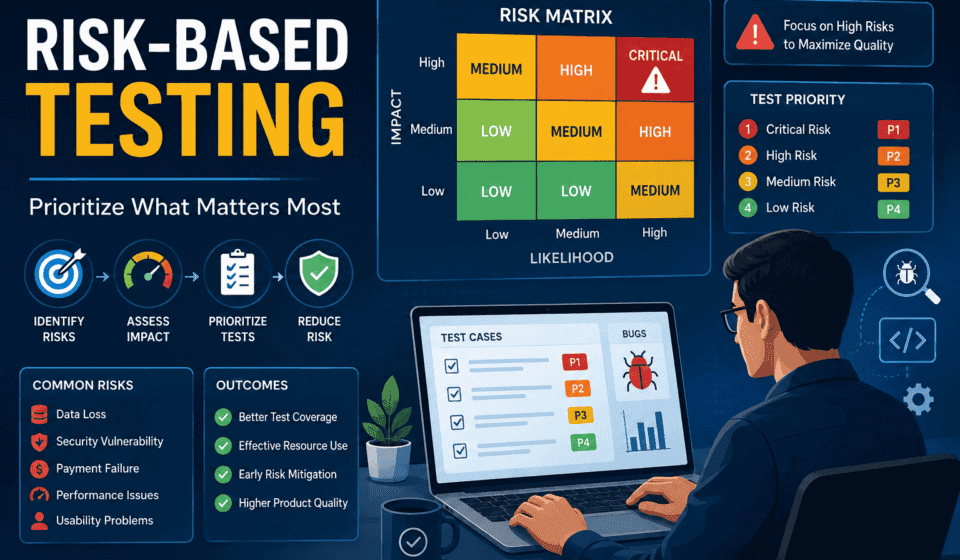
Risk-Based Testing in the AI Era: A Guide for Test Leads and QA Managers
Every Test Lead has lived this moment: two days before release, the regression suite has 4,000 test cases, the pipeline window is six hours, and the release manager wants a “quick health check” by end of day. You cannot run everything. You cannot guess randomly. What you need is a defensible, data-informed answer to one question — where is the risk actually concentrated, and are we testing that first?
That question is the entire premise of Risk-Based Testing. It is not a new idea — risk-based approaches to quality assurance have existed since the 1990s in aerospace, defense, and later in mainstream software engineering. What has changed, dramatically and permanently, is the quality of the signal available to answer that question. A decade ago, risk assessment in QA was largely a workshop exercise: testers, developers, and business analysts sitting in a room, using tribal knowledge and gut feel to rank features as “high,” “medium,” or “low” risk. Today, that same exercise can be informed by machine learning models trained on years of defect history, real-time code churn analysis, production telemetry, customer usage patterns, and natural language processing over requirements and support tickets. Risk-Based Testing has not been replaced by AI — it has been supercharged by it.
This guide is written for Test Leads, QA Managers, Test Architects, and Engineering Managers who are responsible for making testing decisions under constraint — limited time, limited budget, limited automation coverage, and increasing release velocity. It is a long, deliberately thorough guide, because Risk-Based Testing is not a single technique you bolt onto a process; it is a management discipline that touches strategy, staffing, tooling, automation architecture, metrics, and organizational culture. We will cover:
- What Risk-Based Testing actually means, and why the old definitions are incomplete for AI-era software delivery
- How to identify, assess, and prioritize risk using both classical and AI-augmented techniques
- How machine learning and generative AI are being used today to predict defect-prone areas, generate risk-aware test cases, and optimize regression suites
- How to build a practical, auditable Risk-Based Testing strategy your organization can actually sustain
- How to integrate risk-based thinking into Agile, DevOps, and CI/CD without slowing delivery down
- How to measure whether your risk-based approach is actually working, with concrete KPIs
- The organizational and human side: how Test Leads and QA Managers build trust in a risk-based model, manage stakeholders, and avoid the common traps that quietly undermine even well-designed programs
- Domain-specific considerations for regulated and high-stakes industries
- Where this discipline is heading as autonomous and agentic AI testing tools mature
If you manage a QA function today, you are almost certainly already doing some version of Risk-Based Testing, whether you call it that or not. The goal of this guide is to help you do it deliberately, consistently, and with the AI-era tooling now available, rather than reactively and by instinct alone.
What Is Risk-Based Testing? A Definition That Actually Holds Up
Risk-Based Testing is a testing strategy in which the scope, depth, sequencing, and resourcing of test activities are determined by the assessed risk of each area of the application, rather than by convenience, habit, or uniform coverage targets. In plain terms: instead of testing everything equally, you test the things most likely to fail and most damaging if they do fail, first and most thoroughly.
That single sentence hides a surprising amount of nuance, and most teams that claim to practice Risk-Based Testing are actually only doing half of it. A complete definition of Risk-Based Testing rests on three pillars:
1. Risk identification. You cannot prioritize risk you have not named. This means systematically cataloguing the ways a system, feature, or release could fail — functional defects, performance degradation, security vulnerabilities, data integrity issues, integration failures, usability regressions, and compliance violations all count as risk categories, not just “bugs.”
2. Risk assessment and scoring. Once risks are identified, they must be evaluated along at least two dimensions: the probability that a failure will occur, and the impact that failure would have if it did occur. This is usually visualized as a Risk = Probability × Impact calculation, though as we will see later in this guide, that formula is a simplification that AI-era practice is beginning to refine considerably.
3. Risk-driven decision-making. The scores generated in step two must actually change what your team does — which areas get deep exploratory testing versus a smoke check, which get full regression automation versus a single happy-path script, which get performance and security testing versus none, and in what order test execution happens when time is short. If your risk assessment doesn’t change any of these decisions, you have produced a risk report, not Risk-Based Testing.
It’s worth being explicit about what Risk-Based Testing is not. It is not an excuse to test less overall — done correctly, it usually results in testing the same or greater proportion of critical functionality, while consciously reducing effort on low-value areas. It is not a one-time exercise performed at project kickoff and then forgotten — risk profiles shift every sprint as code changes, usage patterns evolve, and new features ship. And it is not synonymous with “test the hardest stuff” — impact matters as much as technical difficulty; a simple button that processes payment refunds carries more risk than a beautifully complex but rarely-used reporting feature.
The Historical Roots of Risk-Based Testing
Risk-based approaches to quality existed long before “software testing” was its own discipline. Failure Mode and Effects Analysis (FMEA), developed by the U.S. military in the 1940s and later adopted heavily by NASA and the automotive industry, is a direct ancestor of modern software risk assessment — it asks the same core questions: what can go wrong, how likely is it, how bad would it be, and how would we detect it. When software testing matured as a discipline in the 1990s and 2000s, testing thought leaders like Rex Black and the International Software Testing Qualifications Board (ISTQB) formalized risk-based testing as a named methodology, embedding it into certification syllabi that remain influential today.
For two decades, however, risk-based testing in most organizations was implemented as a manual, workshop-driven activity: a room full of stakeholders, a whiteboard, and a scoring exercise repeated once per release. It worked reasonably well for slower release cadences — quarterly or monthly releases gave teams time to run this exercise properly. It works far less well in an environment of daily or even hourly deployments, where the “risk landscape” of an application can shift multiple times before a manual risk assessment workshop could even be scheduled. This mismatch between the traditional practice of Risk-Based Testing and the speed of modern software delivery is precisely the gap that AI-augmented approaches are now filling.
Why “Risk” Means More Than “Likely to Have Bugs”
A mature Risk-Based Testing program treats risk as a multi-dimensional concept, not a single bug-probability score. Modern QA organizations typically track risk across categories such as:
- Technical risk — code complexity, architectural fragility, technical debt, third-party dependency instability
- Business risk — revenue impact, customer-facing visibility, brand reputation exposure, contractual/SLA exposure
- Compliance and regulatory risk — data privacy obligations, industry-specific regulations (HIPAA, PCI-DSS, SOX, GDPR), audit requirements
- Security risk — attack surface exposure, sensitivity of data handled, authentication and authorization boundaries
- Operational risk — deployment complexity, rollback difficulty, monitoring and observability gaps
- User experience risk — accessibility, usability for critical user journeys, first-impression features for new users
A payment processing microservice, for example, might score only moderately on pure technical complexity, but it will score very high on business risk, compliance risk, and security risk — which is exactly why experienced Test Leads instinctively over-invest in testing it regardless of how “simple” the code looks. Risk-Based Testing formalizes that instinct into a repeatable, defensible process — one that, as we’ll discuss throughout this guide, AI tooling can now make continuous rather than periodic.
The Evolution: From Manual Risk Workshops to AI-Augmented Risk Intelligence
To understand why Risk-Based Testing looks different in 2026 than it did even five years ago, it helps to walk through the generations of practice most QA organizations have passed through.
Generation One: Intuition-Driven Testing
In the earliest and still most common informal state, risk prioritization exists only in the heads of senior testers and developers. There is no written risk register, no scoring model, and no consistent method — just experienced people saying “we should really hammer the checkout flow this release” based on memory of past incidents. This works surprisingly well with small, stable teams and poorly the moment key people leave, the team scales, or the application grows beyond what any one person can hold in their head. It is invisible to management, impossible to audit, and impossible to improve systematically because it was never made explicit in the first place.
Generation Two: Workshop-Based Risk-Based Testing
This is the “classical” Risk-Based Testing most QA certifications teach. A cross-functional group — QA, development, product, sometimes support and operations — gathers before a release or project phase and works through a structured risk identification and scoring exercise, typically producing a Risk Register or Risk Matrix. Features or components are scored on probability and impact, usually on a 1–5 or 1–3 scale, and the resulting priority order drives test planning. This generation was a massive improvement over pure intuition: it’s documented, auditable, and repeatable. Its weaknesses are speed and staleness — the exercise typically happens once per release cycle, and the resulting risk register is treated as static until the next workshop, even though real risk shifts daily as code changes land.
Generation Three: Metrics-Augmented Risk-Based Testing
As DevOps practices matured, QA organizations began pulling in quantitative signals to supplement (not replace) workshop judgment: defect density by module, code churn (lines changed per file over time), cyclomatic complexity, historical escaped-defect data, test coverage gaps, and production incident frequency by component. This generation still relied on humans to interpret the data and set final priorities, but the inputs became far richer and more objective. Tools like SonarQube for code quality metrics and basic dashboards became standard companions to the risk workshop.
Generation Four: AI-Augmented Risk-Based Testing (Where We Are Now)
This is the generation this guide is primarily concerned with. Machine learning models now ingest the same signals used in Generation Three — code churn, complexity, defect history, incident data — plus signals that were previously too voluminous or too unstructured for humans to process manually: full commit history patterns across thousands of files, natural language analysis of requirements and user stories, semantic similarity between new features and historically buggy ones, production telemetry and real user monitoring (RUM) data at a granularity no dashboard could summarize, and even sentiment and specificity analysis of customer support tickets to detect emerging pain points before they show up as formal defects.
Crucially, in Generation Four, risk scoring is no longer a periodic workshop output — it can be a continuously updated, queryable model that recalculates every time code is committed. A Test Lead can, in principle, ask “which of the 40 files changed in this pull request carry the highest predicted defect risk?” and get an answer in seconds, informed by a model trained on the organization’s own historical data. Generative AI adds a further layer: large language models can read requirements, user stories, and even production logs to draft risk hypotheses and suggest test scenarios a human might not have considered, dramatically compressing the time needed for risk identification itself.
Generation Five: Where We’re Heading — Agentic and Autonomous Risk-Based Testing
We will explore this in depth in the closing sections of this guide, but it’s worth flagging now: the emerging frontier is autonomous test agents that don’t just score risk but act on it — automatically generating and executing tests for the highest-risk changes, adjusting regression suite composition per build without human intervention, and flagging anomalies in production that feed back into the next risk model update, closing the loop between testing and live operation. No organization has this fully mature yet, but the building blocks — AI-powered test generation, self-healing automation, and predictive analytics — are already in production use at leading QA organizations today, which is why this guide treats them as current practice rather than speculative future.
Why AI Changes the Risk Equation, Not Just the Risk Calculation
It’s tempting to think of AI’s contribution to Risk-Based Testing as simply “better math” — faster, more accurate versions of the same probability × impact calculation testers have always done. That understates what has actually changed. AI alters four structural aspects of how risk-based decisions get made.
Speed of recalculation. A workshop-based risk assessment might realistically happen once per release, perhaps once per sprint in a disciplined Agile shop. An AI-driven risk model can recalculate on every commit, every pull request, or every hour, which means the risk register stops being a static artifact and becomes a live signal that can drive automated pipeline decisions — for example, automatically expanding the test scope for a build that touches historically high-risk files, without anyone manually re-running a workshop.
Volume of signal. A human risk workshop can meaningfully reason about perhaps a few dozen features or components at a time before cognitive load makes the exercise unreliable. A machine learning model can score every file, every API endpoint, and every user journey in a codebase of hundreds of thousands of lines, continuously, without fatigue. This matters enormously for large, legacy-heavy systems where the riskiest code is often not the newest, flashiest feature but an obscure integration module nobody has looked at in two years — exactly the kind of risk a manual workshop is most likely to miss because it isn’t top of mind.
Pattern detection humans cannot perform manually. Machine learning models can detect correlations between seemingly unrelated signals — for instance, that files touched by a particular subset of contributors, changed close to a release freeze, with a specific commit message pattern, have historically produced three times the escaped-defect rate of other changes. No manual process could reliably surface a correlation that specific; it requires statistical learning over a large historical dataset. This is where techniques like historical defect clustering and commit-pattern analysis genuinely outperform intuition, even expert intuition.
Reduction of identification time, not just assessment time. Perhaps the most underrated shift: generative AI dramatically reduces the time cost of the risk identification step, which used to be the most labor-intensive part of the process. Feeding a large language model a set of requirements, user stories, or even a diff of code changes, and asking it to enumerate plausible failure modes, edge cases, and risk factors, can produce in minutes a list that would previously have taken a risk workshop half a day to brainstorm. The human role shifts from generating the list to critically evaluating and prioritizing it — a genuinely different and arguably higher-value use of a senior tester’s time.
None of this eliminates the need for human judgment. AI models are trained on historical data and are, by construction, better at predicting risks similar to ones that have occurred before than genuinely novel failure modes — the “unknown unknowns” that experienced testers sometimes catch through lateral thinking or domain intuition that has never been encoded in any dataset. The right mental model, which we will return to repeatedly in this guide, is AI-augmented, human-governed Risk-Based Testing: machine learning and generative AI dramatically expand the speed and volume of risk signal available, while Test Leads and QA Managers retain ownership of the final prioritization decisions, sanity-check the model’s outputs against business context the model cannot see, and remain accountable for the consequences.
The Core Components of a Modern Risk-Based Testing Framework
Before diving into specific techniques, it helps to see the whole shape of a Risk-Based Testing framework end to end. Every mature program, whether workshop-driven or AI-augmented, moves through the same six stages. Understanding this full cycle matters because most teams that struggle with Risk-Based Testing have usually implemented only two or three of these stages, not all six, and wonder why the practice hasn’t delivered the results they expected.
Stage 1 — Risk Identification. Systematically surface everything that could go wrong: functional defects, non-functional failures (performance, security, accessibility), integration breakages, data risks, and compliance exposures. Inputs include requirements, architecture diagrams, historical defect data, production incidents, and — increasingly — AI-generated risk hypotheses from language models reading your documentation and codebase.
Stage 2 — Risk Analysis and Scoring. Assign each identified risk a probability and impact score, producing a composite risk value. This is where AI-era organizations diverge most from traditional practice, using predictive models trained on historical outcomes rather than pure expert judgment.
Stage 3 — Risk Prioritization. Rank risks and translate the ranking into concrete decisions: what gets deep testing, what gets a smoke check, what gets automated first, what gets manual exploratory attention, and what can reasonably be deferred or accepted without further testing.
Stage 4 — Test Strategy and Design Aligned to Risk. Design test cases, automation scope, and test data specifically calibrated to the risk level of each area — not uniformly across the application. High-risk areas get deeper technique coverage (boundary value analysis, negative testing, security testing, performance testing); low-risk areas get lighter-touch validation.
Stage 5 — Execution and Monitoring. Execute tests in risk-priority order, particularly important when time or environment constraints prevent full execution. Monitor results not just for pass/fail but for whether the risk model’s predictions are holding up — did the “high risk” areas actually produce more defects than the “low risk” ones?
Stage 6 — Feedback and Model Refinement. Feed actual defect outcomes, production incidents, and escaped-defect data back into the risk model (whether that model lives in a spreadsheet or a machine learning pipeline) so that future risk assessments improve. This closing-the-loop stage is the single most commonly skipped step in immature programs, and it is exactly the stage where AI tooling provides the most durable advantage, because models can be retrained automatically on new outcome data in a way manual workshops never systematically were.
It’s worth stating plainly: a program that only does Stages 1 through 3 has built a risk report, not Risk-Based Testing. The value is only realized when the risk assessment measurably changes what gets tested, how deeply, and in what order — and when the outcomes of that testing feed back to sharpen the next cycle’s risk assessment.
Who Owns Each Stage
A common point of organizational confusion is who is actually responsible for each of these six stages. In practice, ownership typically breaks down as follows, though it varies by organizational maturity:
- Risk identification is a shared responsibility across QA, development, product management, security, and (for regulated industries) compliance teams. QA Managers typically facilitate this but should not own it exclusively — risk that only QA sees is incomplete risk.
- Risk analysis and scoring is where Test Leads and QA Managers should hold primary ownership, particularly when AI models are involved, since interpreting model outputs correctly requires QA domain expertise about what the scores actually mean for test planning.
- Prioritization decisions ultimately need product and engineering leadership buy-in, especially when risk assessment suggests deprioritizing testing on something a stakeholder assumed would be thoroughly tested. This is a governance conversation, not just a QA decision, and we’ll return to how to manage it later in this guide.
- Test strategy and execution are squarely QA and automation engineering territory.
- Feedback and model refinement should be a joint responsibility between QA Managers (who understand what “getting it right” looks like from a testing perspective) and whichever team owns the AI/ML tooling — increasingly a platform engineering or QA engineering function rather than a separate data science team, as risk-prediction tooling becomes a standard part of the QA toolchain rather than a bespoke data science project.
Risk Identification Techniques: Classical and AI-Augmented
Risk identification is the foundation stage of Risk-Based Testing — get it wrong, and every subsequent stage inherits a blind spot no amount of clever scoring can fix. This section walks through the techniques Test Leads should have in their toolkit, starting with proven classical methods and layering in how AI now accelerates and extends each one.
Classical Risk Identification Techniques
Structured brainstorming and risk workshops. Cross-functional sessions in which QA, development, product, and operations walk through a feature or release and enumerate what could go wrong. Effective when facilitated well, with a neutral facilitator and a structured prompt list (e.g., “what could fail functionally, what could fail under load, what could fail from a security perspective, what could fail for accessibility”). Weak when dominated by the loudest voice in the room or when the same handful of “usual suspects” get discussed every time.
Checklists and taxonomies. Many QA organizations maintain a standing risk taxonomy — a checklist of risk categories (data integrity, third-party dependency, concurrency, localization, backward compatibility, and so on) that gets applied to every new feature. This guarantees baseline coverage of known risk types even when a workshop’s organic discussion misses them.
Historical defect analysis. Reviewing where defects have clustered in the past — by module, by feature area, by developer team, by defect type — is one of the single strongest predictors of where future defects will occur. The well-established Pareto principle holds remarkably consistently in software defect data: a small proportion of modules typically account for a large majority of production defects, release after release, unless deliberately remediated.
Requirements and design review. Ambiguous, incomplete, or frequently-changed requirements are themselves a leading indicator of risk — features whose specifications changed multiple times during development have measurably higher defect rates than stable ones, because implementation and testing both chase a moving target. Reviewing requirement churn history is a cheap and effective risk signal.
Complexity metrics. Cyclomatic complexity, code churn (how many times a file has changed and by how many different developers), coupling between modules, and the size of a pull request are all objective, calculable proxies for risk that don’t require subjective judgment. Tools like SonarQube, CodeClimate, and various static analysis platforms surface these automatically.
Stakeholder and customer input. Support ticket volume, customer complaints, and Net Promoter Score verbatims about specific features are an underused risk signal — an area with a high complaint rate, even without formal defects logged against it, represents real business risk that a code-only analysis would miss entirely.
AI-Augmented Risk Identification
Natural language processing over requirements and user stories. Large language models can ingest a backlog of user stories, acceptance criteria, and requirements documents and flag ambiguity, missing edge cases, and internal inconsistencies far faster than a manual review. A well-prompted LLM reviewing a user story such as “as a user I can update my payment method” can reliably surface questions a human reviewer might miss on a busy day: What happens if the update fails mid-transaction? What happens to in-flight subscriptions during the update? Is there a rate limit on update attempts? Is the old payment method retained for a grace period or immediately purged? This doesn’t replace human requirements review, but it makes the first pass dramatically faster and more thorough.
Semantic similarity to historically buggy code. Modern risk models can compare new or changed code against a database of historically defect-prone code, not just by file name or module, but by structural and semantic similarity — code that resembles, in shape and pattern, code that has previously caused production incidents, even in a completely different part of the codebase. This catches a category of risk that pure “this file has a history of bugs” analysis misses: brand-new files written in a risky pattern.
Commit and pull-request pattern analysis. Machine learning models trained on an organization’s own commit history can learn patterns correlated with defect introduction — commits made close to a release freeze, unusually large diffs, changes touching multiple unrelated modules in a single commit, or changes authored by contributors newer to a specific codebase area. These patterns are often organization-specific, which is precisely why a generic industry benchmark is less useful here than a model trained on your own repository history.
Production telemetry and anomaly detection. Real user monitoring, application performance monitoring (APM), and log analysis tools increasingly incorporate AI-based anomaly detection that flags subtle behavioral drifts in production before they escalate into customer-facing incidents — a slow but steady increase in a particular API’s error rate, a gradual change in response time distribution, or an unusual pattern of retried requests. Feeding these signals back into the risk model for the next release closes a loop that manual processes historically left open.
Customer support and sentiment analysis. AI-based text analytics over support tickets, app store reviews, and social media mentions can surface emerging pain points related to specific features at a volume and speed no human triage team could match, converting unstructured customer feedback into a structured, prioritizable risk signal.
Synthetic risk hypothesis generation. Given a description of a feature or a diff of proposed code changes, generative AI models can produce a structured list of plausible failure modes, drawing on patterns learned from a vast corpus of software documentation, bug reports, and post-incident reviews across many organizations and industries — effectively acting as a tireless, well-read junior risk analyst whose output still requires senior review, but who never runs out of energy for the fifth risk workshop of the week.
A practical note for Test Leads: none of these AI techniques work well without decent underlying data hygiene. A model trained on inconsistent defect-tracking data (bugs logged with sparse component tags, no consistent severity taxonomy, no linkage between defects and the commits that introduced them) will produce a mediocre risk signal no matter how sophisticated the underlying algorithm. If your organization is early in AI adoption for Risk-Based Testing, the highest-leverage first investment is usually cleaning up defect and commit data hygiene, not purchasing an off-the-shelf AI risk tool.
Risk Assessment: Scoring Models That Actually Hold Up Under Pressure
Once risks are identified, they need to be scored in a way that produces a defensible, comparable ranking. This section covers the scoring models every Test Lead should know, from the classical probability × impact formula through to the more nuanced AI-era refinements.
The Classical Probability × Impact Model
The traditional risk-scoring formula is:
Risk Score = Probability of Failure × Impact of Failure
Both factors are typically scored on a simple scale (commonly 1–5), and the product gives a risk value from 1 to 25, which is then bucketed into risk bands (e.g., 1–6 = Low, 7–14 = Medium, 15–25 = High). This model’s enduring popularity comes from its simplicity: it’s easy to explain to non-technical stakeholders, easy to apply consistently across a workshop, and easy to visualize as a risk matrix (a grid with probability on one axis and impact on the other, with color-coded risk bands).
Its weaknesses, however, are well documented in risk management literature more broadly, not just software testing. Multiplying two ordinal scales (1–5 is a ranking, not a true numeric quantity) produces a product that has questionable mathematical meaning — a probability of 5 and impact of 1 nets the same score as probability of 1 and impact of 5, even though these represent completely different risk profiles requiring different mitigation strategies (the first needs monitoring and quick detection, the second needs failsafes and careful review even though failures are rare). Experienced Test Leads therefore rarely rely on the raw product alone — they examine the two axes separately.
Detectability: The Missing Third Dimension
Borrowed directly from Failure Mode and Effects Analysis (FMEA), many mature Risk-Based Testing programs add a third factor: Detectability — how likely is it that, if a failure occurs, existing controls (monitoring, code review, automated tests, staged rollouts) would catch it before it reaches customers?
Risk Priority Number (RPN) = Probability × Impact × (11 − Detectability), using a 1–10 scale for each factor and inverting detectability so that lower detectability (harder to catch) drives the RPN higher. This third dimension matters enormously in practice: a moderate-probability, moderate-impact risk that is currently completely undetected by any monitoring or test coverage deserves more testing attention than a high-probability, high-impact risk that is already caught reliably by existing automated regression tests and production alerting. Many QA organizations that skip detectability end up over-testing already well-covered areas and under-testing genuine coverage gaps.
AI-Era Refinements to Risk Scoring
Continuous, granular probability estimation. Rather than a human assigning a 1–5 probability score based on gut feel, machine learning models trained on historical defect data can produce a genuinely continuous probability estimate (e.g., “this file has a 34% predicted probability of containing at least one defect that will escape to production, based on its complexity, churn rate, and the historical defect rate of its authors”). This is not just more precise — it changes the granularity of decisions possible: a continuous score allows fine-grained ranking across hundreds of components rather than lumping dozens of them into the same crude “Medium” bucket.
Impact modeling using real usage data. Impact scoring has historically been the weaker of the two classical factors, often based on subjective judgment about “how important” a feature is. AI-era organizations increasingly calculate impact from real production data: how many active users touch this feature per day, what percentage of revenue flows through this code path, how many downstream services depend on this API, and how many support tickets historically reference this area. This converts impact from an opinion into a measurable, defensible number.
Weighted multi-factor risk models. Rather than the simple three-factor RPN, machine learning models can incorporate dozens of weighted signals simultaneously — code churn, complexity, historical defect density, requirement volatility, author experience with the module, test coverage percentage, time since last full regression pass, and production traffic volume — combined through a trained model (commonly a gradient-boosted decision tree or logistic regression model in practice, since these tend to be more interpretable than deep neural networks for this use case, which matters when a QA Manager needs to explain to an auditor or executive why a particular area was scored high-risk).
Confidence intervals, not point estimates. A meaningful maturity marker for AI-augmented risk programs is moving beyond a single risk score toward a score with an associated confidence level — a component with sparse historical data (a brand-new microservice, for instance) should be flagged as having a wide confidence interval around its risk estimate, signaling to the Test Lead that human judgment should weigh more heavily for that component, rather than blind trust in a thin-data model prediction.
A Practical Scoring Template for Test Leads
For teams without a mature machine learning pipeline yet, a hybrid scoring approach works well as a stepping stone toward full AI-augmentation:
- Score Probability using a blend of two inputs — historical defect rate for the component (quantitative) and expert judgment on requirement stability and complexity (qualitative) — averaged or weighted 60/40 in favor of the quantitative input where data exists.
- Score Impact using production usage data (active users, revenue exposure, downstream dependents) as the primary input, adjusted by business stakeholder input for strategic considerations a pure usage metric might miss (e.g., a new feature with low current usage but high strategic visibility for an upcoming customer demo).
- Score Detectability based on current automated test coverage percentage and monitoring/alerting coverage for the component.
- Calculate a composite score, but always review the top and bottom deciles manually before finalizing — automated scores should be sanity-checked by an experienced Test Lead, not applied blindly, especially in the first few release cycles of a new scoring model.
AI-Powered Risk Prediction Models: How the Machine Learning Actually Works
This section is written for the Test Lead or QA Manager who wants to understand, at a working level, what happens “under the hood” of an AI-powered risk prediction system — enough to have an informed conversation with a data science or platform engineering team, evaluate a vendor tool intelligently, or scope a build-vs-buy decision. You do not need to become a machine learning engineer to lead a Risk-Based Testing program, but a Test Lead who does not understand roughly how these models work will struggle to use their outputs critically, which is exactly the failure mode this guide is trying to prevent.
The Data Inputs That Actually Matter
Every AI-powered risk model, regardless of the specific algorithm underneath, is only as good as its training data. The most commonly used and highest-value inputs across the industry are:
- Code churn — how frequently a file changes, and how much of it changes each time. Files with high churn are consistently among the strongest predictors of future defects across nearly every empirical study of software defect prediction going back over a decade.
- Code complexity metrics — cyclomatic complexity, nesting depth, number of dependencies, lines of code. Complex code is harder to reason about, harder to review thoroughly, and harder to test exhaustively, all of which correlate with defect rates.
- Historical defect data — which files, modules, or components have produced defects in the past, weighted by recency (a module that had defects two years ago and has been stable since is a weaker signal than one with defects last month).
- Author and team experience — changes made by developers newer to a specific codebase area have measurably higher defect rates in most organizations’ historical data than changes made by developers with deep familiarity with that area.
- Test coverage — the percentage of code exercised by automated tests, and more usefully, the type of coverage (unit, integration, end-to-end) since coverage percentage alone is a weak signal without knowing what kind of testing produced it.
- Requirement and design churn — how many times requirements or designs changed during the development of a feature, a strong leading indicator of eventual defect rates.
- Production telemetry — error rates, latency distributions, and traffic patterns for a given service or endpoint, which can reveal risk even in code that has not recently changed (a “silent” degradation from an upstream dependency, for instance).
Common Modeling Approaches
Logistic regression and gradient-boosted trees (e.g., XGBoost, LightGBM). These remain the workhorses of defect prediction in production QA tooling, not because they’re the most sophisticated algorithms available, but because they offer a strong balance of predictive accuracy and interpretability. A gradient-boosted tree model can produce feature-importance rankings — telling a QA Manager not just “this file is high risk” but “this file is high risk primarily because of churn and secondarily because of low test coverage” — which is essential for a Test Lead who needs to explain and act on the prediction, not just trust it blindly.
Neural network and deep learning approaches. Increasingly used for tasks involving unstructured data — natural language processing over requirements and support tickets, semantic code similarity analysis, and pattern detection in large-scale log data. These models can capture more complex, non-linear relationships than simpler models, but at the cost of interpretability, which is a genuine trade-off QA organizations need to weigh: a model that’s 3% more accurate but cannot explain its reasoning is often less useful in a regulated or audit-heavy environment than a slightly less accurate but fully explainable one.
Large language models (LLMs) for risk hypothesis generation. Distinct from the predictive models above, LLMs are increasingly used not to score numerical risk but to generate qualitative risk analysis — reading a pull request diff or a set of requirements and producing a structured, human-readable list of plausible risk factors and suggested test scenarios. This is a fundamentally different (and complementary) use case: predictive models answer “how risky is this, numerically, based on patterns,” while LLMs answer “what specifically might go wrong here, described in natural language, based on general software engineering knowledge.” The strongest AI-augmented Risk-Based Testing programs use both together.
Ensemble and ensemble-of-ensembles approaches. Mature implementations rarely rely on a single model. It’s common to combine a quantitative risk score (from a gradient-boosted tree model trained on churn, complexity, and defect history) with a qualitative risk narrative (from an LLM reading requirements) and a human expert adjustment factor, producing a final risk assessment that draws on the strengths of each approach while mitigating the weaknesses of relying on any single one.
Evaluating Model Quality: Precision, Recall, and the Cost of Being Wrong
A critical, often-overlooked point for QA Managers evaluating or building a risk prediction model: the cost of a false positive and a false negative are not symmetric, and your evaluation approach needs to reflect that.
A false negative in risk prediction — the model says a component is low-risk, but it actually contains a defect that escapes to production — is typically far more costly than a false positive — the model flags a component as high-risk, extra testing effort is spent, and it turns out to have been fine. This asymmetry means that when tuning or evaluating a risk prediction model, most QA organizations should deliberately bias toward higher recall (catching a higher proportion of the truly risky areas, even at the cost of some wasted effort on false positives) rather than optimizing for raw accuracy or precision alone. A model that is 85% accurate but systematically misses the 5% of changes that produce catastrophic outages is far more dangerous than a model that is 75% accurate but reliably flags everything in that catastrophic 5%, even if it also over-flags some safe areas along the way.
Practically, this means Test Leads evaluating a vendor’s AI-powered risk tool (or a homegrown model) should ask directly: what is the model’s recall on historically severe (Sev1/Sev2) production incidents specifically, not just its overall accuracy across all defect severities? A tool that performs impressively on aggregate metrics but poorly on catching the handful of changes that caused your worst outages last year is not solving the problem that actually matters to the business.
The Cold-Start Problem
One practical limitation every Test Lead should understand before committing budget to an AI-powered risk model: these models need historical data to train on, and a new product, a newly formed team, or an organization with poor historical defect-tracking hygiene will struggle to get a useful model out of the box. This is known as the cold-start problem, and it has two common mitigations. First, transfer learning — using a model pre-trained on aggregated, anonymized data across many organizations and codebases (offered by several commercial AI testing platforms) as a starting point, then fine-tuning on your own data as it accumulates. Second, a deliberate hybrid period — running classical workshop-based risk assessment in parallel with a nascent AI model for several release cycles, comparing the two, and gradually shifting weight toward the model only as its track record against your own actual outcomes is established. Organizations that skip this validation period and trust a brand-new model’s output uncritically from day one are taking on unmanaged risk in the name of managing risk — a irony worth avoiding.
Prioritization Frameworks: Turning Risk Scores Into Testing Decisions
A risk score is only useful once it’s translated into a concrete prioritization decision — what gets tested first, what gets tested deeply, and what gets a lighter touch. This section covers the frameworks Test Leads use to make that translation systematic rather than ad hoc.
The Risk Matrix
The simplest and most widely used tool is the risk matrix — a grid plotting probability against impact, divided into color-coded zones (commonly red/amber/green). Every identified risk is plotted as a point or a labeled cell on the grid. This visual format is popular for a good reason: it communicates instantly to non-technical stakeholders, including executives who will never read a detailed risk register, exactly where the biggest exposures sit. Its main limitation, discussed earlier, is that it flattens nuance (probability and impact are treated as equally important, and detectability is often omitted entirely), but as a communication tool for stakeholder alignment, it remains extremely effective, and most QA Managers should keep some version of it in their toolkit even alongside more sophisticated AI-driven scoring underneath.
MoSCoW for Test Scope
Borrowed from requirements prioritization, the MoSCoW method (Must test, Should test, Could test, Won’t test this cycle) maps cleanly onto risk-based test planning, particularly useful when communicating scope decisions to product and engineering stakeholders in a release planning meeting:
- Must test — highest risk score, typically covering critical business flows, security-sensitive areas, and anything with regulatory exposure. These get full regression coverage, exploratory testing, and sign-off before release regardless of time pressure.
- Should test — meaningful risk but not release-blocking on its own. Gets solid coverage if time permits, with a documented decision if it must be trimmed.
- Could test — lower risk, nice to validate but explicitly acceptable to skip under time pressure, with the trade-off documented rather than silently dropped.
- Won’t test this cycle — assessed as low enough risk (or low enough active change) to explicitly defer, with the decision and rationale recorded so it’s a conscious choice rather than an oversight.
The documentation of the “Won’t test” and “Could test” decisions matters enormously for organizational trust in Risk-Based Testing — stakeholders who later discover a defect in an area that was “not tested this cycle” respond very differently when they can see a documented, reasoned risk-based decision versus discovering testing was simply skipped without anyone deciding to skip it.
The 80/20 Regression Optimization Approach
For regression suite management specifically — arguably where Risk-Based Testing delivers its most measurable ROI — a common and effective approach is identifying the roughly 20% of test cases (or code areas) that historically account for 80% of caught defects, and structuring execution so that subset always runs first and always runs regardless of time constraints, with the remaining 80% of tests prioritized and trimmed based on available time. AI-powered test impact analysis tools (covered in depth in the next section) have made this approach dramatically more precise than the traditional manual approach of “the tests the senior QA engineer remembers catch the most bugs.”
Risk-Based Release Gating
A more advanced application of prioritization is using aggregate risk scores to drive automated release gates in a CI/CD pipeline — for example, a rule that any build with a computed aggregate risk score above a defined threshold automatically triggers an expanded test suite, a mandatory manual exploratory testing pass, or a required sign-off from a senior QA reviewer before it can proceed to production, while builds below the threshold can proceed through a lighter automated gate. This turns Risk-Based Testing from a planning input into an actual pipeline control mechanism, which we’ll explore in more depth in the CI/CD integration section later in this guide.
Weighted Scoring Models for Multi-Stakeholder Environments
In larger organizations, different stakeholders often weight risk factors differently — a security team cares most about attack surface exposure, a compliance team cares most about regulatory risk, and a product team cares most about revenue and user experience impact. A weighted scoring model, where each risk factor is assigned an organizationally-agreed weight (e.g., Security Impact × 0.3 + Revenue Impact × 0.3 + Compliance Exposure × 0.2 + Technical Complexity × 0.2) and stakeholders agree on the weights in advance, avoids the recurring, energy-draining argument about “whose risk matters more” happening anew in every release planning meeting. Getting stakeholder agreement on weights once, then applying the formula consistently, is one of the most underrated organizational hacks a QA Manager can implement — it converts a recurring political negotiation into a one-time governance decision.
Test Case Design for Risk-Based Testing
Once priorities are set, test design itself needs to reflect the assigned risk level — this is where many teams that have done good risk identification and scoring work still fall short, because they still apply the same test design techniques uniformly regardless of the risk tier a feature landed in.
Calibrating Test Depth to Risk Tier
For “Must test” / highest-risk areas: apply the full spectrum of test design techniques — equivalence partitioning and boundary value analysis for functional coverage, negative and error-path testing (what happens when things go wrong, not just when they go right), security testing (input validation, authentication/authorization boundary testing, injection attack surface), performance and load testing under realistic and peak conditions, and dedicated exploratory testing sessions by your most experienced testers, who are best equipped to find the “unknown unknowns” a scripted test plan won’t anticipate.
For “Should test” / medium-risk areas: solid functional coverage of primary paths and the most likely failure scenarios, lighter negative testing focused on the most probable error conditions rather than exhaustive edge-case enumeration, and automated regression coverage rather than dedicated new exploratory sessions each cycle.
For “Could test” / lower-risk areas: happy-path smoke testing to confirm basic functionality, relying on automated regression suites run periodically rather than fresh manual test design each release, and explicit acceptance that some edge cases in this tier may go untested — a conscious trade-off, not an oversight.
AI-Assisted Test Case Generation Calibrated to Risk
Generative AI tools are increasingly capable of producing test case suggestions directly calibrated to a stated risk level — given a user story or requirement and a specified risk tier, an LLM can generate a proportionate set of test scenarios: dozens of boundary and negative test cases for a “must test” payment flow, versus a handful of primary-path scenarios for a “could test” cosmetic UI change. This calibration step matters: naively asking an AI tool to “generate test cases for this feature” without specifying the risk context tends to produce a roughly uniform volume of test suggestions regardless of actual risk, which defeats the purpose of risk-based prioritization if testers then execute all AI-suggested cases with equal diligence. Test Leads adopting AI test generation tools should explicitly prompt or configure these tools with the risk tier of each feature, and should review AI-generated test suggestions for the highest-risk areas personally rather than accepting them uncritically, since this is precisely where the cost of a missed edge case is highest.
Data Design and Risk
Test data itself should be risk-calibrated. High-risk financial or healthcare features warrant test data that specifically probes boundary conditions relevant to their domain — maximum transaction amounts, currency rounding edge cases, date boundary conditions around fiscal year-end, or protected health information handling under various consent states. Lower-risk features can typically rely on simpler, representative test data without this domain-specific depth. AI-powered synthetic test data generation tools have become genuinely useful here, capable of producing realistic, privacy-safe synthetic datasets that mirror the statistical properties and edge-case distribution of real production data — a substantial improvement over the older practice of either using unrealistic hand-crafted test data or, worse, unmasked production data copies that create their own compliance risk.
AI Tools and Technologies Powering Risk-Based Testing Today
This section maps the practical tooling landscape a Test Lead or QA Manager will actually encounter when building out an AI-augmented Risk-Based Testing capability. Rather than naming specific vendors, whose feature sets and market positions shift constantly, we’ll organize by category of capability, since understanding the category is what actually matters for a build-vs-buy or tool-evaluation decision — you can map any specific product you’re evaluating onto these categories to understand what it actually does and what gap it fills.
Category 1: Test Impact Analysis (TIA) Tools
Test Impact Analysis tools analyze which automated tests are relevant to a given code change by mapping code coverage data against the specific lines or methods modified in a commit or pull request, then recommend running only the subset of the regression suite that actually exercises the changed code, rather than the full suite. This is one of the most mature and widely adopted categories of AI-assisted risk tooling, because the underlying technique (coverage-to-code mapping) is well understood and the ROI is immediate and easily measured — teams commonly report cutting regression execution time substantially while maintaining or even improving defect-catch rates, precisely because the tests that run are the ones actually relevant to what changed, rather than a static, historically-accumulated full suite that includes many tests irrelevant to the current change.
Category 2: Predictive Defect Analytics Platforms
These platforms ingest historical defect data, code repository metadata, and (increasingly) production telemetry to produce ongoing risk scores for files, modules, or services, typically surfaced as a dashboard a Test Lead can review during sprint planning, or as an automated comment on a pull request flagging “this change touches historically high-risk code.” This is the category most directly implementing the machine learning approaches discussed in the previous section. Evaluation criteria for this category should focus heavily on explainability (can the tool tell you why something is scored high-risk, not just that it is) and on integration with your existing defect tracking and version control systems, since a predictive model that requires manual data export/import to function will quietly fall out of use within a few sprints.
Category 3: AI-Powered Test Case Generation
Tools in this category use large language models to generate test cases from requirements, user stories, API specifications, or even directly from application UI exploration (crawling an application’s interface and generating test scenarios based on observed interactive elements). The strongest implementations allow risk-tier calibration as discussed in the previous section, and increasingly can generate not just functional test cases but also negative, boundary, and even basic security test scenarios. A practical limitation Test Leads should watch for: AI-generated test cases require human review before being trusted for high-risk areas, both to confirm they accurately reflect intended behavior (LLMs can misinterpret ambiguous requirements just as human testers can) and to confirm they don’t merely restate the requirement rather than genuinely probing for failure.
Category 4: Self-Healing Test Automation
A persistent, expensive problem in traditional UI test automation is brittleness — a minor change to a UI element’s identifier or layout breaks dozens of automated tests that have nothing conceptually to do with that change, generating maintenance overhead that erodes the ROI of automation over time. Self-healing automation tools use AI (typically computer vision and machine learning models trained to recognize UI elements by multiple attributes rather than a single brittle selector) to automatically adapt test scripts when the underlying UI changes in minor ways, dramatically reducing false-failure maintenance burden. This matters directly for Risk-Based Testing because brittle, high-maintenance automation suites are one of the most common reasons organizations under-invest in automating their highest-risk regression areas in the first place — if the ROI calculation includes a heavy ongoing maintenance tax, teams rationally choose to automate less than the risk profile actually warrants.
Category 5: Visual AI and Regression Testing
Visual testing tools using AI-based image comparison (rather than brittle pixel-diff comparison, which flags every rendering variance including harmless ones like anti-aliasing differences) can detect meaningful visual regressions — broken layouts, missing elements, unreadable text — while ignoring cosmetically irrelevant differences. This category is particularly relevant for risk-based prioritization of user-experience risk, an often under-tested risk category in purely functional risk models, since visual regressions can significantly damage user trust and brand perception without technically being “functional defects” in the traditional sense.
Category 6: AI-Driven Exploratory Testing Assistance
An emerging category uses AI agents to autonomously explore an application, similar to how a human exploratory tester would, systematically clicking through UI states, filling forms with varied inputs, and flagging anomalous behavior (crashes, error states, unexpected navigation) without a pre-scripted test case. This is particularly valuable for surfacing genuinely unanticipated risk — the “unknown unknowns” that scripted testing, whether human or AI-assisted, structurally cannot find because nobody wrote a test case for a scenario nobody thought of. Current maturity in this category varies considerably between vendors, and Test Leads evaluating these tools should pilot carefully against known historical defects in their own application before trusting them for genuinely novel risk discovery.
Category 7: Production Risk Monitoring and Feedback Loops
Tools in this category — often application performance monitoring (APM) or observability platforms with AI-based anomaly detection layered on top — feed production behavior back into the risk assessment loop, flagging services or endpoints showing early signs of degradation before they generate a formal incident. Integrating this category with your risk-based test prioritization closes the loop described in Stage 6 of the framework covered earlier in this guide, ensuring that emerging production risk translates into elevated test priority for related areas in the next release cycle, rather than existing purely as an operations concern disconnected from the testing function.
A Build-vs-Buy Framework
For QA Managers weighing whether to build custom AI risk tooling in-house versus adopting a commercial platform, three questions tend to be decisive:
- How mature and clean is your historical defect and commit data? Organizations with years of consistently-tagged defect data, clear commit-to-defect linkage, and stable component taxonomies are well positioned to build effective custom models, since the hardest part of AI risk tooling is usually data engineering, not algorithm selection. Organizations without this foundation will get more immediate value from a commercial platform’s built-in transfer-learning capability, discussed earlier as a mitigation for the cold-start problem.
- How specialized is your domain risk profile? Highly regulated industries (healthcare, financial services, aerospace) often have risk factors specific enough that generic commercial tooling requires substantial customization anyway, narrowing the practical gap between build and buy.
- What is your realistic in-house data science and ML engineering capacity, ongoing, not just for an initial build? AI risk models require ongoing retraining, monitoring for model drift, and maintenance as your codebase and team evolve. A one-time built model that nobody maintains after the initial project team moves on will degrade in accuracy over time, often silently, which is arguably worse than not having a model at all, since stale, degrading model outputs that nobody is monitoring can quietly erode trust in Risk-Based Testing as a discipline when the model’s predictions stop matching reality and nobody notices why.
Building a Risk-Based Testing Strategy: A Step-by-Step Playbook
This section is the practical core of this guide — a step-by-step playbook a Test Lead or QA Manager can follow to stand up a Risk-Based Testing program from scratch, or to mature an existing informal practice into a structured, AI-augmented one. We present it as a phased rollout because attempting to implement everything in this guide simultaneously is a reliable way to overwhelm a team and fail; mature Risk-Based Testing programs are typically built over two to four release cycles, not overnight.
Phase 1: Establish the Foundation (Weeks 1–4)
Audit your current state honestly. Before introducing any new process or tooling, document how risk prioritization decisions actually get made today, even if the honest answer is “informally, based on the tech lead’s gut feel.” This baseline matters because it’s the comparison point you’ll use later to demonstrate the value of a more structured approach, and because it often surfaces which parts of Generation One or Two practice (described earlier in this guide) are already unconsciously working well and worth preserving rather than discarding.
Clean up your defect and commit data. As emphasized in the AI modeling section, this is the highest-leverage early investment if AI augmentation is on your roadmap at all. Establish a consistent defect severity taxonomy, ensure defects are tagged to the components or modules they affect, and establish (or improve) linkage between defects and the commits that introduced them. This unglamorous data hygiene work is genuinely the foundation everything else in this guide depends on.
Define your risk taxonomy. Agree, with cross-functional input, on the categories of risk relevant to your product — functional, security, compliance, performance, usability, and any domain-specific categories (data privacy for a healthcare product, financial accuracy for a fintech product, and so on). This becomes the checklist structure for your risk identification stage.
Select an initial scoring model. Start simple — a classical probability × impact matrix, perhaps with the detectability factor added, is a perfectly reasonable starting point even if AI augmentation is the eventual goal. Trying to introduce a machine learning model before your team has internalized the basic discipline of risk-based prioritization is a common and avoidable mistake; the tooling should amplify a working practice, not substitute for a practice that doesn’t yet exist.
Phase 2: Run a Manual Pilot (Weeks 5–10)
Choose a pilot scope. Rather than rolling out Risk-Based Testing organization-wide immediately, pilot it on one product area, one team, or one release cycle. This lets you refine the scoring model, the workshop facilitation approach, and the prioritization-to-test-design translation process on a manageable scale before wider rollout.
Run the risk identification and scoring workshop. Apply the classical techniques from earlier in this guide — structured brainstorming, checklists, historical defect review — to produce an initial risk register for the pilot scope.
Translate scores into test scope decisions explicitly. This is the step most commonly skipped or done superficially. For each risk tier, document specifically what test design techniques, what automation scope, and what execution priority apply — not just a vague intention to “focus more” on high-risk areas.
Execute and measure. Run the testing according to the risk-prioritized plan, and afterward, honestly assess: did the areas scored as high-risk actually produce more defects than the areas scored as low-risk? This validation step, often skipped, is essential — if your risk scoring isn’t correlating with actual outcomes, the model (whether a manual workshop process or an early AI model) needs refinement before wider rollout, not wider rollout regardless.
Phase 3: Introduce Quantitative and AI-Augmented Signals (Months 3–6)
Layer in objective metrics. Begin incorporating code churn, complexity metrics, and historical defect density into your scoring model alongside the workshop-based qualitative input, moving toward the Generation Three hybrid approach described earlier.
Pilot an AI-powered tool in one category. Rather than attempting to adopt AI-powered risk tooling across every category described in the previous section simultaneously, pilot one — Test Impact Analysis for regression optimization is often the best starting point, since its ROI is fast, measurable, and low-risk to validate (a wrong TIA recommendation simply means running a few extra tests, not missing a critical risk entirely, while trust and process maturity are established).
Establish a feedback loop. Set up the mechanism, even if manual at first, to compare risk predictions against actual outcomes after each release, and use this comparison to refine your scoring weights or model inputs.
Phase 4: Scale and Integrate (Months 6–12)
Expand AI tooling adoption to additional categories based on validated success from the pilot phase, informed by the build-vs-buy framework discussed earlier.
Integrate risk signals into your CI/CD pipeline as automated gates, discussed in depth in the next section, moving risk-based decision-making from a planning-time activity to a continuous, pipeline-embedded one.
Formalize governance. Establish clear ownership (per the RACI-style breakdown discussed earlier), a regular cadence for reviewing and refining the risk model, and a clear escalation path for disputes about risk-based scope decisions between QA and other stakeholders.
Institutionalize the practice in onboarding and documentation. A Risk-Based Testing program that lives only in the heads of its original champions will not survive team turnover. Document the process, the scoring model, the tooling, and the rationale clearly enough that a new Test Lead joining the team a year later can understand and continue the practice without having read this guide.
Integrating Risk-Based Testing Into Agile and DevOps/CI-CD Workflows
Risk-Based Testing was historically designed around release-cycle cadences measured in weeks or months. Modern Agile and DevOps environments, with releases happening daily or even multiple times per day, require the practice to be re-architected around much shorter cycles — and this is precisely where AI-driven continuous risk scoring earns its keep, since a workshop-based process simply cannot keep pace with this cadence.
Risk-Based Testing Within Sprint Ceremonies
Sprint planning. Incorporate a lightweight risk assessment as a standing part of story estimation and acceptance criteria definition — for each story entering the sprint, a quick risk tier assignment (using your established taxonomy and scoring model) should inform how much test design and automation investment that story warrants during the sprint, not as an afterthought during test execution.
Backlog refinement. Use AI-assisted risk hypothesis generation (discussed earlier) during backlog refinement sessions to surface edge cases and risk factors for upcoming stories before they’re even pulled into a sprint, giving the team lead time to plan appropriate test coverage rather than discovering complexity only once development is underway.
Daily standups. Risk status — particularly for stories in the “Must test” tier — should be a visible, explicit part of standup reporting, not buried in a test management tool nobody checks daily. A simple visual indicator (red/amber/green) tied to test completion against the risk-appropriate plan for each high-risk story keeps risk visibility continuous rather than concentrated only at sprint end.
Sprint review and retrospective. Close the feedback loop explicitly: did the risk assessments made during planning hold up against what actually happened during the sprint? Did any “low risk” story produce an unexpected defect, suggesting a gap in the risk model or taxonomy that needs addressing?
Risk-Based Gates in CI/CD Pipelines
The most operationally powerful application of AI-augmented Risk-Based Testing is embedding it directly into automated pipeline decision-making, rather than relying on humans to manually apply risk-based judgment at each stage. Common patterns include:
Risk-triggered test scope expansion. A pipeline rule that automatically expands the executed test suite — running the full regression suite instead of a fast subset, or triggering additional security or performance test stages — when a computed aggregate risk score for a given commit or pull request exceeds a defined threshold, using Test Impact Analysis and predictive defect analytics tooling discussed earlier to make this determination automatically rather than requiring a human to remember to request expanded testing.
Risk-triggered manual review requirements. Pipeline configuration that requires a mandatory senior QA or security reviewer sign-off before merge or deployment when a change touches historically high-risk components, ensuring human judgment is deliberately inserted at exactly the points where it matters most, rather than either requiring universal manual review (which doesn’t scale) or allowing fully automated merge for everything (which under-protects genuinely risky changes).
Progressive delivery informed by risk. Feature flagging and canary deployment strategies can be explicitly risk-informed — a higher-risk change might be rolled out to 1% of traffic with heightened monitoring for a longer bake-in period before full rollout, while a low-risk change can proceed through a faster progressive rollout schedule, using the risk score to calibrate deployment caution rather than applying a one-size-fits-all rollout policy regardless of risk profile.
Automated rollback triggers informed by risk-relevant monitoring. For high-risk deployments, automated rollback thresholds (error rate, latency, or business-metric degradation triggers) can be set more sensitively than for low-risk deployments, reflecting the lower tolerance for sustained impact in genuinely high-stakes areas.
The Cultural Shift This Requires
Embedding risk-based gates into automated pipelines requires a genuine cultural shift for many engineering organizations: development teams need to trust that a risk model isn’t an arbitrary bureaucratic gate but a genuinely useful signal, and QA needs to trust that automated risk-triggered decisions won’t silently let genuinely risky changes through without appropriate scrutiny. This trust is built gradually, through the validated feedback loop discussed throughout this guide — a risk model whose predictions are regularly checked against actual outcomes, and refined when they diverge, earns organizational trust over time in a way that a risk model imposed top-down without demonstrated accuracy never will.
Risk-Based Test Automation: Architecture and Practice
Test automation and Risk-Based Testing are frequently discussed as separate disciplines, but in mature AI-era QA organizations, they are deeply intertwined — automation strategy itself should be risk-driven, and risk models increasingly drive automation execution decisions in real time. This section covers how to architect an automation program that genuinely reflects risk-based principles, rather than automating whatever happens to be easiest to automate.
The Common Anti-Pattern: Automating for Coverage Percentage, Not Risk
A pervasive anti-pattern in test automation programs is optimizing for a coverage percentage target (“we need 80% automated test coverage”) without reference to risk. This produces automation suites heavily weighted toward whatever is easiest to automate — often simple, stable, low-risk UI flows — while genuinely high-risk areas (complex business logic, integration points, edge-case-heavy financial calculations) remain under-automated because they’re harder to automate, not because they’re lower risk. A risk-based automation strategy inverts this: automation investment should be prioritized by risk score first, ease of automation second. This sometimes means investing disproportionate automation engineering effort into a technically difficult-to-automate but high-risk area, rather than chasing an easy coverage percentage number that looks good on a dashboard but doesn’t reflect genuine risk reduction.
Layering Automation by Risk Tier
Highest-risk areas warrant investment across multiple automation layers — unit tests for business logic correctness, integration tests for service-boundary correctness, end-to-end tests for critical user journeys, and dedicated non-functional automation (performance, security scanning) run on every relevant change, not just periodically. This is also where investment in self-healing automation (discussed in the AI tools section) pays the highest dividend, since these are the suites you most need to remain reliable and low-maintenance over time, given how much organizational weight rests on their continued accuracy.
Medium-risk areas typically warrant solid end-to-end coverage of primary paths, automated at the UI or API layer depending on what’s most stable and maintainable, without necessarily requiring the full depth of unit, integration, and end-to-end triangulation reserved for the highest-risk tier.
Lower-risk areas are often well served by lightweight smoke automation — enough to catch a catastrophic regression (the page fails to load at all, a critical button is missing) without the deeper investment reserved for higher tiers.
AI-Optimized Regression Suite Composition
One of the most immediately valuable applications of AI in test automation is dynamic, per-build regression suite composition, replacing the traditional static “run the same 3,000 tests every time” approach. Using Test Impact Analysis and predictive risk scoring together, a pipeline can compose a regression suite specific to each build: always including the fixed set of highest-risk “Must test” automated cases regardless of what changed, adding tests specifically relevant to the changed code paths as identified by code coverage mapping, and optionally adding a randomly or intelligently sampled subset of the broader regression suite to maintain some ongoing validation of areas not directly touched by the current change (guarding against the risk that a change in one area has an unanticipated side effect elsewhere). This approach commonly allows organizations to reduce regression execution time substantially while maintaining or improving defect-catch rates, because the tests actually running are more relevant to the specific change than a static, historically-accumulated full suite would be.
Maintaining Automation Health as a Risk Factor in Itself
An automation suite that has degraded — with a growing number of flaky, frequently-skipped, or disabled tests — is itself a risk factor that should feed back into your risk model. A “high-risk” area whose automated tests have been silently skipped or disabled for months due to flakiness is actually an area with dangerously low detectability (recall the FMEA-derived third risk factor discussed earlier), and this should elevate its computed risk score, not leave it artificially lower because the broken tests are quietly excluded from coverage reporting. Mature QA organizations track automation suite health (flakiness rate, skip rate, time since last meaningful update) as an explicit input to their risk model, ensuring that automation debt itself is treated as a risk to be actively managed rather than a quiet, growing blind spot.
Balancing Automation and Manual Exploratory Testing
Risk-Based Testing does not imply automating everything — for the highest-risk areas in particular, dedicated manual exploratory testing sessions by experienced testers remain valuable precisely because scripted automation, however extensive, can only test for failure modes someone thought to script. AI-driven exploratory testing assistance (discussed in the AI tools section) is narrowing this gap, but has not eliminated the value of experienced human testers applying domain knowledge, intuition, and lateral thinking to genuinely high-stakes areas. A mature risk-based automation strategy explicitly allocates time for manual exploratory testing on highest-risk areas as a deliberate line item, not as whatever time happens to be left over after automation maintenance is complete.
Metrics and KPIs: How to Know If Your Risk-Based Testing Program Is Actually Working
A recurring theme throughout this guide has been the importance of validating risk predictions against actual outcomes. This section consolidates the specific metrics Test Leads and QA Managers should track to answer the central question: is our Risk-Based Testing program actually reducing risk, or just producing paperwork that feels rigorous without changing outcomes?
Predictive Accuracy Metrics
Defect capture rate by risk tier. For each release, calculate what percentage of escaped production defects occurred in areas scored as high, medium, and low risk respectively. A well-functioning risk model should show a strong majority of escaped defects concentrated in the high-risk tier — if low-risk areas are producing a disproportionate share of production defects, your risk model has a calibration problem that needs investigation.
Risk score correlation with defect density. More rigorously, calculate the statistical correlation between a component’s computed risk score and its actual defect density over subsequent releases. This is the single most important validation metric for an AI-powered risk model specifically, and should be tracked over time to detect model drift — a correlation that was strong six months ago but has weakened recently suggests the model needs retraining on more recent data, or that the underlying codebase or team composition has shifted in ways the model hasn’t adapted to.
False negative rate for severe incidents. As discussed in the AI modeling section, track specifically how many Sev1/Sev2 production incidents originated in areas the risk model scored as low risk. This asymmetric metric matters more than aggregate accuracy, since missing a severe incident in a “low risk” area is far more costly than the model being imprecise about less severe issues.
Efficiency Metrics
Regression execution time reduction. Track the time (and, if relevant, compute cost) required for regression execution before and after implementing risk-based test selection or AI-powered Test Impact Analysis, while holding defect-catch rate steady or improving it — reduction in execution time alone, without maintaining catch rate, is not a meaningful win.
Test design and review cycle time. Track how much time is spent on risk identification, scoring, and test design activities before and after AI augmentation — a key expected benefit of AI-augmented Risk-Based Testing is compressing the time cost of what were previously manual, workshop-heavy activities, freeing senior tester time for higher-value critical review and exploratory testing rather than initial brainstorming.
Automation maintenance burden. Track flaky test rate and automation maintenance hours over time, particularly for high-risk area automation suites, since (as discussed in the previous section) a degrading automation suite is itself a risk factor that undermines the entire risk-based approach if left unmanaged.
Business and Organizational Metrics
Production incident rate and severity trend. The ultimate outcome metric — is your overall production incident rate, weighted by severity, trending down over time as your Risk-Based Testing program matures? This is a lagging indicator and subject to many confounding factors beyond testing alone, but it remains the metric executives care about most, and QA Managers should be prepared to discuss it honestly, including its limitations as a sole measure of QA effectiveness.
Cost per defect prevented. A more sophisticated ROI metric increasingly used to justify AI tooling investment — estimating the cost of production incidents historically caused by defects in areas similar to those now caught pre-release due to risk-based prioritization, compared against the cost of the testing effort and tooling investment required to catch them.
Stakeholder confidence and trust. A qualitative but important metric — periodically survey product, engineering, and executive stakeholders on their confidence in QA’s risk-based scope decisions. Declining confidence, even if defect metrics look fine, is an early warning sign of an organizational trust or communication problem that will eventually surface as resistance to risk-based scope trade-offs, discussed further in the next section.
Building a Metrics Dashboard That Doesn’t Lie
A practical warning for QA Managers: it is easy to build a dashboard that shows impressive-looking metrics (high risk-tier coverage percentage, fast regression execution times) while missing the metrics that actually matter (false negative rate on severe incidents, correlation between risk score and actual outcomes). When designing your Risk-Based Testing metrics dashboard, deliberately include at least one metric that could make the program look bad if it isn’t working — a dashboard that only ever shows good news is a dashboard nobody should fully trust, including the QA Manager who built it.
Roles and Responsibilities: The Test Lead and QA Manager in the AI Era
The rise of AI-augmented Risk-Based Testing has genuinely changed what it means to excel as a Test Lead or QA Manager, shifting emphasis away from certain traditional skills and toward others. This section is a candid look at how these roles are evolving.
From Test Case Writer to Risk Strategist
The traditional image of a senior tester — someone who writes exhaustive, detailed test cases from requirements — is decreasingly the highest-value use of experienced QA talent in an AI-augmented environment, since generative AI can now produce a solid first draft of test scenarios far faster than a human. What AI cannot yet do reliably is exercise the judgment to know which of those generated scenarios actually matter given business context, which risk tier a feature truly belongs in given factors a model can’t see (an upcoming executive demo, a contractual SLA commitment, a known-fragile third-party integration the model has no visibility into), and when a model’s risk assessment should be overridden based on domain expertise. The highest-value Test Lead skill in the AI era is increasingly risk judgment and critical evaluation of AI outputs, not exhaustive manual test case authorship.
New Core Competencies
Data literacy. Test Leads and QA Managers increasingly need enough fluency in how predictive models work — precision versus recall, feature importance, confidence intervals — to interpret AI tool outputs critically rather than accepting them uncritically or, at the opposite extreme, dismissing them reflexively because they don’t fully understand them. This does not require becoming a data scientist, but it does require more quantitative comfort than the role historically demanded.
Prompt engineering and AI tool evaluation. As generative AI becomes embedded in risk identification and test case generation workflows, the ability to craft effective prompts (or evaluate and tune AI-generated risk hypotheses and test scenarios for genuine relevance versus generic, unhelpful suggestions) has become a practical, valuable skill for senior QA practitioners.
Stakeholder translation. As risk-based decisions increasingly involve explaining AI model outputs to non-technical stakeholders — why a machine learning model flagged a particular area as high-risk, why an automated pipeline gate blocked a release — the ability to translate technical model reasoning into business-relevant language has become a more central QA Manager skill than it was a decade ago.
Governance and audit-readiness. Particularly in regulated industries, QA Managers increasingly need to be able to explain and defend AI-driven testing decisions to auditors and compliance stakeholders, which requires maintaining clear documentation of model inputs, scoring rationale, and human override decisions — a governance responsibility that didn’t exist in the same form when risk assessment was purely a manual workshop exercise.
What Doesn’t Change
It’s worth being clear about what remains constant even as tooling evolves. Domain expertise about the business the software serves remains irreplaceable — an AI model can tell you a component has high code churn, but only a Test Lead with genuine business context can tell you that a seemingly low-traffic feature is actually mission-critical because it’s used exclusively by the company’s three largest enterprise customers during month-end close. Communication and stakeholder management skills remain as central as ever, arguably more so, since AI-augmented risk decisions require more, not less, explanation to build organizational trust. And ultimately, accountability for testing decisions remains a human responsibility — no organization should allow “the AI model said it was low risk” to become an acceptable explanation for an escaped defect, and QA Managers need to establish clear governance ensuring human judgment remains the final checkpoint on consequential risk-based decisions.
Building a Risk Culture: Stakeholder Buy-In and Organizational Trust
Even a technically excellent Risk-Based Testing program will fail if the organization around it doesn’t trust or support risk-based trade-off decisions. This section addresses the human and political dimension of the practice, which experienced QA Managers will recognize as often harder than the technical dimension.
The Core Political Challenge: Explicit Trade-offs Feel Riskier Than Implicit Ones
A curious but consistent pattern in organizations adopting Risk-Based Testing for the first time: stakeholders often react more negatively to an explicit, documented decision to test something less thoroughly than they did to the same reduced testing happening implicitly and undocumented under time pressure. This is somewhat irrational — the actual risk exposure is identical or even lower in the explicit case, since it was a deliberate, reasoned decision rather than an accidental oversight — but it’s a very human and very common reaction. QA Managers introducing Risk-Based Testing need to anticipate this reaction and manage it proactively rather than being surprised by it.
Practical mitigation: Frame risk-based scope decisions in terms of what you’re increasing focus on, not just what you’re reducing. “We’re deepening our testing on the payment flow and the new API integration, and running lighter smoke checks on the settings page redesign, based on our risk analysis” lands very differently from “we’re not going to fully test the settings page,” even though both statements describe the same underlying decision.
Getting Executive Buy-In
Executives generally respond well to Risk-Based Testing framed in business terms — it directly addresses two things executives consistently care about: release velocity (testing smarter, not just testing less, is a direct lever on time-to-market) and risk exposure communicated in business language (revenue impact, compliance exposure, customer trust) rather than technical jargon. When pitching a Risk-Based Testing initiative to executive sponsors, lead with a concrete example from your own organization’s recent history — a specific incident that occurred in an area that could have been flagged as high-risk with the techniques in this guide, and an estimate of how a risk-based approach might have caught it earlier or prevented it. Concrete, specific stories move budget decisions far more effectively than abstract methodology descriptions.
Managing Developer and Product Manager Skepticism
Developers sometimes perceive risk-based test prioritization as implying their code is being judged or distrusted, particularly when AI-powered predictive models flag their changes as high-risk based on factors like their relative unfamiliarity with a codebase area. Framing matters considerably here: risk scores should be presented as informing testing investment, not as a judgment of developer competence, and QA Managers should be alert to and actively correct any tendency for risk scores to be used punitively (e.g., in performance reviews), which will rapidly and justifiably destroy developer trust in and cooperation with the entire program.
Product managers sometimes resist risk-based scope trade-offs when they perceive every feature they’ve championed as inherently high-priority and deserving of maximum testing attention. The weighted scoring model approach discussed earlier — getting agreement on risk factor weights once, in a calm planning context, rather than relitigating priority in every release crunch — is the most effective mitigation, since it moves the disagreement from an emotionally charged, time-pressured moment to a calmer governance discussion.
Transparency as a Trust-Building Mechanism
Perhaps the single most effective practice for building organizational trust in a Risk-Based Testing program, AI-augmented or not, is radical transparency about how decisions are made. Publish your risk taxonomy, your scoring methodology, and (where an AI model is involved) a plain-language explanation of what inputs drive the model’s scores. Make your risk register visible to relevant stakeholders, not just QA. When a risk-based decision turns out to have been wrong in hindsight — an area scored low-risk that produced a defect — discuss this openly in a blameless retrospective, treating it as a signal to refine the model or taxonomy rather than something to hide or minimize. Organizations that treat their risk model as a transparent, evolving, occasionally-wrong-but-continuously-improving tool build far more durable trust than organizations that present risk scores as an infallible black box, which inevitably erodes credibility the first time the model gets something visibly wrong.
Common Challenges and Pitfalls in Risk-Based Testing
Even well-intentioned Risk-Based Testing programs run into a recurring set of pitfalls. This section names them directly, since recognizing a pitfall your own program may be falling into is the first step toward correcting it.
Pitfall 1: Treating risk assessment as a one-time exercise. As discussed throughout this guide, risk profiles shift continuously as code changes and usage patterns evolve. A risk register produced once at project kickoff and never revisited becomes stale and misleading within a few release cycles. Mitigation: build the feedback loop and recalculation cadence (whether workshop-based or AI-continuous) into your process from the start, not as an afterthought.
Pitfall 2: Conflating “complex” with “risky.” Technically complex code is not automatically the highest business risk — a simple, low-complexity function that processes payment refunds carries more risk than an intricate but rarely-used internal reporting algorithm. Mitigation: ensure your risk scoring genuinely incorporates business impact factors (revenue exposure, compliance exposure, user visibility), not just technical complexity metrics, which are easier to measure automatically and therefore tempting to over-weight.
Pitfall 3: Letting AI model outputs go unquestioned. As discussed in the AI modeling section, models trained on historical data are structurally better at predicting risks similar to past ones than genuinely novel failure modes, and can encode historical biases (for instance, if certain teams’ code has historically been under-scrutinized, a model may underweight risk in their changes not because the code is actually less risky, but because defects in that area were historically under-reported). Mitigation: maintain human review of model outputs, particularly at the extremes (very high and very low scores) and particularly for any model decision with significant business consequences.
Pitfall 4: Under-investing in risk identification for “boring” legacy areas. Risk workshops and even AI models trained primarily on recent commit activity can systematically under-identify risk in stable, rarely-touched legacy code that nonetheless remains business-critical — the “if it ain’t broke, don’t look at it” blind spot. A legacy billing engine that hasn’t changed in three years can still be a catastrophic risk if a rare edge case (a leap year, a currency the system was never designed to handle, a data volume threshold finally being crossed) triggers a failure. Mitigation: explicitly include “time since last thorough review” and “business criticality regardless of recent change activity” as risk factors, not just recent churn and complexity.
Pitfall 5: Risk-based testing used to justify testing cuts without corresponding rigor increase elsewhere. Some organizations adopt Risk-Based Testing language primarily as cover for reducing overall QA investment, without actually increasing rigor on the areas identified as high-risk. This is a hollow, bad-faith implementation that will produce worse outcomes than either full testing or honest, resourced risk-based testing, and QA Managers should be alert to and push back on this dynamic when they see leadership using risk-based framing purely as a budget-cutting justification.
Pitfall 6: Ignoring detectability and automation health. As discussed earlier, a risk model that doesn’t account for current test coverage and monitoring detectability will systematically under-prioritize genuinely under-protected areas whose risk is compounded by the fact that failures there wouldn’t even be caught quickly if they occurred.
Pitfall 7: Organizational trust erosion from poor communication. As discussed in the previous section, even a technically sound risk-based approach fails if stakeholders don’t trust or understand the trade-off decisions it produces. This is as much a management and communication challenge as a technical one, and QA Managers who focus exclusively on the technical rigor of their risk model while neglecting stakeholder communication will find their program undermined regardless of its technical merit.
Real-World Scenarios: Risk-Based Testing in Practice
To ground the concepts covered so far, this section walks through several realistic, composite scenarios reflecting patterns commonly seen across QA organizations adopting AI-augmented Risk-Based Testing. These are illustrative composites reflecting common industry patterns rather than accounts of specific named organizations.
Scenario 1: The E-Commerce Platform Under Release Pressure
A mid-sized e-commerce company running weekly release cycles faced a familiar problem: a regression suite that had grown to several thousand test cases over years of feature additions, taking nearly the entire available testing window to execute, leaving little time for exploratory testing of new features before each release. The QA team’s initial instinct was to simply delete “old, probably irrelevant” tests — a risky approach with no data behind which tests were actually safe to remove.
Instead, the team implemented Test Impact Analysis, mapping code coverage data against each release’s actual code changes, and began running a risk-prioritized subset of the regression suite for each release rather than the full suite by default, reserving full-suite execution for pre-determined milestone releases (e.g., before major sales events) and for any release touching a defined list of highest-risk checkout and payment components. Combined with historical defect clustering analysis that confirmed the majority of past production incidents had originated in a relatively small subset of components (primarily checkout, inventory sync, and pricing calculation), the team was able to reduce average regression execution time substantially while maintaining their defect escape rate, freeing meaningful time each cycle for exploratory testing of new features — precisely the activity most likely to catch genuinely novel risk that scripted regression, however well-targeted, would miss.
Scenario 2: The Fintech Startup Building Trust with Regulators
A fintech startup preparing for a regulatory audit needed to demonstrate a defensible, documented approach to test risk management, not just evidence that testing had occurred. The team built a risk register explicitly mapping regulatory requirements (transaction accuracy, data privacy controls, audit trail completeness) to specific risk-scored components, with clear documentation of the scoring rationale, the test coverage applied to each risk tier, and a change log showing how the risk assessment had evolved as the product changed. Rather than relying purely on an opaque AI model score, the team specifically chose gradient-boosted tree models over less interpretable alternatives for their quantitative risk scoring, precisely because auditors needed to understand the reasoning behind risk classifications, not just trust a black-box output. This scenario illustrates a recurring lesson for regulated industries: explainability of your risk model is sometimes a compliance requirement, not just a nice-to-have, and should factor directly into tool and technique selection from the outset.
Scenario 3: The Legacy Enterprise System With an Under-Documented Codebase
A large enterprise software company maintaining a decade-old, monolithic core product found that neither its testers’ institutional memory nor its early attempts at an AI-powered risk model were fully reliable — the model, trained primarily on the last two years of commit history, systematically under-scored risk in stable, rarely-touched modules that were nonetheless business-critical, since so little recent activity existed in those files for the model to learn from. The team addressed this by explicitly supplementing the model’s churn-and-complexity-based scoring with a separate “criticality regardless of recent activity” factor, populated through structured interviews with long-tenured engineers who held institutional knowledge about which quiet, rarely-touched modules were nonetheless load-bearing for major customer workflows. This scenario illustrates a lesson emphasized earlier in this guide: AI models trained on recent activity data have a structural blind spot for stable-but-critical legacy risk, and mature programs deliberately compensate for this rather than assuming the model alone is sufficient.
Scenario 4: The SaaS Company Scaling Its QA Function
A fast-growing SaaS company scaling from a single QA team to multiple product-aligned QA pods found that inconsistent risk assessment practices across pods (some using detailed scoring models, others relying purely on tribal knowledge) produced wildly inconsistent testing rigor across the product, with some areas over-tested relative to their actual business risk and others dangerously under-tested. The QA leadership team’s solution was to establish a shared risk taxonomy and scoring methodology at the organizational level (the weighted, multi-stakeholder scoring model discussed earlier in this guide), implemented consistently across all pods, while allowing each pod flexibility in tooling and execution approach beneath that shared framework. This illustrates an important scaling lesson: as QA functions grow beyond a single team, standardizing the risk assessment methodology (the “what” and “why”) while allowing implementation flexibility (the “how”) tends to work better than either fully centralized control or fully independent pod-level practices.
Risk-Based Testing for Specific Domains and Industries
While the core principles of Risk-Based Testing apply universally, different industries have distinct risk profiles and regulatory contexts that shape how the practice should be implemented. This section covers considerations specific to several common domains.
Financial Services and Fintech
Financial services testing carries distinctive risk factors: transaction accuracy and reconciliation correctness, regulatory compliance (anti-money laundering checks, know-your-customer verification, various jurisdiction-specific financial regulations), data precision (rounding errors in financial calculations can have outsized real-world consequences and legal exposure), and fraud detection accuracy. Risk models for financial services should weight compliance and data-accuracy risk factors heavily, often more heavily than pure technical complexity or churn metrics would suggest on their own. Explainability of AI-driven risk scores is frequently a genuine regulatory requirement, not merely a best practice, as illustrated in the fintech scenario above — auditors and regulators need to understand the reasoning behind testing scope decisions, particularly for anything touching customer funds or regulatory reporting.
Healthcare and Life Sciences
Healthcare software testing must account for patient safety risk as the paramount consideration, alongside data privacy regulations (HIPAA in the United States and GDPR or equivalent regulations elsewhere) governing protected health information. Risk models here should incorporate clinical severity classifications — a defect in a dosage calculation feature carries fundamentally different risk than a defect in an appointment scheduling reminder, even if both features have similar code complexity or usage volume. Regulatory frameworks like the FDA’s guidance on Software as a Medical Device impose specific documentation and validation requirements that shape how risk-based test evidence must be recorded and retained, often requiring more rigorous traceability between requirements, identified risks, and executed tests than typical commercial software development demands.
E-Commerce and Retail
E-commerce risk profiles center heavily on revenue-impacting flows (checkout, payment processing, inventory accuracy, pricing display) and are notably time-sensitive around specific business events — a risk that would be moderate on a typical Tuesday becomes severe if it affects the checkout flow during a major promotional sales event. Mature e-commerce QA organizations often maintain event-aware risk scoring, temporarily elevating risk tiers for checkout and payment-adjacent components in the weeks surrounding known high-traffic events, reflecting the reality that impact (one of the two core factors in every risk scoring model discussed throughout this guide) genuinely varies with timing, not just with the inherent nature of the feature itself.
Aerospace, Automotive, and Safety-Critical Systems
Industries governed by functional safety standards (DO-178C in aerospace, ISO 26262 in automotive) have the most mature and formalized risk-based testing traditions of any industry, predating most of the AI-augmented practices discussed in this guide by decades, since these standards were built directly on the FMEA-derived risk methodologies discussed in the historical section earlier. Organizations in these industries adopting AI-augmented risk tooling need to carefully validate that AI model outputs can be reconciled with and mapped into their existing formal safety case documentation requirements, since regulatory certification processes in these industries are generally unforgiving of black-box reasoning that cannot be traced back to auditable, deterministic justification.
SaaS and B2B Software
B2B SaaS risk profiles often center on integration reliability (API stability for third-party integrations customers depend on), multi-tenancy data isolation (a defect that leaks one customer’s data into another’s view is catastrophic regardless of how “minor” the underlying code change seems), and enterprise customer-specific risk (a defect affecting a feature used exclusively by a handful of large enterprise accounts carries disproportionate revenue and relationship risk relative to its usage volume alone, which is why usage-volume-only impact scoring, discussed earlier as a common AI-era refinement, needs to be balanced with account-value-weighted impact scoring for B2B contexts specifically).
The Future of Risk-Based Testing: Agentic AI and Autonomous Quality Assurance
Having covered current practice in depth, it’s worth looking ahead at where Risk-Based Testing is heading over the next several years, since Test Leads and QA Managers building programs today should architect them with this trajectory in mind, even if the most advanced capabilities described here are not yet fully mature in production use anywhere.
From Recommendation to Autonomous Action
Today’s AI-augmented Risk-Based Testing tools primarily recommend — a model scores risk, a tool suggests which tests to run, a dashboard flags an area of concern, and a human decides what to do with that information. The emerging frontier is agentic AI systems that don’t just recommend but act autonomously within defined guardrails: automatically generating and executing new test cases in response to a detected risk signal, automatically adjusting regression suite composition per build without a human curating the rules, and automatically opening a detailed investigation (including a preliminary root-cause hypothesis) when production anomaly detection flags a concerning pattern, before a human engineer has even been paged. This shift from recommendation to autonomous action within governed boundaries is likely to be the defining QA capability shift of the next several years, analogous to the shift from manual deployment to automated CI/CD pipelines a decade earlier.
Continuous, Closed-Loop Risk Modeling
The feedback loop described throughout this guide — comparing risk predictions against actual outcomes and refining the model accordingly — is currently a largely manual or semi-automated process in most organizations, often reviewed monthly or quarterly. The maturing direction is toward fully closed-loop systems where production outcomes automatically retrain risk models on a continuous basis, with appropriate guardrails to prevent model drift or manipulation (a malicious or careless actor should not be able to game the risk model by manipulating what gets logged as a defect, for instance). This requires more sophisticated MLOps discipline than most QA organizations currently maintain, and is likely to drive closer collaboration between QA engineering and platform/ML engineering functions than has traditionally existed.
Multi-Agent Testing Ecosystems
Rather than a single AI model or tool handling risk assessment, an emerging pattern involves multiple specialized AI agents collaborating — one agent focused on security risk analysis, another on performance risk, another on functional test generation, another on exploratory UI testing — coordinated by an orchestration layer that synthesizes their outputs into a unified risk assessment and test execution plan. This mirrors a broader trend in enterprise AI adoption toward multi-agent architectures rather than monolithic single-model systems, and is likely to make risk assessment increasingly comprehensive across risk categories that have historically been handled by entirely separate, poorly-coordinated teams (security testing and functional QA, for instance, often operate with minimal shared tooling or risk visibility today).
Generative AI and Synthetic Risk Scenario Modeling
As generative AI models continue to improve at reasoning over complex systems, an increasingly viable capability is synthetic scenario modeling — using AI to simulate how a proposed code change might interact with existing system behavior under a wide range of hypothetical conditions, surfacing risk before code is even fully written, based on architectural and design-level analysis rather than only analyzing risk after implementation and testing against real or synthetic data. This would represent a meaningful shift of Risk-Based Testing further left in the development lifecycle than most current practice achieves, catching risk at the design review stage with a rigor previously only achievable through expensive, time-intensive formal methods used in safety-critical industries.
What Won’t Change
Even as these capabilities mature, several things are unlikely to change. Human accountability for consequential decisions will remain a governance requirement in virtually every regulated or high-stakes context, meaning autonomous AI action will operate within human-defined guardrails and escalation triggers, not as a fully unsupervised replacement for QA leadership judgment. Business context that lives outside the codebase and outside historical data — competitive pressure, customer relationships, strategic priorities, regulatory timing — will remain something only humans with organizational context can weigh appropriately, meaning the Test Lead and QA Manager roles will continue to center on judgment and prioritization even as the raw analytical and execution work becomes increasingly automated. And the fundamental logic of Risk-Based Testing — that finite testing effort should be allocated according to where failure would actually hurt the most, weighted by how likely and how detectable that failure is — will remain exactly as valid and exactly as necessary as it has been since the earliest days of formal risk management, regardless of how sophisticated the tooling used to apply that logic becomes.
Best Practices Checklist for Test Leads and QA Managers
Consolidating the guidance throughout this article, here is a practical checklist to assess and guide your own Risk-Based Testing program:
Foundation
- Do you have a documented, agreed-upon risk taxonomy covering functional, security, compliance, performance, and usability risk categories relevant to your product?
- Is your historical defect data consistently tagged with component, severity, and root cause, and linked to the commits that introduced the defects?
- Do you have an explicit, documented risk scoring model (even a simple one), rather than relying purely on undocumented tribal knowledge?
Process
- Does your risk assessment happen continuously or at least every sprint, rather than once per project or once per quarter?
- Do risk scores actually change concrete decisions — test design depth, automation investment, execution order — rather than existing only as a report nobody acts on?
- Do you have a documented process for explicitly deferring or reducing testing scope on lower-risk areas, with the rationale recorded?
AI Augmentation
- If using AI-powered risk scoring, can you explain in plain language what inputs drive a high-risk classification for any given component?
- Do you track and report the asymmetric cost of false negatives (missed high-risk areas) separately from overall model accuracy?
- Do you have a human review checkpoint for AI-generated risk scores and test suggestions at the highest risk tiers?
Automation
- Is your automation investment prioritized by risk score, not just by ease of automation?
- Do you track automation suite health (flakiness, skip rate) as an input to your risk model, recognizing degraded automation as a detectability risk in itself?
- Do you use Test Impact Analysis or equivalent techniques to dynamically compose regression suites per build, rather than running a static full suite every time regardless of relevance?
Governance and Culture
- Is ownership of each stage of your risk-based process (identification, scoring, prioritization, execution, feedback) clearly assigned?
- Have you gotten explicit stakeholder agreement on risk factor weights in a calm planning context, rather than relitigating priorities during every release crunch?
- Do you review risk-based decisions that turned out to be wrong in a blameless retrospective, feeding lessons back into your taxonomy or scoring model?
Measurement
- Do you track defect capture rate by risk tier and the correlation between risk scores and actual defect density over time?
- Do you have at least one metric on your dashboard that could reveal your program isn’t working, not just metrics that always look favorable?
- Do you periodically assess stakeholder trust and confidence in your risk-based scope decisions, not just technical defect metrics?
Risk-Based Testing Compared to Other Testing Strategies
It’s useful for Test Leads to understand how Risk-Based Testing relates to and differs from other named testing strategies, since these terms are often used loosely and interchangeably in job descriptions, vendor marketing, and internal process documentation, when in fact they represent genuinely different (though sometimes complementary) approaches.
Risk-Based Testing vs. Exhaustive Testing
Exhaustive testing — attempting to test every possible input combination and code path — is a theoretical ideal that is provably impossible for any non-trivial software system (the combinatorial explosion of possible input states for even a modestly complex form makes full exhaustive testing mathematically infeasible within any realistic timeframe). Risk-Based Testing exists precisely because exhaustive testing is impossible, providing a principled method for choosing which subset of the theoretically infinite test space to actually cover. Some teams mistakenly believe more automation or more AI tooling might eventually make exhaustive testing achievable — it will not, since the combinatorial nature of the problem is mathematical, not a matter of insufficient tooling. Risk-Based Testing is the right response to an unavoidable constraint, not a compromise solution scheduled for eventual replacement by exhaustive coverage.
Risk-Based Testing vs. Coverage-Based Testing
Coverage-based testing targets a specific code coverage percentage (line coverage, branch coverage) as its primary goal. This is a fundamentally different optimization target than Risk-Based Testing, and the two can pull in different directions — a coverage-percentage target can be satisfied by adding tests for simple, low-risk code that is easy to cover, without necessarily improving coverage of complex, high-risk logic that may be harder to test but matters far more. Coverage percentage is a useful supporting metric within a risk-based approach (as a component of the detectability factor discussed earlier), but should not be treated as a standalone testing strategy or primary success metric on its own.
Risk-Based Testing vs. Regression Testing
Regression testing refers to re-testing previously working functionality after a change to confirm it hasn’t broken — it’s a testing activity, not a prioritization strategy. Risk-Based Testing informs how regression testing should be scoped and prioritized (which regression tests matter most, given the current change and current risk landscape), but the two terms are not interchangeable; you can have unprioritized, brute-force regression testing (running the entire suite every time regardless of relevance) or risk-prioritized regression testing (dynamically scoped based on risk, as discussed in the automation section of this guide).
Risk-Based Testing vs. Shift-Left Testing
Shift-left testing refers to moving testing activities earlier in the development lifecycle — testing requirements and designs before code is written, rather than only testing after implementation. This is a complementary practice to Risk-Based Testing, not a competing one: the earlier risk identification techniques discussed in this guide (reviewing requirement churn, using AI to analyze requirements for ambiguity and missing edge cases) are themselves shift-left activities applied through a risk-based lens. The two practices reinforce each other well — shifting risk identification as early as possible in the lifecycle is one of the most effective ways to make Risk-Based Testing genuinely proactive rather than reactive.
Risk-Based Testing vs. Model-Based Testing
Model-based testing generates test cases automatically from a formal model of expected system behavior (a state machine or decision table, for instance). This is a test design technique, and can be applied within any risk tier of a risk-based strategy — you might build a formal behavioral model specifically for your highest-risk components to generate exhaustive-within-the-model test coverage there, while relying on lighter-weight techniques for lower-risk areas. The two are complementary, operating at different layers of the overall testing strategy (model-based testing is about how to design tests for a given scope; risk-based testing is about what scope deserves that design effort in the first place).
Risk-Based Testing vs. Session-Based Exploratory Testing
Session-based exploratory testing structures unscripted, exploratory testing into time-boxed sessions with defined charters (a specific area or risk to investigate) and structured note-taking. This pairs naturally with Risk-Based Testing — the highest-risk areas identified through your risk assessment process are exactly where dedicated exploratory testing sessions deliver the most value, since scripted test cases (however AI-augmented) cannot fully substitute for a skilled human actively probing a genuinely high-stakes area for unanticipated failure modes.
Practical Templates and Artifacts
This section provides lightweight, adaptable templates that Test Leads can use as starting points for their own Risk-Based Testing documentation, rather than building from a blank page.
Sample Risk Register Template
A functional risk register, whether maintained in a spreadsheet or a dedicated tool, typically includes the following columns for each identified risk item:
- Risk ID — a unique identifier for tracking and reference across releases
- Component/Feature — the area of the system the risk pertains to
- Risk Description — a clear, specific statement of what could go wrong (not just “payment might fail,” but “payment authorization could time out under high concurrent load during flash sale events, leaving orders in an ambiguous state”)
- Risk Category — mapped to your organizational risk taxonomy (functional, security, compliance, performance, usability, etc.)
- Probability Score — with a brief note on what evidence informs the score (historical defect data, code churn, expert judgment)
- Impact Score — with a brief note on what evidence informs the score (revenue exposure, user volume, compliance exposure)
- Detectability Score — reflecting current test coverage and monitoring for this area
- Composite Risk Score — the calculated value from your chosen formula
- Risk Tier — the resulting Must/Should/Could/Won’t test classification
- Mitigation/Test Approach — the specific test design, automation, and execution approach assigned given the risk tier
- Owner — who is accountable for ensuring the mitigation approach is actually executed
- Status — current state of testing against this risk item
- Last Reviewed Date — when this risk item was last reassessed, critical for avoiding the “stale risk register” pitfall discussed earlier
- Outcome Notes — after the fact, whether this risk item actually materialized as a defect, feeding your feedback loop
Sample Risk Scoring Rubric
A simple 1–5 scale rubric for probability, usable as a starting point before layering in quantitative AI-driven scoring:
- 1 — Rare: No historical defects in this area; stable, well-understood, low-complexity code; experienced team familiarity
- 2 — Unlikely: Few historical defects; moderate complexity; stable requirements
- 3 — Possible: Some historical defect history; moderate-to-high complexity or churn; some requirement volatility
- 4 — Likely: Meaningful historical defect density; high complexity or churn; significant requirement changes during development; newer team members involved
- 5 — Almost Certain: Extensive historical defect history in this area or closely similar areas; very high complexity or churn; highly volatile or ambiguous requirements
And correspondingly for impact:
- 1 — Negligible: No customer-facing effect; internal tooling only; trivial or cosmetic issue
- 2 — Minor: Limited customer visibility; easy workaround exists; no revenue or compliance exposure
- 3 — Moderate: Noticeable customer impact; some support ticket volume expected; limited revenue exposure
- 4 — Major: Significant customer-facing impact; meaningful revenue or reputational exposure; no easy workaround
- 5 — Severe: Critical business function affected; substantial revenue, compliance, or safety exposure; potential for major reputational or regulatory consequence
Sample RACI for a Risk-Based Testing Program
A lightweight RACI (Responsible, Accountable, Consulted, Informed) structure, adaptable to organizational size:
- Risk identification: Responsible — QA and Development jointly; Accountable — Test Lead; Consulted — Product, Security, Compliance; Informed — Engineering Leadership
- Risk scoring: Responsible — Test Lead, with AI tooling support; Accountable — QA Manager; Consulted — Data/ML engineering (if applicable); Informed — Product and Engineering Leadership
- Prioritization decisions: Responsible — QA Manager; Accountable — QA Manager and Engineering Leadership jointly; Consulted — Product Management; Informed — Executive stakeholders for highest-tier decisions
- Test strategy and execution: Responsible — Test Leads and Automation Engineers; Accountable — QA Manager; Consulted — Development; Informed — Product Management
- Feedback and model refinement: Responsible — QA Manager and Platform/ML Engineering jointly; Accountable — QA Manager; Consulted — Development leadership; Informed — Executive stakeholders on a periodic (e.g., quarterly) basis
Frequently Asked Questions About Risk-Based Testing
Is Risk-Based Testing only relevant for large organizations with mature QA functions? No. While this guide has covered sophisticated AI-augmented techniques used by larger, more mature QA organizations, the core discipline of Risk-Based Testing — deliberately identifying and prioritizing risk rather than testing everything equally or relying purely on instinct — is valuable and applicable at any organizational scale, including a single QA engineer working alone on a small product. A solo tester can maintain a simple risk register in a spreadsheet and apply the same probability-impact-detectability logic covered throughout this guide without any AI tooling at all. The AI-augmented techniques become increasingly valuable as scale and complexity grow, but they are an amplifier of good practice, not a prerequisite for it.
How is Risk-Based Testing different from just prioritizing by business stakeholder opinion? Stakeholder input is a legitimate and necessary input to risk assessment — particularly for the impact dimension, where business context matters enormously — but Risk-Based Testing as a discipline requires that input to be structured, documented, and combined with other evidence (historical defect data, technical complexity, detectability) rather than relied upon as the sole prioritization mechanism. Pure stakeholder-opinion-driven prioritization is vulnerable to recency bias (whatever the loudest recent voice cared about most), positional bias (whoever has the most organizational influence gets their area prioritized regardless of actual risk), and blind spots (stakeholders often don’t have visibility into technical risk factors like code complexity or historical defect clustering). Risk-Based Testing incorporates stakeholder input as one structured signal among several, not the only signal.
Can Risk-Based Testing be applied to manual testing only, without any automation? Yes, entirely. Risk-Based Testing is fundamentally a prioritization and scoping discipline, independent of whether the resulting tests are executed manually or through automation. Many of the classical techniques covered in this guide — risk workshops, checklists, historical defect analysis — predate widespread test automation and remain valid for manual-only testing contexts. That said, automation (and increasingly AI-powered automation) makes it dramatically more feasible to act on risk assessments at speed and scale, which is why this guide has covered automation integration in depth.
What’s the minimum viable version of Risk-Based Testing a small team can start with this week? Start with a simple spreadsheet-based risk register covering your current release scope, score each item on a basic 1–5 probability and impact scale using whatever historical defect knowledge and expert judgment your team already has, multiply the two scores, and use the resulting ranking to explicitly decide test depth and execution order for the current cycle. This requires no new tooling, no AI investment, and can be implemented in an afternoon. The AI-augmented techniques and formal frameworks covered throughout this guide are refinements to layer in over time, not prerequisites for getting started.
How do I convince skeptical developers that AI-driven risk scores are trustworthy? Don’t ask them to trust the score blindly — show them the evidence behind it. As discussed in the AI modeling section, favor interpretable models (like gradient-boosted trees with feature-importance output) over black-box approaches specifically so you can explain why a component scored high-risk, not just assert that it did. Additionally, run a validation period (discussed in the cold-start problem section) where the model’s predictions are compared against actual outcomes over several release cycles before asking developers to act on its recommendations, and share that validation data transparently. Trust is earned through demonstrated accuracy and explainability, not asserted through authority.
How often should a risk register be updated? At minimum, every sprint or release cycle for active development areas — stale risk assessments are one of the most common pitfalls discussed in this guide. If using AI-powered continuous risk scoring, the underlying model can recalculate far more frequently (on every commit or pull request), but even in a fully AI-augmented environment, a periodic human review (at least monthly, more frequently for high-velocity teams) remains valuable to catch model drift, sanity-check outlier scores, and incorporate business context the model cannot see.
Does Risk-Based Testing mean lower-risk areas never get tested? No — lower-risk areas typically still get some level of testing (smoke tests, periodic automated regression), just proportionally less deep or frequent testing than higher-risk areas, and this reduced scope should be an explicit, documented decision rather than an implicit assumption. As discussed in the MoSCoW prioritization section, even “Won’t test this cycle” items should be a conscious, recorded decision, revisited in future cycles, not a permanent write-off.
What’s the biggest mistake organizations make when adopting AI-powered risk tools? Based on the pitfalls discussed throughout this guide, the most damaging and common mistake is trusting a newly deployed model’s outputs uncritically from day one, without a validation period comparing its predictions against actual outcomes, and without maintaining human review checkpoints particularly at the score extremes. A close second is neglecting the underlying data hygiene (consistent defect tagging, clear commit-to-defect linkage) that any AI model’s accuracy fundamentally depends on, expecting sophisticated algorithms to compensate for poor-quality input data, which they generally cannot do reliably.
How does Risk-Based Testing apply to testing AI-powered features themselves (as opposed to using AI to test)? This is a distinct but related and increasingly important question as more products incorporate AI/ML features directly (recommendation engines, generative AI chat features, automated decision-making systems). Testing AI-powered features requires risk consideration of additional factors beyond traditional software risk: model accuracy degradation over time (model drift), bias and fairness across different user populations, hallucination or incorrect-output risk for generative AI features, and explainability requirements that may be regulatory in nature depending on the domain (credit decisioning, for instance). Frameworks such as the NIST AI Risk Management Framework and the OWASP AI Testing Guide are increasingly useful reference points for structuring this category of risk. These deserve their own dedicated risk taxonomy categories, and organizations building AI-powered product features should extend their risk-based testing framework to explicitly cover these AI-specific risk factors rather than assuming traditional functional risk categories are sufficient.
Should security testing be a separate discipline from Risk-Based Testing, or integrated into it? Security risk should be one risk category within your overall risk taxonomy, not a completely separate, disconnected discipline, even though specialized security testing (penetration testing, vulnerability scanning, guided by resources like the OWASP Web Security Testing Guide) often requires distinct expertise and tooling from general functional QA. The risk-scoring and prioritization logic covered throughout this guide applies equally to deciding which components warrant deep security testing attention — components handling sensitive data, authentication boundaries, and payment processing should score high on security risk within your unified risk model, driving proportionate security testing investment, rather than security testing being scoped through an entirely separate, uncoordinated process that QA has no visibility into.
How do I measure ROI on investing in AI-powered risk tooling specifically, as opposed to Risk-Based Testing generally? Isolate the comparison by tracking your key metrics (regression execution time, defect capture rate by risk tier, false negative rate on severe incidents) before and after specific AI tool adoption, ideally with a pilot period as described in the strategy playbook section, rather than adopting AI tooling and Risk-Based Testing methodology simultaneously in a way that makes it impossible to separate which change drove which improvement. Many organizations already practicing workshop-based Risk-Based Testing see the clearest incremental ROI signal from AI tooling specifically in regression suite optimization (Test Impact Analysis) and in reduced time spent on manual risk identification and test case drafting, both of which are relatively easy to measure in before/after time comparisons.
What happens when the AI risk model and human expert judgment disagree? This should be treated as valuable signal, not a problem to suppress. Document the disagreement, and after the fact, once actual outcomes are known, feed the result back into refining the model (if the model was wrong, what input was it missing that the human expert had access to) or into refining institutional practice (if the human expert was wrong, what pattern did the model catch that intuition missed). Over time, tracking these disagreements and their eventual resolution is one of the richest sources of insight for improving both your model and your team’s risk judgment simultaneously.
Glossary of Key Terms
Risk-Based Testing — A testing strategy in which test scope, depth, and sequencing are determined by assessed risk (probability and impact of failure) rather than uniform coverage.
Risk Register — A documented, typically tabular record of identified risks, their scores, and their associated mitigation/test approach.
Risk Matrix — A visual grid plotting probability against impact, used to communicate risk prioritization to stakeholders.
FMEA (Failure Mode and Effects Analysis) — A structured risk analysis methodology, originating in engineering and defense contexts, that scores probability, impact/severity, and detectability to produce a Risk Priority Number.
Test Impact Analysis (TIA) — A technique (often AI-assisted) that maps code coverage to code changes to identify which existing tests are relevant to a specific change, enabling smaller, targeted regression runs.
Code Churn — A measure of how frequently and extensively a given file or module changes over time, a strong empirical predictor of defect likelihood.
Cyclomatic Complexity — A quantitative measure of the number of independent paths through a piece of code, used as a proxy for how difficult that code is to test exhaustively and how likely it is to contain defects.
Cold-Start Problem — The challenge AI models face when insufficient historical data exists to train an accurate predictive model, common for new products or teams.
Precision and Recall — Statistical measures of model accuracy; precision measures how many flagged items were genuinely relevant, recall measures how many genuinely relevant items were successfully flagged. Risk models generally should be tuned to favor recall given the asymmetric cost of missing genuine high-risk areas.
Self-Healing Automation — Test automation tooling that uses AI to automatically adapt to minor UI changes, reducing false-failure maintenance burden.
Detectability — The third risk factor (alongside probability and impact) measuring how likely existing controls are to catch a failure before it reaches customers.
Model Drift — The gradual degradation in a predictive model’s accuracy over time as the underlying system or data patterns it was trained on change.
MoSCoW — A prioritization framework (Must, Should, Could, Won’t) commonly adapted for risk-based test scope decisions.
Progressive Delivery — Deployment strategies (canary releases, feature flags, staged rollouts) that can be calibrated based on risk assessment to control exposure of higher-risk changes.
A Worked Example: Scoring Risk From First Principles
To make the scoring concepts in this guide concrete rather than abstract, this section walks through a fully worked numerical example, the kind of exercise worth running with your own team before you trust any tool-generated score.
Imagine a mid-sized SaaS product preparing for a release that includes three changes: (1) a redesign of the account settings page, (2) a new integration with a third-party accounting export API, and (3) a performance optimization to the search indexing service.
Redesign of account settings page. Probability: the change is UI-only, moderate complexity, touched by an experienced team member, requirements were stable throughout development — score 2. Impact: used by all customers occasionally but not core to daily workflow, no revenue or compliance exposure, easy to roll back if issues arise — score 2. Detectability: strong existing automated UI test coverage and visual regression testing in place for this area — detectability is high, meaning risk is well-covered, so on the inverted 11-minus-detectability scale (using a 1-10 detectability input), a detectability input of 8 yields (11-8)=3. Composite RPN: 2 × 2 × 3 = 12 — a comparatively low score.
Third-party accounting export integration. Probability: brand-new integration code, moderate-to-high complexity due to external API dependency, some requirement ambiguity around edge cases (partial export failures, rate limiting) still being clarified during development — score 4. Impact: used by a subset of customers but those customers are disproportionately large enterprise accounts for whom accounting accuracy is business-critical, and a failure could mean incorrect financial data flowing into a customer’s accounting system — score 4. Detectability: no existing automated test coverage yet (it’s brand new), and monitoring for this new integration point has not yet been configured — detectability input of 2, yielding (11-2)=9. Composite RPN: 4 × 4 × 9 = 144 — a substantially higher score, correctly flagging this as the highest-priority area for testing attention despite affecting a smaller number of customers than the settings redesign.
Search indexing performance optimization. Probability: touches a complex, high-churn area of the codebase with a history of subtle defects, moderate requirement stability — score 3. Impact: affects all users’ search experience; a regression would be broadly noticeable but not typically business-critical or safety-related, and a workaround (falling back to a simpler search mode) exists — score 3. Detectability: reasonable existing performance monitoring and some automated test coverage, though not as mature as the settings page — detectability input of 5, yielding (11-5)=6. Composite RPN: 3 × 3 × 6 = 54 — a meaningful mid-tier score.
Resulting prioritization: the accounting export integration (144) clearly warrants the deepest testing investment — dedicated exploratory testing, negative and edge-case scenario testing around partial failures and rate limiting, and priority attention to establishing monitoring before release, exactly the kind of area a purely intuition-based process might under-resource simply because it affects fewer total customers than the settings redesign. The search indexing change (54) warrants solid regression coverage and some dedicated performance testing given its complexity and broad reach, but doesn’t need the same exploratory depth as the accounting integration. The settings redesign (12) can rely primarily on existing automated regression and visual testing coverage, with minimal additional manual testing investment — a fast, low-risk item that existing detectability controls already handle well.
This worked example illustrates the value of the three-factor model over a simpler two-factor approach: without the detectability factor, the accounting integration (probability 4, impact 4, simple product = 16) and the search optimization (probability 3, impact 3, simple product = 9) would look reasonably comparable in priority, potentially leading to under-investment in the accounting integration relative to its actual risk, since its lack of existing test coverage and monitoring — its low detectability — is precisely what makes it dangerous.
Making the Business Case: Securing Investment for a Risk-Based Testing Program
Test Leads and QA Managers frequently need to justify budget and headcount investment in building out Risk-Based Testing capability, particularly when AI tooling licensing costs are involved. This section provides a structured approach to building that business case.
Quantify the Cost of the Status Quo
Before pitching a new capability, quantify what the absence of structured Risk-Based Testing is currently costing the organization. This typically includes: the cost of production incidents over the past 12 months (engineering time to diagnose and fix, customer support burden, any direct revenue or SLA penalty impact, and reputational cost where estimable), the cost of current regression execution time (compute costs, engineer time waiting on test results, delayed releases), and the cost of over-testing low-risk areas (QA time spent on activities that historical data suggests deliver limited defect-catching value relative to the effort invested). Most organizations, when they do this exercise honestly for the first time, are surprised by how large these numbers are, since they’re rarely tracked and aggregated in one place.
Build a Conservative ROI Model
Rather than promising dramatic, unproven improvements, build a conservative model based on realistic, evidenced assumptions: if industry benchmarks and pilot data suggest Test Impact Analysis can reduce regression execution time by a meaningful percentage while maintaining defect capture rate, model the compute and engineer-time savings from that reduction, and compare it against the tooling and implementation cost. If historical defect clustering suggests a small percentage of components account for a large majority of production defects, model the risk-reduction value of ensuring near-total confidence in that specific subset, even at the cost of somewhat reduced attention elsewhere. Conservative, evidence-based projections are more persuasive to skeptical finance and executive stakeholders than optimistic, unproven ones, and they protect your credibility when you report back on actual results.
Start With a Low-Cost Pilot to Generate Real Data
As emphasized throughout the strategy playbook section of this guide, a phased pilot approach serves a dual purpose: it de-risks the initial investment, and it generates real, organization-specific data to strengthen your business case for further investment. Presenting a business case with your own organization’s pilot results (“in our four-sprint pilot, risk-prioritized regression selection reduced execution time by X% while defect escape rate remained flat, and we caught Y additional high-severity defects in areas the model flagged that would not have been prioritized under our previous approach”) is dramatically more persuasive than citing generic industry statistics alone.
Address the Total Cost of Ownership Honestly
When pitching AI tooling investment specifically, be upfront about the total cost of ownership, not just licensing fees — this includes data engineering effort to establish clean training data (often underestimated), ongoing model monitoring and retraining effort, and the organizational change management effort (training, communication, trust-building) covered throughout this guide. Underestimating these costs in an initial pitch, only to discover them later, damages credibility far more than including them upfront and building a business case that still holds up with the full cost picture included.
Common Objections and How to Respond to Them
Test Leads introducing or expanding Risk-Based Testing programs consistently encounter a recognizable set of objections. Having a thoughtful, prepared response to each strengthens both the initial pitch and ongoing program credibility.
“We don’t have time to do a risk assessment on top of everything else.” Risk assessment, done well, is a time investment that pays for itself by preventing wasted effort on low-value testing elsewhere — the goal is not to add work on top of existing testing, but to reallocate existing testing effort more intelligently. Starting with a lightweight version (the minimum-viable spreadsheet approach described in the FAQ section) demonstrates this without requiring significant upfront time investment.
“Our AI risk model is just going to be wrong sometimes, so why trust it at all?” Every risk assessment method, including pure human judgment, is wrong sometimes — the relevant comparison is not “is the model perfect” but “does the model, validated against our own historical data, produce better-calibrated risk assessments than our current approach.” The validation period and feedback loop discussed throughout this guide exist precisely to answer this comparison question with evidence rather than assumption.
“This feels like it’s just going to be used to justify testing less.” This is a legitimate concern given the pitfall discussed earlier in this guide about bad-faith implementations. The direct response is to be transparent about how testing effort is being reallocated, not simply reduced, and to show concrete evidence (from your metrics dashboard) that high-risk area testing depth is genuinely increasing, not just that low-risk area testing is decreasing.
“We tried something like this before and it didn’t work.” Understanding specifically why a previous attempt failed is essential before proceeding — was it a data hygiene problem, a lack of organizational buy-in, an overly complex initial scope, or a lack of a feedback loop to demonstrate value over time? Many failed previous attempts at Risk-Based Testing failed for identifiable, addressable reasons covered in the pitfalls section of this guide, and directly naming what will be different this time (a phased pilot, a feedback loop, explicit stakeholder weight agreement) builds credibility with a team that has seen a previous attempt fizzle out.
“Our developers will feel like they’re being surveilled or judged by a risk score.” As discussed in the risk culture section, this requires deliberate framing and governance — risk scores should explicitly never be used in individual performance evaluation, and this should be stated clearly and enforced consistently, since a single instance of a risk score being used punitively will undermine trust far more than any amount of reassuring language can rebuild.
Governance, Ethics, and Responsible AI Use in Risk-Based Testing
As AI models take on a larger role in risk assessment, Test Leads and QA Managers need to think deliberately about governance and ethical considerations that a purely manual, workshop-based process never raised in the same way.
Bias in Historical Data
AI risk models trained on historical defect and commit data can inadvertently encode and perpetuate existing organizational biases. If certain teams, individuals, or codebase areas have historically received less rigorous code review or testing scrutiny (for reasons unrelated to actual risk — perhaps organizational politics, perceived seniority, or simple historical accident), a model trained on that history may learn to underweight risk in those areas, not because they are genuinely lower risk, but because defects there were historically under-detected and under-reported. QA Managers should periodically audit model outputs for this kind of pattern, cross-referencing against independent signals (production incident data, which is generally harder to suppress or under-report than internally-logged defects) to check whether the model’s risk assessments are systematically diverging from ground truth in ways correlated with team or individual identity rather than genuine technical risk factors.
Accountability When AI-Assisted Decisions Go Wrong
When a defect escapes to production in an area that an AI model scored as low-risk, organizational governance needs a clear, pre-established answer to the question of accountability. The position this guide has advocated throughout — that human judgment remains the final checkpoint on consequential risk-based decisions — means that “the model said it was low-risk” should never function as a complete explanation absolving human decision-makers of responsibility. A mature governance approach treats such incidents as valuable data for improving the model and the process (per the blameless retrospective approach discussed in the risk culture section), while maintaining clear ownership of the decision to trust or override a given model output at each stage of the process, documented well enough to support genuine organizational learning rather than either scapegoating or diffusion of responsibility.
Transparency With Customers and Regulators
For organizations in regulated industries, or simply for organizations that value transparency with enterprise customers who may ask about quality assurance practices during procurement or audit processes, it’s worth having a clear, honest, and appropriately technical explanation of how AI is used within your Risk-Based Testing program ready to share. This should cover what data the models are trained on, what human oversight exists, how model accuracy is validated, and what governance exists around consequential decisions — essentially, a plain-language version of the governance principles covered in this section, ready for external stakeholders who reasonably want assurance that AI-assisted decision-making in your quality processes is responsibly managed, not an opaque, unaccountable black box making consequential decisions about product quality and safety.
Data Privacy in Risk Model Training
Where risk models incorporate production telemetry, customer usage data, or support ticket content as training inputs, standard data privacy and governance obligations apply exactly as they would for any other use of that data — appropriate anonymization or pseudonymization where required, respect for data retention policies, and compliance with relevant regulations (GDPR, CCPA, and industry-specific regulations depending on your sector) governing how customer data can be used, even for internal quality improvement purposes. This is a genuinely easy consideration to overlook when the focus is on technical model performance, and QA Managers should involve privacy and legal stakeholders early when designing data pipelines for AI-powered risk tooling, not as an afterthought once the model is already built and dependent on data that turns out to have usage restrictions.
Your First 90 Days: A Practical Action Plan for a New Test Lead or QA Manager
For a reader newly stepping into a Test Lead or QA Manager role and looking to apply the concepts in this guide immediately, this closing practical section lays out a concrete 90-day plan.
Days 1–30: Listen, Observe, and Document the Current State
Resist the urge to immediately overhaul existing practice, however informal or immature it appears. Spend the first month understanding how risk-related decisions currently get made — interview senior testers and developers about how they currently decide what to test deeply versus lightly, review recent production incidents to understand where risk has actually materialized historically, and audit the current state of defect tracking data hygiene, since (as emphasized throughout this guide) this data quality question will determine how quickly you can meaningfully introduce AI augmentation later. Produce a simple, honest current-state assessment: what’s working, what’s implicit and undocumented, and where the biggest gaps are.
Days 31–60: Introduce Lightweight Structure
Based on your current-state assessment, introduce the minimum viable version of structured Risk-Based Testing appropriate to your team’s readiness — likely a simple risk register and scoring rubric (using the templates provided earlier in this guide) applied to your next release or sprint, without yet introducing AI tooling. Facilitate a first risk identification and scoring workshop, deliberately keeping it lightweight and collaborative rather than imposing a top-down process, and use this as an opportunity to build shared language and buy-in around risk-based prioritization concepts before introducing more sophisticated tooling.
Days 61–90: Establish the Feedback Loop and Plan Next Steps
Close the loop on your first risk-based cycle: compare the risk assessments made during the workshop against what actually happened in that release — did the areas flagged as high-risk produce more issues than the areas flagged as low-risk? Present this comparison, along with efficiency metrics (time spent on risk assessment and test design, any regression execution time changes if you’ve begun any automation prioritization), to your stakeholders and leadership as evidence of value and momentum. Use this data to build the business case (per the framework provided earlier in this guide) for the next phase of investment — whether that’s expanding the practice to additional teams, investing in data hygiene work as a foundation for future AI augmentation, or piloting a specific AI-powered tool category most relevant to your organization’s biggest pain point, informed by everything covered in this guide.
Conclusion: Risk-Based Testing as an Enduring Discipline, Not a Passing Trend
Risk-Based Testing has outlasted several generations of testing methodology fashion precisely because it is grounded in an unavoidable, permanent constraint: testing resources are always finite, and software systems always carry more potential failure modes than any team can fully address before a release deadline arrives. Every organization practices some version of risk-based prioritization, whether consciously and systematically, as this guide has advocated, or unconsciously and inconsistently, through whatever combination of habit, memory, and last-minute pressure happens to fill the vacuum when no deliberate process exists.
What has changed, and changed permanently, is the quality and volume of signal available to make these prioritization decisions well. A Test Lead in 2026 has access to machine learning models trained on years of an organization’s own defect history, natural language processing tools that can read a thousand requirements documents in the time it once took to read ten, and automation platforms that can dynamically recompose a regression suite for every single build based on precisely what changed and what that change has historically correlated with. None of this eliminates the fundamental judgment calls at the heart of Risk-Based Testing — what matters most to this business, what would genuinely hurt if it broke, where should a finite team’s attention go first — but it dramatically expands how much relevant evidence can inform those judgment calls, and how quickly that evidence can be refreshed as software and its usage evolve.
The organizations getting the most value from this shift are not the ones that have adopted the most AI tooling, but the ones that have built the underlying discipline first — a clear risk taxonomy, clean historical data, honest feedback loops that check predictions against outcomes, and organizational trust built through transparency rather than asserted through authority — and then layered AI augmentation on top of that foundation, rather than expecting sophisticated tooling to substitute for a discipline that was never properly established in the first place. This is the central, recurring lesson of this guide, worth restating plainly in closing: AI is a powerful amplifier of good Risk-Based Testing practice, and an equally powerful amplifier of bad practice if the underlying discipline, data hygiene, and organizational trust aren’t there to support it.
For the Test Lead or QA Manager reading this guide looking for where to start or where to go next, the path forward is rarely a dramatic, all-at-once transformation. It’s the steady, cumulative work covered across this guide’s sections: naming your risk taxonomy clearly, cleaning up your defect data, running a modest pilot and honestly checking whether your predictions matched reality, building stakeholder trust through transparency rather than assertion, and gradually layering in the AI-augmented techniques that make the most sense for your specific organization’s constraints and risk profile. Risk-Based Testing, done well, is less a specific tool or technique and more a habit of disciplined, evidence-informed judgment under constraint — a habit that, in an era of accelerating release velocity and increasingly capable AI tooling, matters more for the Test Lead and QA Manager than at any previous point in the history of software quality assurance.
Training Your Team: Building Risk-Based Testing Skills Across the QA Organization
A Risk-Based Testing program is only as strong as the collective skill of the team applying it day to day, not just the Test Lead or QA Manager designing the framework. This section covers how to build these skills across a broader QA organization, since a program that depends entirely on one or two senior people’s judgment is fragile and won’t scale.
Teaching Risk Thinking, Not Just Risk Process
The most common failure mode in training junior testers on Risk-Based Testing is teaching the mechanical process (fill out this scoring template) without teaching the underlying thinking (why does this particular factor matter, what makes one feature genuinely riskier than another). Effective training programs use real examples from your own organization’s history — walking through an actual past incident and asking trainees to reconstruct what a good risk assessment would have flagged in advance, using the worked-example approach demonstrated earlier in this guide — rather than abstract, generic training materials disconnected from the specific risk landscape of your actual product.
Building Data Literacy Without Requiring a Data Science Background
As discussed in the roles and responsibilities section, Test Leads increasingly need enough data literacy to interpret AI model outputs critically. This doesn’t require formal data science training, but it does benefit from structured internal education covering, at minimum: the basic difference between correlation and causation (a model flagging a correlation between commit timing and defect rate doesn’t necessarily mean late commits cause defects — it might reflect a confound like rushed pre-release work generally being riskier for reasons the model captures indirectly), the concept of precision versus recall and why risk models should typically be tuned toward recall given asymmetric costs, and how to read a feature-importance output from an interpretable model to understand what’s actually driving a given risk score. A short internal workshop or lunch-and-learn series covering these concepts, run by whoever on your team has the most relevant background (whether a QA engineer who has self-taught these concepts or a partner from a data/ML engineering team), pays dividends in how critically and effectively your broader team engages with AI tooling outputs.
Cross-Training With Security and Compliance Functions
Since security and compliance risk are core categories within a comprehensive risk taxonomy, as discussed earlier in this guide, building working relationships and basic cross-functional literacy between QA and these adjacent functions strengthens risk identification considerably. Consider periodic joint sessions where security engineers walk QA through the organization’s current threat model and recent security findings, and compliance stakeholders walk QA through upcoming regulatory changes relevant to your product, ensuring these risk categories don’t remain siloed and disconnected from the QA team’s day-to-day risk assessment activity.
Mentorship and Pairing on High-Risk Areas
For the highest-risk components in your system, deliberately pair less experienced testers with senior testers or the engineers who built the component, both for immediate test design quality and for long-term institutional knowledge transfer. This directly addresses the legacy-system blind spot discussed earlier in this guide — the risk that institutional knowledge about why a quiet, rarely-touched module is actually critically important lives only in the heads of one or two long-tenured people, and disappears when they leave the organization. Structured mentorship on high-risk areas is a deliberate hedge against this single-point-of-failure risk in your own team’s knowledge base.
Vendor Evaluation Checklist for AI-Powered Risk-Based Testing Tools
For QA Managers evaluating commercial AI-powered risk and testing tools, this checklist consolidates evaluation criteria referenced throughout this guide into a single practical reference to bring into vendor conversations and proof-of-concept evaluations.
Data and integration requirements
- What data does the tool require as input (commit history, defect tracking data, code coverage data, production telemetry), and how does it integrate with your existing toolchain (version control, defect tracker, CI/CD platform)?
- How much historical data is needed before the tool produces meaningfully accurate predictions, and does the vendor offer any transfer-learning or pre-trained baseline to mitigate the cold-start problem discussed earlier in this guide?
- What is the actual data engineering effort required on your side to get the tool integrated and producing useful output, beyond the vendor’s marketing claims of “plug and play” integration?
Model transparency and explainability
- Can the tool explain, in specific and plain language, why a given component or change received a particular risk score, or is it a black-box output with no supporting rationale?
- Does the tool provide confidence levels or uncertainty estimates alongside point predictions, particularly important for components with limited historical data, as discussed in the AI modeling section?
- If your organization operates in a regulated industry, has the vendor worked with similar regulated customers, and can they speak concretely to how their tool’s outputs have been reconciled with audit or compliance documentation requirements?
Accuracy validation
- Will the vendor support a genuine pilot period on your own historical data, allowing you to validate the tool’s predictions against your own known historical outcomes before committing to a full deployment?
- What is the tool’s demonstrated recall specifically on severe (not just aggregate) historical incidents, in case studies or in your own pilot data?
- How does the vendor handle and communicate model drift over time, and what retraining cadence or mechanism exists to keep the model current as your codebase and team evolve?
Governance and control
- Does the tool support configurable human review checkpoints for high-stakes decisions, or does it assume fully automated action without a governance layer?
- What audit trail and documentation capability exists for demonstrating, after the fact, why a particular risk-based testing decision was made — important both for internal retrospectives and for external regulatory or customer audit purposes, as discussed in the governance section of this guide?
- How does the tool handle data privacy for any customer or production data used as model input, and what compliance certifications or commitments can the vendor provide?
Total cost of ownership
- Beyond licensing fees, what ongoing effort (data engineering, model monitoring, retraining, integration maintenance) does the tool realistically require from your team, and does the vendor provide honest, specific guidance on this rather than deflecting the question?
- How does the tool’s pricing scale as your codebase, team, and usage grow, and does that scaling align with your organization’s growth trajectory and budget planning?
Organizational fit
- Does the tool’s output format and workflow integration fit naturally into how your team already works (pull request comments, dashboard views, CI/CD pipeline gates), or would adopting it require significant workflow disruption that will create adoption friction, per the cultural considerations discussed earlier in this guide?
- Has the vendor demonstrated genuine understanding of your specific industry’s risk profile and regulatory context, or is their tool a generic offering with limited customization for domain-specific risk factors relevant to your organization?
Quick-Reference Summary: The Core Ideas of This Guide
For readers who want a condensed reference to revisit after finishing this guide, here is the essential thread running through everything covered above.
Risk-Based Testing is the discipline of allocating finite testing effort according to where failure would hurt the most, weighted by how likely that failure is and how well existing controls would catch it. It rests on six stages — identification, assessment, prioritization, risk-calibrated test design, execution, and feedback — and a program that skips the feedback stage will never improve, no matter how sophisticated its initial scoring model is. The AI era has not changed this underlying logic; it has changed the speed, volume, and precision of the signal available to apply it, shifting risk assessment from a periodic workshop exercise toward a continuous, data-informed, and increasingly automated capability.
Getting AI augmentation right depends on foundations that have nothing to do with algorithms: clean, consistently tagged historical defect data; an agreed risk taxonomy covering more than just “likely to have bugs”; a validation period that checks model predictions against real outcomes before trusting them; and a governance model that keeps human judgment as the final checkpoint on consequential decisions. Getting the organizational side right depends on transparency, careful framing of trade-off decisions, and a genuine commitment to not letting risk-based language become cover for simply testing less without a corresponding increase in rigor where it counts.
For the Test Lead or QA Manager, the role has shifted from primarily writing and executing test cases toward primarily exercising and teaching sound risk judgment — evaluating what an AI model surfaces, supplying the business context no model can see, and being accountable for the decisions that follow. That shift is likely to deepen, not reverse, as agentic and increasingly autonomous AI testing capabilities mature over the coming years. The tools will keep changing. The underlying discipline of Risk-Based Testing — and the judgment required to apply it well — is what will continue to separate QA organizations that ship confidently under pressure from those that are perpetually one bad release away from finding out, the hard way, where their real risk was hiding all along.
A Risk-Based Testing Maturity Model for Self-Assessment
To help Test Leads and QA Managers benchmark where their own organization currently stands, this closing framework distills the generations of practice discussed earlier in this guide into a five-level maturity model you can use for honest self-assessment, and as a roadmap for what to build next.
Level 1 — Ad Hoc. Risk prioritization happens purely through individual instinct and memory, undocumented and inconsistent across people and releases. There is no risk register, no shared taxonomy, and no way to audit or improve the practice because it was never made explicit. Most organizations at this level don’t realize they’re already doing a form of risk-based testing; they simply call it “using common sense” under deadline pressure.
Level 2 — Documented and Structured. A risk register exists, a scoring model (even a simple probability-times-impact matrix) is applied consistently, and risk workshops happen at defined points in the release cycle. Decisions are documented and auditable, though the process is still periodic rather than continuous, and inputs remain largely qualitative and workshop-driven rather than data-informed.
Level 3 — Metrics-Augmented. Quantitative signals — code churn, complexity metrics, historical defect density, test coverage data — are systematically incorporated into risk scoring alongside expert judgment. Dashboards exist. The organization has good data hygiene practices for defect tracking and commit history, laying the groundwork for AI augmentation, even if no predictive model is in production yet.
Level 4 — AI-Augmented. Machine learning models provide continuously updated risk scores, validated against actual outcomes through an established feedback loop. AI-powered tooling supports at least one and often several categories discussed in this guide — Test Impact Analysis, predictive defect analytics, or AI-assisted test generation — integrated into the team’s actual workflow rather than existing as a disconnected side project. Governance structures exist to keep human judgment as the checkpoint on consequential decisions, and risk scores are explicitly kept separate from any individual performance evaluation.
Level 5 — Continuous and Autonomous. Risk-based decision-making is embedded directly into CI/CD pipeline gates, dynamically shaping test scope, deployment strategy, and rollback thresholds on a per-build basis without requiring manual intervention for routine cases. Multiple specialized AI capabilities work in concert (risk scoring, automated test generation, self-healing automation, production anomaly detection) within a closed feedback loop that continuously refines the underlying models. Human oversight remains firmly in place for the escalation paths and consequential decisions that matter most, but the routine, high-volume work of risk assessment and response has been substantially automated within well-governed guardrails.
Most organizations reading this guide will find themselves somewhere between Level 2 and Level 4, and that is entirely normal — very few organizations anywhere have reached a genuine, mature Level 5 today. The value of this model is not in rushing to claim the highest level, but in honestly identifying your current level and using the specific gaps between your current level and the next one as a concrete, prioritized roadmap, informed by everything covered in the strategy playbook, tooling, and governance sections earlier in this guide. A Test Lead who moves their organization thoughtfully from Level 1 to a well-implemented Level 3 has delivered more genuine risk reduction than one who rushes toward Level 5 tooling on top of a foundation that was never properly established at Level 2.
A Final Word on Sustaining the Practice
One last, practical caution for the Test Lead or QA Manager closing this guide and preparing to act on it: the biggest threat to a well-designed Risk-Based Testing program is rarely a technical failure of the scoring model or the AI tooling behind it. It is organizational drift — the slow, quiet erosion that happens when the person who championed the program moves to a new role, when a release crunch leads to skipping the feedback review “just this once,” or when a new AI tool is adopted with enthusiasm but never properly validated against real outcomes because everyone was too busy shipping the next feature.
The defenses against this drift are the same threads that have run through this entire guide: documentation thorough enough that a new Test Lead can pick up the practice without having to reconstruct it from scratch, a feedback loop disciplined enough that it survives being deprioritized for a sprint or two without collapsing entirely, and organizational trust deep enough that risk-based trade-off decisions are respected even when the person who designed the framework has moved on. Build for that durability from the outset, not as an afterthought once the program is already running, and Risk-Based Testing will do what it has always promised to do, now with more capable tools than ever before: help your team ship with confidence, knowing that the finite hours available for testing went to exactly the places where they mattered most.
🔥 Continue Your Learning Journey
Want to go beyond Playwright with Typescript setup and crack interviews faster? Check these hand-picked guides:
👉 🚀 Master TestNG Framework (Enterprise Level)
Build scalable automation frameworks with CI/CD, parallel execution, and real-world architecture
➡️ Read: TestNG Automation Framework – Complete Architect Guide
👉 🧠 Learn Cucumber (BDD from Scratch to Advanced)
Understand Gherkin, step definitions, and real-world BDD framework design
➡️ Read: Cucumber Automation Framework – Beginner to Advanced Guide
👉 🔐 API Authentication Made Simple
Master JWT, OAuth, Bearer Tokens with real API testing examples
➡️ Read: Ultimate API Authentication Guide
👉 ⚡ Crack Playwright Interviews (2026 Ready)
Top real interview questions with answers and scenarios
➡️ Read: Playwright Interview Questions Guide


